
Segment #1092
You're referring to a viral video of a group of predominantly female singers in New York City calling for the abolition of the NYPD.
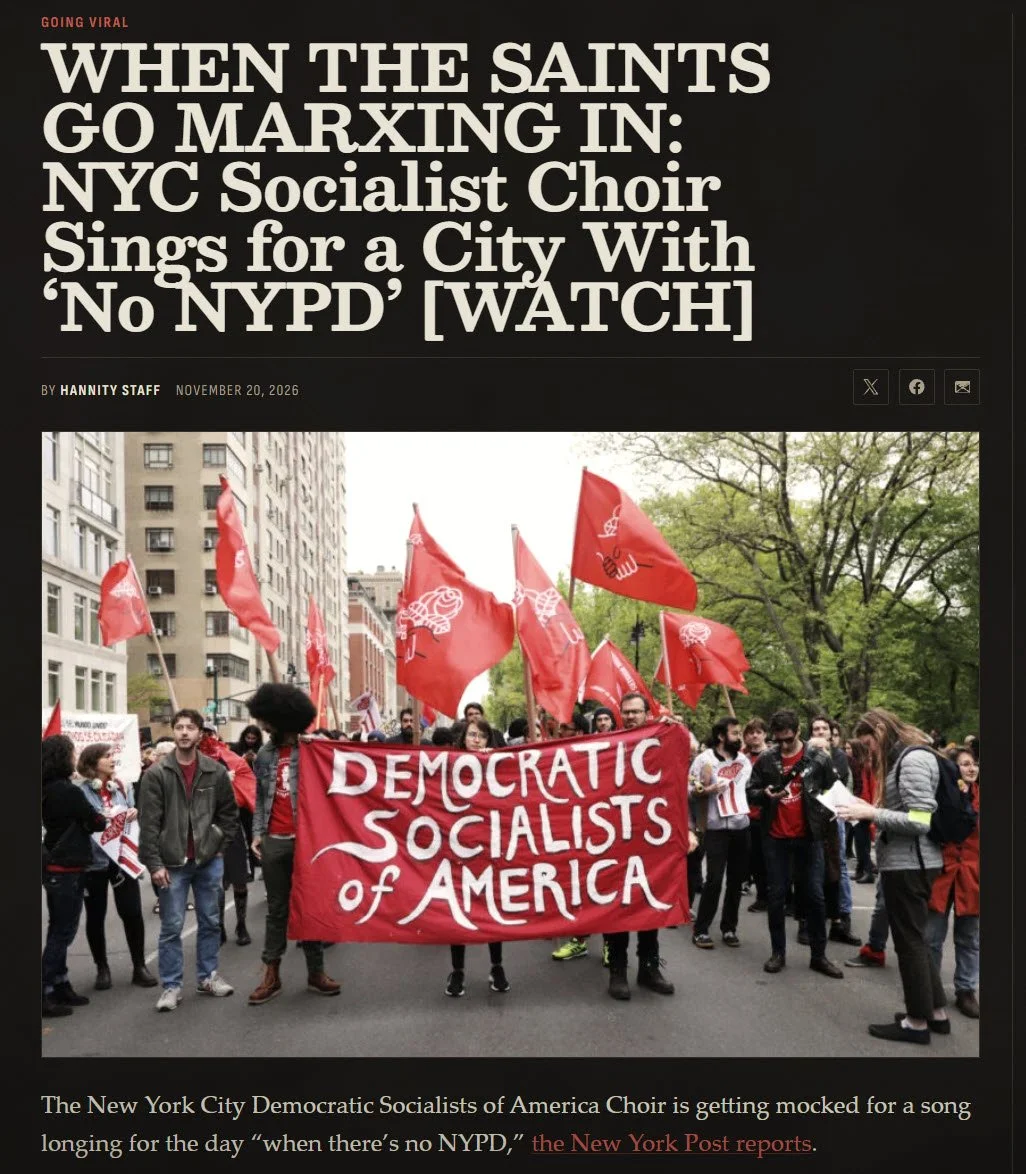
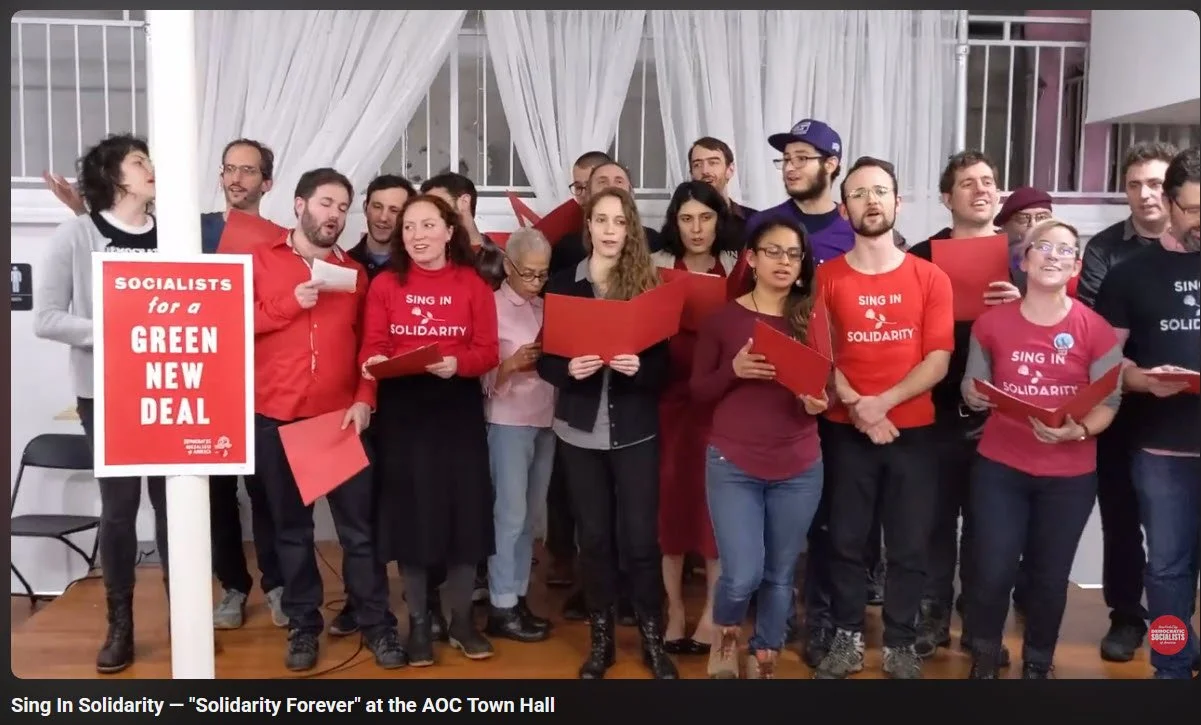
The group is the New York City Democratic Socialists of America (NYC-DSA) Choir, also associated with Sing in Solidarity.
This Joy | Resistance Revival Chorus
resistancerevivalchorus.bandcamp.com
What happened?
The choir performed a rewritten version of When the Saints Go Marching In, imagining a future without the New York Police Department.
Original video: Posted September 2026.
Viral attention: November 18–20, 2026.
Political affiliation: Democratic Socialists of America.
Other causes promoted: Free healthcare, housing, and Palestinian freedom.
The performance attracted considerable ridicule online and was featured on Fox News' Gutfeld! on November 19.
New York Post+1
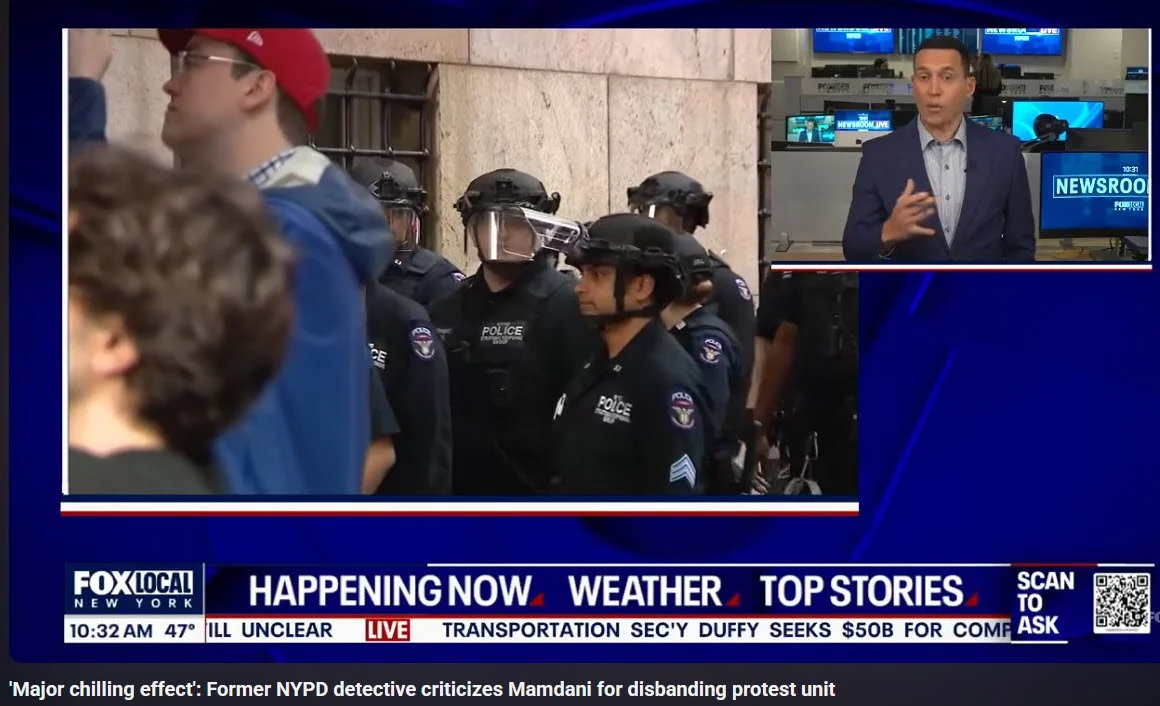
Mayor Zohran Mamdani and NYPD Commissioner Jessica Tisch announced that the NYPD's Strategic Response Group (SRG) will no longer handle protests in New York City. Instead, a new civilian team and specialized officers will be deployed to de-escalate demonstrations. David Sarni, a John Jay College professor and former NYPD detective, breaks down why he believes it's a mistake.
Watch the video
Watch the NYC socialist choir singing about abolishing the NYPD
Connection to Mayor Mamdani
The controversy comes as Mayor Zohran Mamdani announced on November 16 that he was disbanding the NYPD's Strategic Response Group, a specialized protest-response and counterterrorism unit.
Important distinction: Mamdani has not abolished the NYPD. The specialized unit's responsibilities are being redistributed, while the choir is advocating a much more sweeping change.
NYC Mayor's Office+1
The central public-policy question is what would replace conventional policing for violent crime, emergency response, and public safety if the NYPD were abolished.
The First 30 Days Without NYPD
What Would Really Happen in NYC During the First 30 Days Without the NYPD?
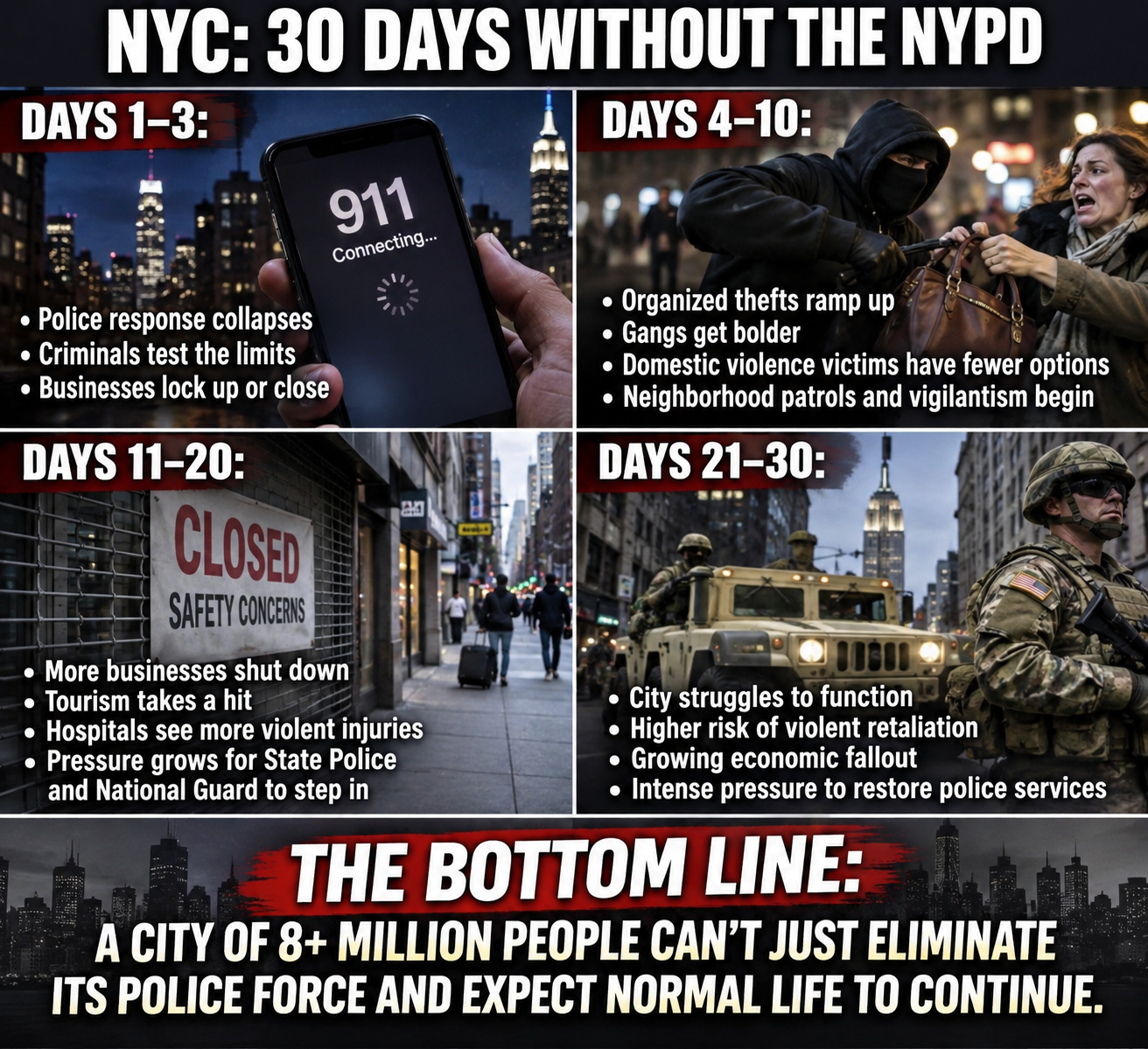
Assume the NYPD's roughly 35,000 officers disappear overnight. No replacement police force, no armed patrols, no homicide detectives, and no effective response to violent crime.
New York City would face an immediate public-safety emergency. The greatest danger would not be that every resident suddenly became a criminal. It would be that criminals willing to use violence would discover that the normal risk of immediate police intervention had largely disappeared.
Days 1–3: The shock
911 police response effectively collapses. Armed robberies, assaults, burglaries, and domestic violence emergencies would have no normal police response.
Criminals begin testing the limits. Some would quickly recognize the absence of patrols and exploit vulnerable businesses, individuals, and neighborhoods.
Retailers and banks increase security or close. Businesses handling cash, jewelry, luxury goods, and pharmaceuticals would face particular exposure.
The subway becomes a major concern. Without NYPD transit officers, the MTA would have to depend on its own limited police resources and other agencies.
Private security demand surges. Wealthier buildings and commercial properties could hire additional protection, while poorer neighborhoods would have fewer alternatives.
Days 4–10: The crisis spreads
Organized theft crews could exploit the absence of coordinated investigations and arrests.
Gang conflicts could become more dangerous where police previously intervened.
Domestic violence victims would face greater difficulty obtaining immediate protection.
Businesses could shorten hours or temporarily shut down.
Residents might begin organizing informal neighborhood patrols, raising the risk of confrontations and vigilantism.
The most serious problem would be the loss of deterrence: offenders would know that the city had substantially reduced its ability to stop, investigate, and arrest them.
Days 11–20: Economic disruption and emergency intervention
Businesses begin making longer-term closure decisions. Retail chains, restaurants, and small businesses would assess whether they could safely operate.
Tourism takes a hit. Images of unanswered emergencies, store closures, or violent incidents could prompt cancellations.
Emergency rooms face additional pressure. Hospitals would still treat victims, but medical personnel could face greater risks when responding to violent situations.
State authorities come under enormous pressure. The governor would face demands to deploy additional State Police and potentially the National Guard.
Federal law enforcement would intervene within its jurisdiction. The FBI, ATF, and other agencies could address federal crimes, but they could not replace everyday city policing.
Days 21–30: A city struggling to function
If no effective replacement had emerged, I would expect:
More businesses operating behind locked doors, with restricted hours or private guards.
Wealthier neighborhoods purchasing protection that poorer neighborhoods could not afford.
Greater risks of retaliatory violence and vigilantism.
Significant pressure on the governor and mayor to restore armed policing.
Increasing economic uncertainty as employers, residents, and tourists reconsider their plans.
The bottom line after 30 days
The most likely political and operational development would be an emergency effort to restore police services, whether through reinstating officers, creating a replacement department, or deploying additional state resources.
There is no defensible way to calculate exactly how many murders, robberies, or assaults would occur. Nor can anyone guarantee that the city would descend into widespread rioting.
But one conclusion is straightforward: a city of more than eight million people cannot simply eliminate its principal law-enforcement organization overnight and expect normal public safety to continue.
The people most exposed would include residents of high-crime neighborhoods, domestic violence victims, elderly residents, small-business owners, and anyone unable to purchase private security.
And the irony is that abolishing the NYPD without replacing its essential functions could ultimately require a far more visible and intrusive emergency security presence than the city had before.