
Segment #1077
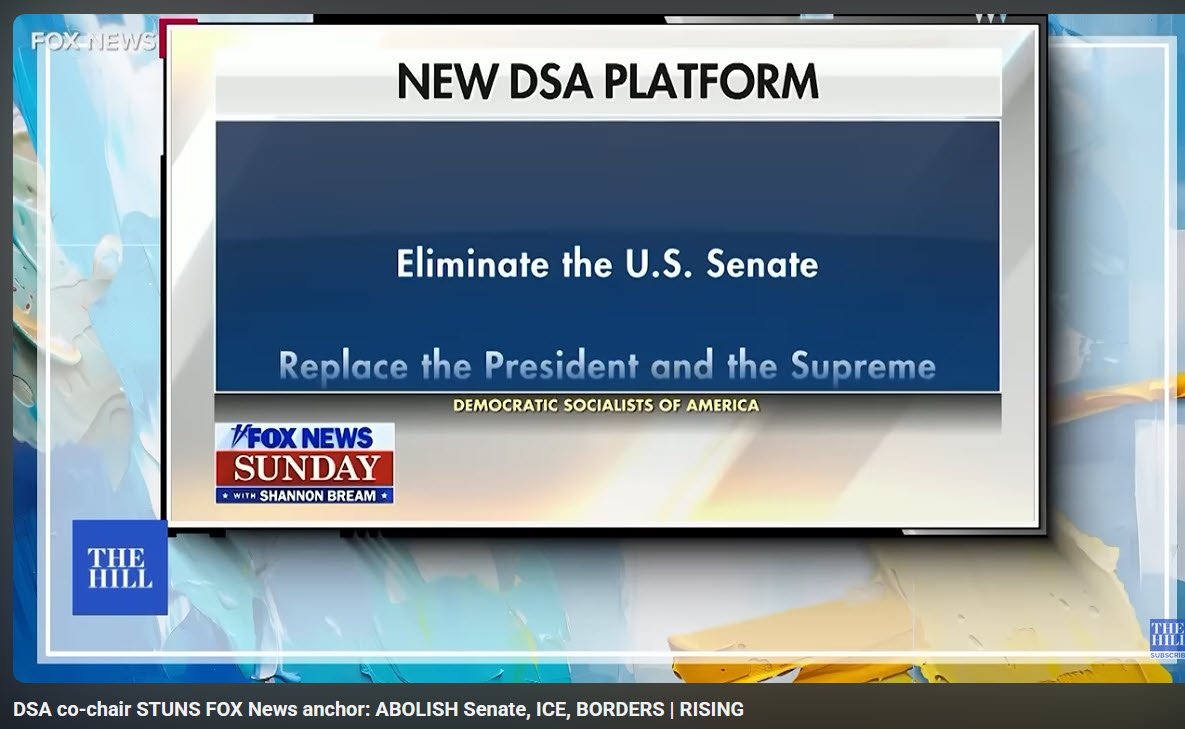
On July 26, 2026, Megan Romer, national co-chair of the Democratic Socialists of America (DSA), appeared on Fox News Sunday with Shannon Bream and explicitly confirmed a series of far-reaching proposals associated with the DSA's political program. This was not simply an interpretation by political opponents. RealClearPolitics +1
The seven proposals Romer confirmed
Abolish the U.S. Senate - "True."
Replace the presidency and Supreme Court as presently constituted "Yup."
Abolish Immigration and Customs Enforcement (ICE) - "Absolutely."
Abolish national borders and grant amnesty to undocumented immigrants "As a long term plan, yes."
Defund the Pentagon "Absolutely."
Abolish prisons, at least in large part - Yes, as part of a long-term program - Government or public ownership of most large corporations - "Yes, absolutely."
These answers are documented in the interview transcript and subsequent CNN coverage. RealClearPolitics +1
What makes the interview significant
Romer went beyond confirming individual policies. She explained that the DSA seeks to replace the bicameral Congress with a larger, single-chamber legislature. She described open borders and prison abolition as long-term objectives rather than immediate measures.
She also acknowledged that DSA candidates use Democratic Party ballot lines because the American two-party system makes independent political competition difficult. RealClearPolitics
The distinction matters: these are publicly acknowledged objectives of a national DSA leader, not merely accusations made by Republicans. However, they are not necessarily positions endorsed by the Democratic Party as a whole or by every DSA-affiliated candidate.
Watch and read the interview
The central political question is how much influence this explicitly stated DSA program is gaining within the broader Democratic Party, particularly where DSA-supported candidates win Democratic primaries. That can be examined through documented endorsements, election results, and the policy positions of individual candidates rather than assuming the two organizations share an identical platform.
If so, yes. The DSA has a publicly articulated political program, organizational strategy, and policy platform, expressed through its official website, convention resolutions, and published political statements. Its stated objectives include democratic socialism, expanding public ownership and democratic control of major economic institutions, strengthening labor organizations, universal healthcare, housing reform, and reducing the influence of private capital over politics.
France and the United States
There is no reason to assume that political coalition-building tactics employed in France could not also be employed in the United States. The important distinction is between the possibility of such a strategy and evidence that it is already being coordinated or financed here.
France provides an interesting case because elements of the radical left and Islamist-oriented political activism have sometimes converged around immigration, opposition to Israel, anti-discrimination campaigns, and electoral mobilization.
French critics frequently describe this phenomenon as islamo-gauchisme (Islamo-leftism). The term is politically contested, but the underlying question is legitimate: can movements with fundamentally different long-term objectives cooperate to gain political influence?
The answer is yes. Political coalitions do not require agreement on every objective. They may cooperate around immediate interests while maintaining entirely different visions for society.
What France's investigation actually found
In December 2025, a French parliamentary commission published an investigation into connections between political parties and Islamist networks.
The commission identified proximity between certain politicians, particularly within La France Insoumise (LFI), and individuals promoting Islamist ideology. It warned about entrisme—the strategy of gaining influence inside established political and civic institutions.
Significantly, the commission did not establish systematic financial or organizational links between French political parties and Islamist movements. It did identify political relationships and vulnerabilities that warranted scrutiny. Assemblée nationale +1
Funding is the critical question
In October 2024, the U.S. Treasury sanctioned Samidoun, describing it as a fundraising front for the Popular Front for the Liberation of Palestine (PFLP), a designated terrorist organization. Treasury specifically identified operations in Europe and North America. The PFLP is a secular Marxist organization, not an Islamist movement, but the case demonstrates how extremist financing networks can operate internationally through ostensibly civic organizations. U.S. Department of the Treasury
This makes several questions relevant to an American investigation: whether foreign money passes through nonprofit intermediaries, whether organizations coordinate political campaigns, whether activists receive funding from common sources, and whether any relationships violate campaign-finance, sanctions, or material-support laws.