3 Presidents and Iran
Segment #803
Things just don’t happen… there is a reason that we are where we are. Each President gets a set of conditions that they choose to deal with for better or worse for the rest of us. There is a compelling argument that Trump was handed with a very bad situation that he uniquely chose to deal with. Viewing the long game this President was the right man at this time in history to solve a problem and not just avoid it with happy talk. There may be a price to pay now for what might have been horrendous and unthinkable in the future.
Iran – US History
Obama's Vanishing Red Line - WSJ Opinion
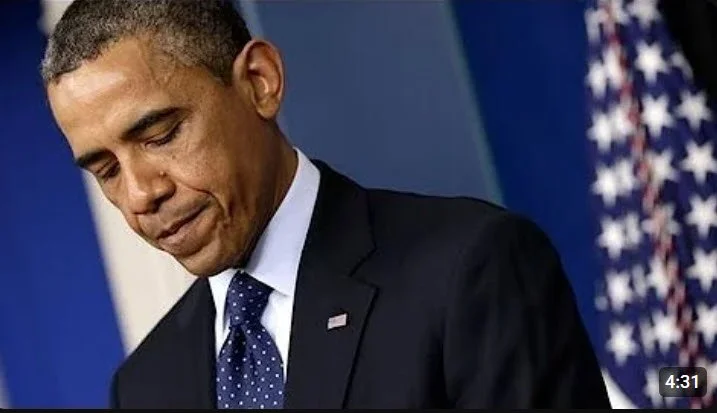
Hoover Institution fellow Fouad Ajami on President Obama's disappearing red line. Photos
Obama
JCPOA (Joint Comprehensive Plan of Action) 2015 The deal aimed to limit Iran's nuclear program in exchange for lifting certain international sanctions, allowing Iran access to an estimated $100–150 billion in its own frozen assets held abroad. Critics, including some Republicans, argued this indirectly funded Iran's activities. The U.S. did transfer $400 million in foreign currency (euros, Swiss francs, and others) to Iran on wooden pallets via an unmarked plane on January 17, 2016—the same day Iran released four American prisoners and the JCPOA's "Implementation Day" began. This was the first installment of a $1.7 billion settlement resolving a decades-old dispute: In the 1970s, Iran (under the Shah) paid the U.S. $400 million for military equipment that was never delivered after the 1979 Islamic Revolution. The U.S. added $1.3 billion in estimated interest, and the full amount was paid in cash due to sanctions that barred Iran from the U.S. financial system, making wire transfers impossible.
Under President Barack Obama's administration, the U.S. lifted or eased various sanctions on Iran as part of the 2015 Joint Comprehensive Plan of Action (JCPOA), also known as the Iran nuclear deal. Funding Terrorism and Regional Instability: Sources claim that lifting sanctions provided Iran with up to $150 billion in windfalls, which the regime used to support terrorism, proxy groups like Hezbollah, Hamas, the Houtis and aggression in the Middle East. Conservatives argue the deal lacked real enforcement. Instead of dismantling Iran's nuclear program, it legitimized enrichment and lifted sanctions prematurely. Obama treated the JCPOA as an executive agreement rather than a treaty, avoiding Senate ratification, which conservatives view as an end-run around constitutional checks. Additional revelations, like secret side deals allowing Iran self-inspection of sites and temporary U.S. Treasury licenses for dollar transactions, fueled accusations of misleading Congress and the public. The deal is portrayed as a foreign policy failure that emboldened Iran, with some linking it to later issues like Iran's increased oil sales under subsequent administrations. Even former Obama advisers, like David Petraeus, rejected its terms.
Obama’s credibility in the Middle East was weakened with his failure to follow through on his red line.
Obama's Warning (August 2012): In a press conference, Obama stated that the movement or use of chemical weapons in Syria would cross a "red line" for the U.S., changing his "calculus" and potentially leading to military action.
This was amid concerns over Assad's stockpiles during the civil war, where Iran provided significant support to the regime. The Ghouta Attack (August 2013): Assad's forces launched a sarin gas attack on rebel-held areas near Damascus, killing civilians and clearly violating the red line. Obama initially prepared for airstrikes but pivoted to a U.S.-Russia agreement for Syria to declare and destroy its chemical weapons under UN supervision. This removed over 1,300 tons of chemicals but left room for future violations, as Assad continued limited use.
The Red Line on Nuclear Weapons: Obama declared preventing Iran from obtaining a nuclear weapon as a core U.S. policy, effectively a red line against weaponization. This was "blurry" compared to Syria's, focusing on enrichment to weapons-grade levels (e.g., 90% uranium) rather than all nuclear activities. The 2015 JCPOA aimed to enforce this by limiting Iran's program in exchange for sanctions relief. The Syria red line's perceived weakness is cited as a cautionary tale for Iran policy, with calls for enforcement to avoid repeating Obama's "mistake."
Trump
President Trump announces that the US military killed General Qasem Soleimani, the leader of the Iranian Quds Force. The president cites Soleimani as "the number-one terrorist anywhere in the world." Jan 03, 2020
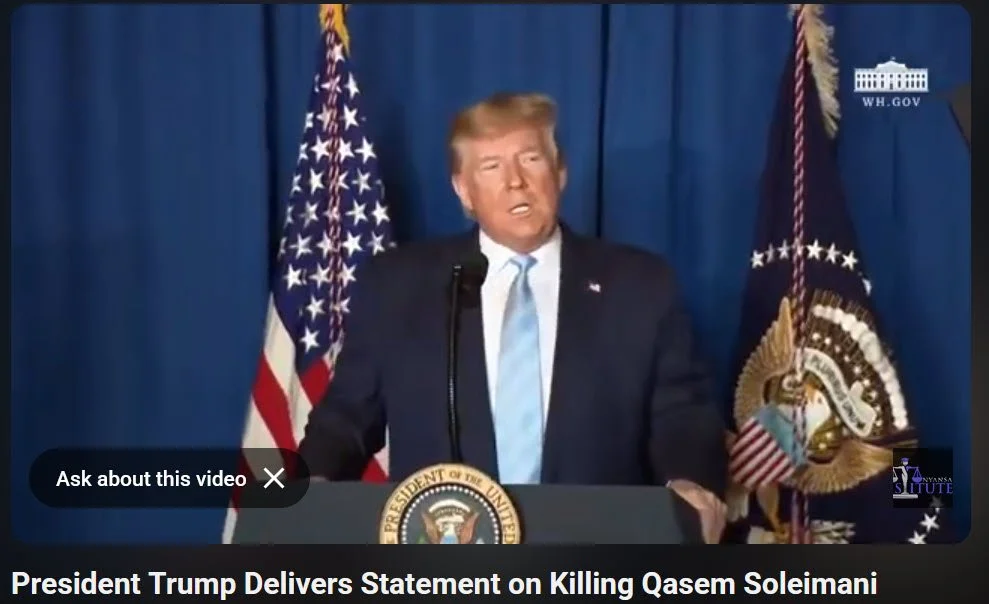
The Trump administration withdrew from the JCPOA in 2018, reimposing sanctions. Trump exited the Iran nuclear deal, labeling it a "disaster," and reinstated "maximum pressure" sanctions targeting Iran's oil sector, banking, and elite Revolutionary Guard Corps (IRGC), which he designated as a foreign terrorist organization in 2019—the first time a U.S. president applied that label to a state entity. This policy aimed to deny Iran paths to nuclear weapons, neutralize its terrorist networks, and counter its missile development. By 2020, Iran's economy had shrunk significantly, with oil exports dropping from over 2 million barrels per day to under 300,000. The 2020 drone strike killing Iranian General Qasem Soleimani in Iraq was a pinnacle of this approach, justified as preempting attacks on U.S. interests but criticized as risking broader war.
Biden
Don’t
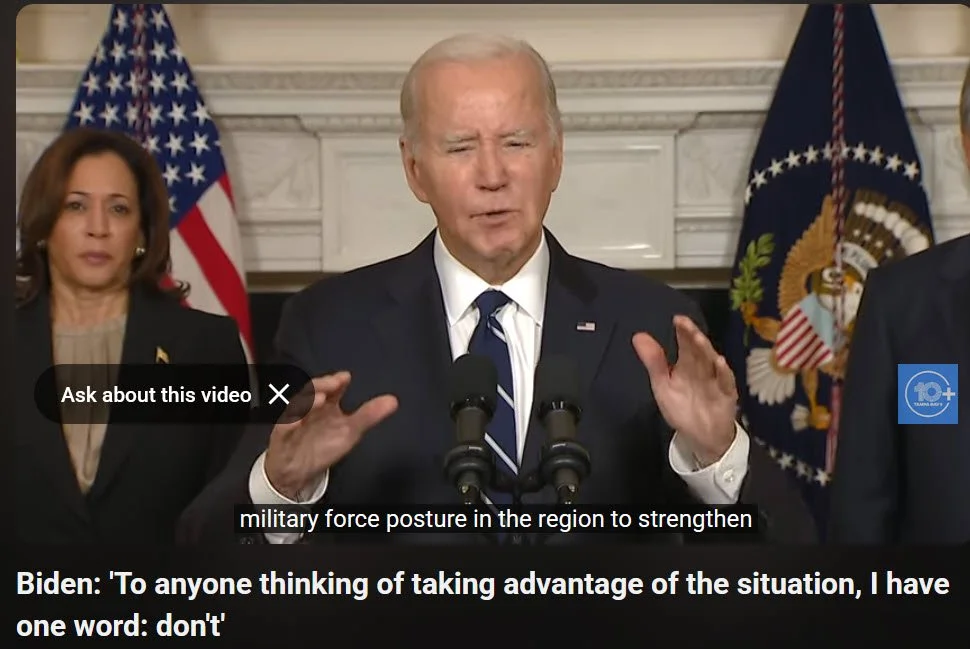
Biden during his presidency (2021–2025), took steps to ease certain sanctions on Iran as part of efforts to revive diplomacy, though he did not fully lift all Trump-era restrictions and imposed new ones in response to Iranian actions. He pursued negotiations to rejoin the Joint Comprehensive Plan of Action (JCPOA) but ultimately did not succeed in re-entering the deal. Biden also repeatedly warned Iran and its proxies against aggression with the blunt message "Don't," a stance critics dubbed the "Don't" doctrine for its perceived lack of enforcement. This approach aimed to deter escalation, particularly after the October 7, 2023, Hamas attack on Israel, but Iran and its allies continued provocative actions, including direct strikes on Israel in 2024.
Withdrawal of Trump's UN Sanctions Restoration (February 2021): Early in his term, Biden rescinded Trump's 2020 attempt to "snap back" UN sanctions on Iran, signaling a return to diplomacy and helping pave the way for JCPOA talks. Restoration of Nuclear Waivers (February 2022): The administration restored waivers allowing international cooperation on Iran's civil nuclear projects, such as those involving Russia and China, to support indirect talks in Vienna on reviving the JCPOA. Access to Frozen Funds: Biden renewed waivers multiple times, enabling Iran to access up to $10 billion in electricity payments from Iraq (held in restricted accounts in Oman and elsewhere for humanitarian trade like food and medicine). In August 2023, this included a deal unlocking $6 billion in South Korean-held oil revenues in exchange for the release of five American detainees. The last such renewal occurred in November 2024, shortly after Trump's election victory.
Post-October 7, 2023: After Hamas' attack on Israel, Biden warned Iran-backed groups: "Don't, don't, don't" exploit the situation. He reiterated this amid Houthi attacks on shipping and proxy strikes on U.S. troops in Iraq/Syria, where three Americans were killed in January 2024.
Iran continued to enrich uranium: Stockpile of highly enriched uranium surged from minimal amounts in 2021 to dangerous levels by 2025. For instance: May 2021: About 2.27 kg (5 pounds) of near-weapons-grade uranium. November 2024: 182 kg at 60% purity and 840 kg at 20%. February 2025: 275 kg at 60%. May 2025: 408.6 kg at 60% (a 50% increase from February) and total enriched uranium at 9,247.6 kg. June 2025: 440.9 kg at 60% (enough for ~10 nuclear weapons if enriched further) and total enriched uranium at 9,874.9 kg. This represented a ~627 kg increase in total stockpile from May alone. These advances shortened Iran's "breakout time" to produce weapons-grade material to weeks or months, per U.S. assessments. Biden's waivers allowed Iran access to frozen funds (e.g., $10 billion from Iraq), which some sources link to funding nuclear expansion, though the administration imposed new sanctions on enrichment-related entities. By mid-2025, Iran's program was targeted in U.S.-Israeli strikes during a brief war, setting it back 1–2 years, but the pre-war buildup under Biden showed no deterrence.
Iran ramped up drone (UAV) production and exports during Biden's term, supplying them to Russia for Ukraine, proxies like the Houthis and Hezbollah, and using them in attacks on U.S. forces. Despite U.S. sanctions and task forces to curb technology access, Iran circumvented restrictions, incorporating Western (including U.S.) components. Production and Advancements: Iran enhanced its drone capabilities, producing models like the Shahed-136 "kamikaze" drones with higher-end sensors and semiconductors sourced abroad. By 2022–2023, drones recovered in Ukraine contained parts from 13 U.S. companies, despite export controls. Production was financed by ~$100 billion in funds accessed under Biden, per critics, and involved firms like the Iran Aircraft Manufacturing Industrial Company (HESA). Exports and Military Use: Iran transferred hundreds of drones and production blueprints to Russia starting in 2022, enabling "kamikaze" strikes in Ukraine (e.g., 30 Shahed drones in one 2023 attack). Drones were also supplied to proxies for attacks on U.S. bases (e.g., January 2024 strike in Jordan killing three Americans) and shipping in the Red Sea. In 2024, Iran used drones in a direct assault on Israel. U.S. Response and Lack of Deterrence: Biden launched a task force in 2022 to investigate U.S. components in Iranian drones and imposed sanctions on networks (e.g., September 2023 on Chinese/Russian firms aiding production).
However, these measures failed to halt proliferation, as Iran adapted and continued exports.
Ballistic Missile Development and Tests: Iran advanced its ballistic missile program, conducting tests, improving accuracy, and expanding ranges, while supplying missiles to proxies and using them in conflicts. This occurred despite U.N. restrictions expiring in 2023 and U.S. sanctions. Advancements: Iran developed nuclear-capable missiles with improved guidance, longer ranges (up to 2,000+ km), and hypersonic claims. By 2025, U.S. Defense Intelligence Agency (DIA) assessed potential for intercontinental ballistic missiles (ICBMs) by 2035. The program evolved from North Korean tech acquisitions to domestic production. Tests and Use: Multiple tests occurred, including September 2025 (unidentified missile at Semnan) and December 2025 (drills in Tehran, Isfahan, etc.). g +2
Iran fired ballistic missiles at Israel in June 2025 (during a 12-day war, causing dozens of deaths) and used them via proxies against U.S. interests. Post-2023 U.N. ban expiration, tests intensified. U.S. Response and Lack of Deterrence: Biden imposed sanctions on missile programs (e.g., October 2023 after U.N. ban expired), but Iran continued advancements and proxy warfare. The program threatened U.S. allies, with no significant slowdown.
Trump
Iran was enriching uranium even after the June attacks. It also was engaged in a military buildup far beyond a defensive capability. But Trump tried on multiple occasions diplomacy to get a commitment from Iran for a peaceful Middle East. They stalled and Trump’s decision was attack now when Iran was weaker than they had been in decades or later when their defensive and offensive capabilities were strengthened and they were closer to a nuke.
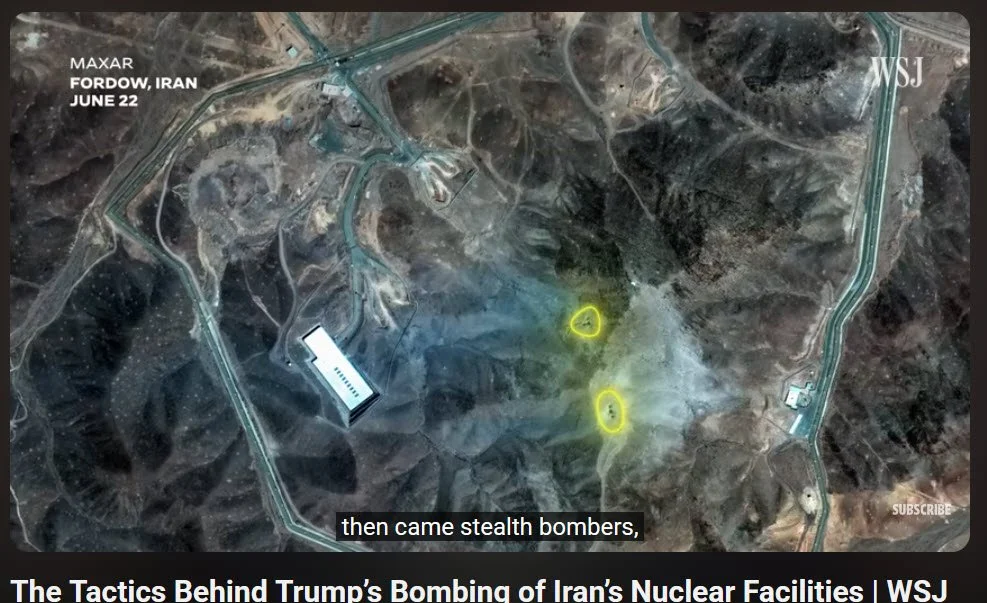
As the U.S. deployed decoy B-2 bombers west over the Pacific, military officials quietly sent a “strike package” east over the Atlantic to hit three nuclear facilities in Iran: Fordow, Natanz and Isfahan. In one night, the U.S. used three-quarters of its stockpile of GBU-57 “bunker buster” bombs in what President Trump called a “spectacular military success.”
https://yourtruthmaynotbemine.com/blog/the-case-for-attacking-iran
As to the plan after attacking Iran:
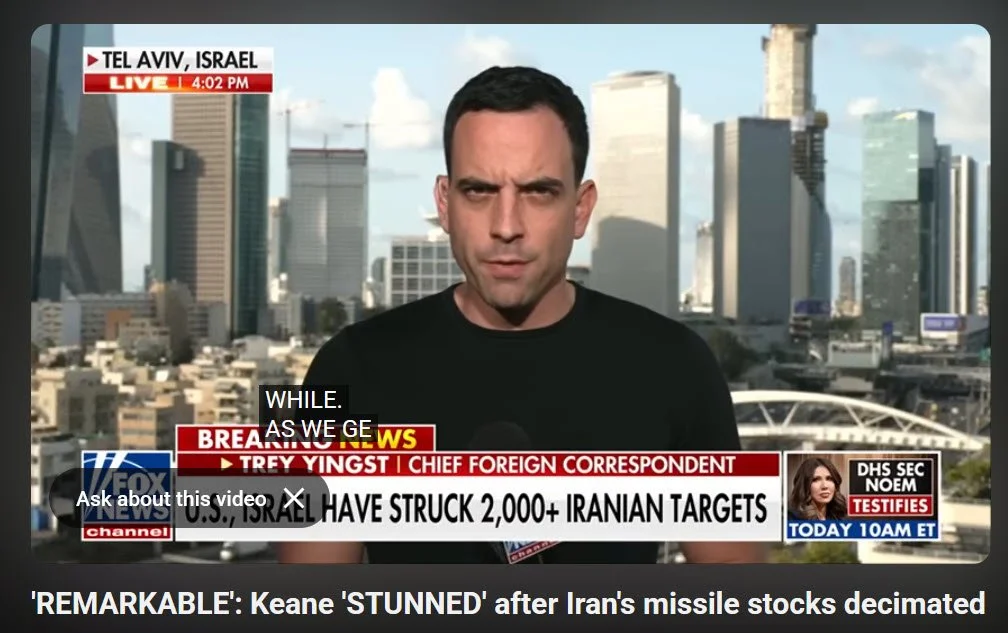
Fox News' chief foreign correspondent Trey Yingst reports as air raid sirens ring out over Tel Aviv. Senior strategic analyst Gen. Jack Keane analyzes the success of 'Operation Epic Fury.'
Iran does not compare to previous conflicts such as Vietnam, Afghanistan, or Iraq. Trump has no desire to nation build in Iran. He wants in and then out as quickly as possible. As much as the left slanders and denigrates Trump, a careful study of the man pretty clearly reveals that this guy is no light weight. Ask Europe.. ask Asia ask South America.. Trump is far more consequential than most of his predecessors. Underestimate Trump at your peril.
You might ask why anyone would vote for Trump. Many find him brash, uncouth, hyperbolic, arrogant, and boastful…. all of which become totally inconsequential when you measure him historically as a leader and president.