Segment #1102
We the more we learn about election fraud, the more we understand how little we know. It is everywhere. It is impactful. There might be hope. We are not Europe, or the U.K. ….YET.
In the coming days we are covering the changes in legacy media and how it might well change your access to real journalism
The Indiana petition fraud could have affected Barack Obama's path to the Democratic presidential nomination in 2008. Whether it ultimately changed who became president, however, is a separate question. The issue is not simply whether signatures were forged, but whether those forged signatures enabled Obama to appear on a ballot for which he otherwise would not have qualified.
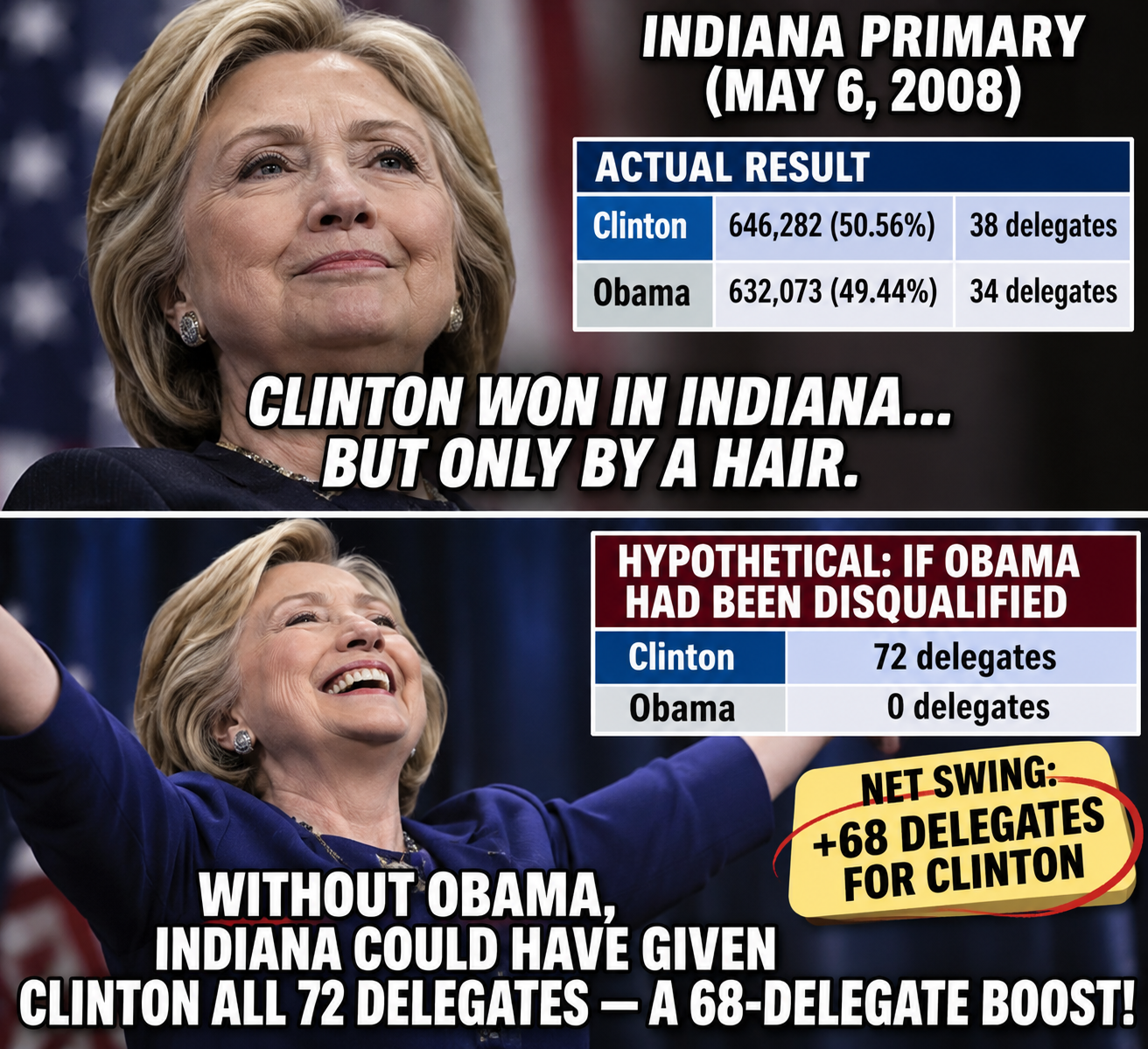
The potential 68-delegate swing
On May 6, 2008, Hillary Clinton narrowly defeated Barack Obama in the Indiana Democratic primary, receiving 646,282 votes (50.56%) to Obama’s 632,073 (49.44%). Clinton secured 38 pledged delegates to Obama’s 34. Had Obama been disqualified and all 72 pledged delegates awarded to Clinton, the result would have been a net swing of 68 delegates in Clinton’s favor, potentially affecting the broader nomination contest. This hypothetical assumes that all of Obama’s delegates would have been reallocated to Clinton rather than subjected to another Democratic Party remedy.
The political consequences could have extended well beyond Indiana
The timing was particularly important. Clinton was still actively contesting the nomination, and hundreds of delegates remained available.
On May 10, just four days after the Indiana primary, Obama overtook Clinton in superdelegate support and never relinquished that lead.
A 2014 Heritage Foundation legal analysis examined the potential consequences of Obama's disqualification, including:
A major national scandal involving presidential ballot qualification.
Damage to Obama's fundraising and campaign momentum.
Undecided superdelegates reconsidering their support.
A significant reduction in Obama's delegate advantage.
A stronger position for Clinton going into the remaining primaries.
Heritage Foundation+1
Independent historical research published in the Indiana Magazine of History also identified Obama's unexpectedly close performance in Indiana as an important turning point in the nomination contest.
What has been legally established?
The Indiana Court of Appeals' 2014 decision in Dustin Blythe v. State of Indiana documents testimony that the county Democratic chairman instructed workers to copy signatures from earlier petitions onto presidential nomination petitions.
This is a judicial record of organized election-related fraud, not political speculation.
Indiana Courts
However, no court determined that Obama would necessarily have been disqualified, and there is no established evidence that he personally knew about the forgery operation.
Could American history have been different?
The documented fraud raises a legitimate historical counterfactual. Had it been detected before the filing deadline, Obama might have obtained replacement signatures. Had it been detected afterward, disqualification and a national political controversy were possible.
The delegate arithmetic alone does not establish that Clinton would have secured the nomination. The broader effects on fundraising, media coverage, voter perceptions and superdelegate commitments cannot be reconstructed with certainty.
The defensible conclusion is that criminal election fraud potentially influenced a pivotal contest in the process that made Barack Obama president. Its ultimate impact on the 2008 presidential election will never be known with certainty, precisely because the fraud was not exposed until three years after the election.
Fact-check: The Indiana presidential primary election fraud scandal
The central allegation in this post is true. In Indiana, Democratic Party officials were involved in a criminal scheme to forge signatures on petitions used to qualify Barack Obama and Hillary Clinton for the 2008 presidential primary ballot.
This was not merely an allegation of election fraud. It resulted in criminal convictions and exposed significant weaknesses in the election verification process.
The most troubling aspect of the case is that the fraudulent signatures passed through the safeguards that were supposed to detect them before the election took place.
What actually happened
Indiana law required presidential primary candidates to obtain at least 500 signatures from registered voters in each of the state's nine congressional districts.
Owen "Butch" Morgan, the longtime St. Joseph County Democratic Party chairman, directed workers to copy names and signatures from petitions submitted for Democratic gubernatorial candidate Jim Schellinger onto presidential primary petitions.
Among the forged signatures were those of former Indiana Governor Joe Kernan and St. Joseph County Prosecutor Mike Dvorak.
Making matters considerably worse, the operation involved personnel working within the county voter registration office itself.
Indianapolis Business Journal+1
The criminal convictions
All four defendants were convicted or pleaded guilty in 2013.
Individual - Position - Punishment
Butch Morgan - Democratic county chairman - One year in prison, one year community corrections, two years probation
Dustin Blythe - Voter registration employee - One year community corrections, two years probation
Pamela Brunette - Voter registration official - Two years probation
Beverly Shelton - Voter registration employee - Two years probation
Morgan actually served six months in prison before being released for good behavior.
ABC57+1
Would Obama have qualified without the fraudulent signatures?
This is perhaps the most significant part of the investigation.
Obama's reported signatures in Indiana's 2nd District
534
Certified signatures reported by the state Election Division
Reported certified signatures
534
Legal requirement
500
Remaining if 100 signatures were invalid
434
Margin above requirement
34
Suspected invalid Obama signatures
100+
Illustrative calculation based on the October 2011 investigative reporting.
The Indiana Democratic Party disputed the state's signature totals, producing a report showing 580 signatures for Obama. Even under that higher number, removing more than 100 questionable signatures would have placed him below the required threshold. There is substantial evidence that Obama may not have legally qualified for the Indiana primary ballot.
Speckin Forensics+1
Who actually discovered the fraud?
Not the election officials responsible for certifying the petitions. The scandal was exposed through investigative work involving Ryan Nees, a Yale University student, the South Bend Tribune and Howey Politics Indiana.
The chronology is particularly disturbing:
Date - Event
2008 - Fraudulent petitions submitted and certified
May 2008 - Indiana presidential primary held
November 2008 - Obama elected president
October 2011 - Investigative reporting exposes fraud
April 2012 - Criminal charges filed
June 2013 - Defendants sentenced
The fraud remained publicly undiscovered for approximately three years, rather than the two years suggested in the post. Criminal accountability took approximately five years.
Daily Herald+2
Fact-checking the social media post
Claim - Assessment
Four Democrats were convicted - True
Signatures were copied from previous petitions - True
A former governor's signature was forged - True
Democratic chairman went to prison - True
Fraud escaped detection before the election - True
Exposed two years later
Approximately three years
Fraud changed presidential history
Not established
Hillary Clinton narrowly won the Indiana primary. Obama nevertheless received delegates from the contest. There is no established evidence that the petition fraud determined the national nomination or the general election, or that Obama personally knew about the scheme.
I have verified the underlying criminal case, but not the complete CNN exchange shown in the screenshot.
The larger implications for election integrity
The Indiana case raises a number of legitimate questions that should concern anyone interested in election security.
Insider corruption: What happens when the individuals responsible for preventing fraud are themselves committing it?
Independent verification: Why were the fraudulent signatures not detected through an independent examination?
Detection rates: How can the number of discovered fraud cases be treated as a reliable measure of the total incidence of fraud when detection mechanisms themselves can fail?
Timely accountability: What practical remedy exists when election fraud is discovered years after an election?
Deterrence: Is six months of actual imprisonment sufficient punishment for orchestrating a criminal conspiracy involving presidential ballot access?
The distinction between ballot petition fraud and fraudulent votes is legally important, but both can compromise the integrity of an election.
Conclusion
Perhaps the most instructive aspect of the Indiana scandal is that, had a college student and investigative journalists not pursued the evidence, the crime might never have entered the official statistics on election fraud.
That exposes a fundamental weakness in relying exclusively on documented convictions to assess the security of our elections. A conviction measures fraud that was committed, discovered, investigated and successfully prosecuted. It does not measure undetected fraud.
This case does not establish that election fraud is widespread nationally. It does, however, demonstrate that organized political insiders can circumvent election safeguards and that those safeguards can fail for years without detection.
Election integrity should depend on independently verifiable procedures, not on assurances from the people administering them.
###
CNN's election coverage on August 11, 2026, at approximately 8:13 p.m. Eastern Time, during the Minnesota and Wisconsin primaries.
The discussion concerned Trump's willingness to consider declaring a national security emergency to implement voter ID, proof of citizenship and restrictions on mail-in ballots.
Original broadcast: Anderson Cooper 360°, August 11, 2026, 8–9 p.m.
CNN official transcript of the broadcast — look around the 20:10:20 timestamp for Republican strategist Pete Seat's comments on electoral fraud.
Search YouTube for the Pete Seat CNN segment
Search X for the original clip
Watch Trump's original interview with Wayne Allyn Root