
Segment #1103
CNN and CBS: Is American television journalism approaching a turning point?
The shakeups at CNN and CBS potentially represent something considerably more significant than personnel changes. They may signal a fundamental restructuring of television journalism, driven by declining audience trust, changing viewing habits, corporate consolidation, political polarization and competition from independent media.
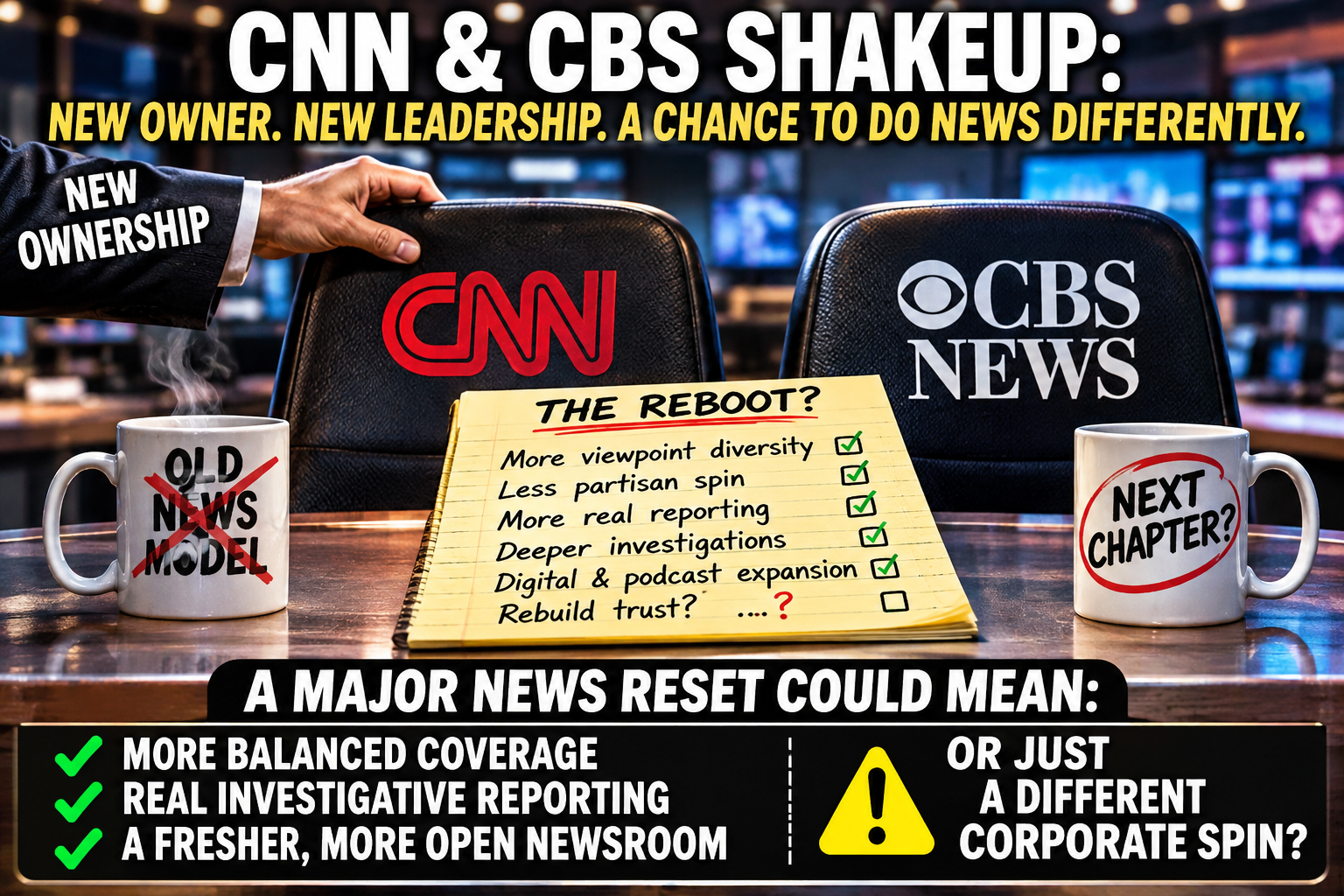
For decades, the major television networks exercised enormous influence not only over what Americans knew but also over which stories received national attention. That power is being challenged by alternative news platforms, independent journalists, podcasts, social media and increasingly sophisticated AI research tools.
The question is whether corporate management now recognizes that restoring credibility could be as important to long-term profitability as cutting costs.
The Ellison factor — a new media power structure
On October 6, 2026, the approximately $110 billion merger of Paramount and Warner Bros. Discovery brought CNN and CBS News under the same corporate ownership, headed by David Ellison.
This puts an extraordinary collection of media assets under one corporate umbrella, including CNN, CBS News, 60 Minutes, Paramount, HBO and Warner Bros.
Here comes Bari Weiss. What does it mean for CBS News? - Los Angeles Times
David Ellison — Chairman and CEO
Controls the overarching corporate strategy, capital allocation and senior management appointments. His stated objective is to keep the company out of politics.
Bari Weiss — CBS News
Founder of The Free Press and former New York Times opinion editor. She has been an outspoken critic of ideological conformity within established news organizations.
Mark Thompson | Warner Bros. Discovery
Mark Thompson — CNN
Former director general of the BBC and CEO of The New York Times. He has been retained as chairman and editor-in-chief of CNN, preserving separate editorial leadership.
Both Weiss and Thompson report directly to the new corporate leadership. Significantly, Weiss has not been given editorial authority over CNN.
Reuters+2
CBS may be the testing ground for industry reform
Bari Weiss represents a departure from traditional network management. Her background is in building a digital media organization that deliberately challenges established institutional thinking.
Her approach could produce several fundamental changes:
Greater ideological diversity among correspondents, commentators and guests.
More scrutiny of assumptions underlying political coverage.
Increased separation between factual reporting and editorial commentary.
Greater willingness to investigate stories overlooked by competing networks.
Recruitment of journalists from outside the traditional television establishment.
Greater emphasis on podcasts, extended interviews and digital distribution.
The restructuring of 60 Minutes, including the dismissal of Scott Pelley in June following disagreements over personnel decisions, demonstrates that management is prepared to challenge even some of its most established personalities.
Los Angeles Times
Supporters see this as a necessary correction to entrenched newsroom culture. Critics fear that legitimate investigative journalism could be compromised by corporate or political pressure. The eventual quality of the reporting will determine which assessment proves more accurate.
CNN faces an existential business problem
CNN's original brilliance was the creation of a 24-hour global news operation. When something extraordinary happened anywhere in the world, CNN was frequently the first place Americans turned.
Today, breaking news is available almost instantaneously through thousands of competing sources. Political panel discussions are inexpensive to produce but increasingly difficult to distinguish from what independent commentators offer online.
CNN has several potential avenues for rebuilding its competitive advantage.
Traditional model - Potential future model
Celebrity anchors - Recognized subject-matter experts
Repetitive political panels - Investigative reporting
Partisan confrontations - Substantive debates
Cable subscriptions - Direct digital subscriptions
Scheduled broadcasts - On-demand coverage
Short interview excerpts - Complete interviews and source documents
Reliance on institutional reputation - Demonstrable accuracy and transparency
Retaining Thompson suggests that Ellison is initially pursuing continuity at CNN rather than an immediate wholesale transformation.
However, I would expect significant pressure over the next several years to demonstrate that CNN can attract viewers beyond its existing political and demographic audience.
The economic penalty for ideological conformity
For years, cable news organizations benefited from cultivating politically loyal audiences. Outrage generated engagement, engagement generated ratings, and ratings generated advertising revenue.
That business model now has a serious vulnerability. Independent commentators can generate similar engagement with a fraction of a television network's overhead.
A network employing thousands of people, maintaining international bureaus and paying celebrity anchors millions of dollars cannot indefinitely justify its expenses by producing essentially the same political commentary as someone operating from a home studio.
The competitive advantage of a major network should be its ability to investigate, verify, document and provide context that independent commentators cannot easily duplicate.
That may create a powerful financial incentive to return to substantive journalism.
Artificial intelligence could accelerate accountability
One of the most interesting developments will be the increasing ability of ordinary viewers to independently evaluate news coverage.
AI-assisted analysis can help viewers:
Compare how different networks cover the same event.
Examine complete transcripts rather than selectively edited excerpts.
Identify inconsistencies in previous reporting.
Compare political statements with historical records.
Analyze differences in story selection and framing.
Locate original documents, legislation and statistical evidence.
AI is not infallible and can introduce biases and factual errors of its own. Nevertheless, used with verifiable primary sources, it could substantially weaken the traditional gatekeeping power of television news.
The consumer increasingly has the ability to audit the product.
The danger of concentrated media ownership
There is a potential downside to the Ellison acquisition that should not be overlooked.
Two independently managed national news organizations now answer to the same corporate ownership. Financial efficiency could eventually mean shared news bureaus, investigative teams, production facilities and editorial resources.
As part of the merger settlement, Skydance agreed to establish a five-member editorial independence board. However, questions remain about its enforcement authority and its ability to challenge the corporate leadership that appoints its members.
Reuters+1
Replacing one prevailing editorial orthodoxy with another would accomplish very little.
The objective should not be to make CNN or CBS conservative, liberal or even artificially centrist. It should be to make their reporting sufficiently rigorous that the political preferences of the individual reporters become largely irrelevant.
What I anticipate between 2027 and 2030
Development - My assessment
Departure of additional veteran television personalities - Likely
Consolidation of CNN and CBS operational resources = Likely
Expansion into podcasts and streaming - Very likely
Greater ideological diversity in guest selection - Plausible
Reduced dependence on highly paid celebrity anchors - Likely
Greater use of AI in news production and research - Very likely
Increased publication of original source material - Plausible
Restoration of broad public confidence - Uncertain
Complete merger of CNN and CBS editorial operations - Uncertain
These are projections, not announced corporate decisions. As of November 28, many of the long-term integration and editorial plans remain undisclosed.
The real test of the new management
Over the next two or three years, I would evaluate CNN and CBS against six straightforward questions:
Are they willing to investigate powerful political figures regardless of party affiliation?
Are they covering significant stories that contradict the prevailing assumptions of their own journalists?
Are corrections receiving visibility comparable to the original erroneous reporting?
Are interview subjects being subjected to consistent standards of scrutiny?
Are viewers being given access to the underlying evidence?
Are journalists challenging corporate ownership when the facts warrant it?
Conclusion
The Ellison acquisition could prove to be one of the most consequential developments in American broadcast journalism in decades.
The opportunity is not simply to capture conservative viewers who abandoned mainstream news or to retain liberal viewers who remain loyal to it. It is to recapture the enormous potential audience that has become exhausted by predictable political narratives, selective indignation and endless partisan confrontation.
There is a potentially lucrative market for journalism that treats its audience as intelligent adults capable of reaching their own conclusions.
The most revolutionary thing CNN and CBS could do in the coming years might also be the most old-fashioned: report the news, substantiate the facts, challenge everyone in power and allow the audience to decide what it means.