Why There Will Be No Assimilation
Segment #881
It is often observed that a segment of the American public displays a certain level of naivety regarding why foreign cultures do not immediately view Western political systems as an ultimate ideal. While the geopolitical complexities are vast, the underlying issue is frequently attributed to a lack of informed perspective and a tendency toward narrow-mindedness.
Failing to acknowledge these fundamental cultural differences—and neglecting to address them through a lens of cultural preservation—risks leading the United States toward the same path as nations like France, Germany, and the UK. These countries are currently grappling with deep-seated immigration challenges that many argue are placing an unsustainable strain on their national identities.
This interview with Dave Rubin features Ayaan Hirsi Ali, who offers a perspective on her Somali roots and the complex societal structures within the country. Below is a summary of the interview.
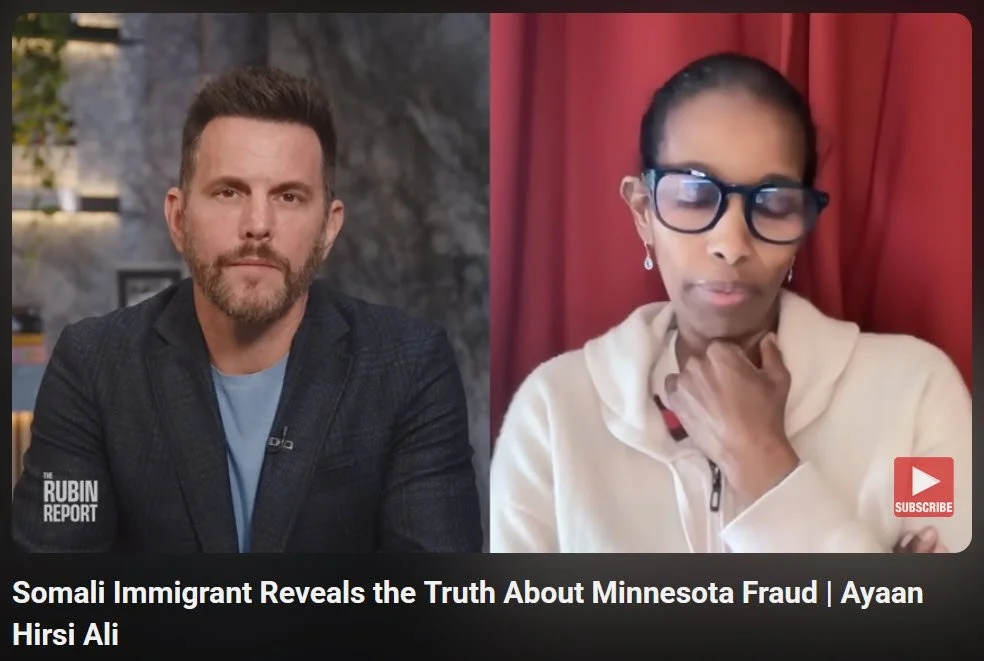
Dave Rubin of “The Rubin Report” talks to Ayaan Hirsi Ali about her Somali background and the clan-based system shaping Somali society; how clan loyalty and political Islam operate as alternative moral systems that clash with Western nation-states; how these dynamics inform Somali communities in Minnesota, fraud scandals, and identity politics; the influence of Islamist networks like the Muslim Brotherhood; Democratic electoral strategies built around ethnic blocs and dependency; the broader threat to liberal democracy and Western values; and much more. Watch Dave Rubin's FULL interview with Ayaan Hirsi Ali her
Somali Background and the Clan System
Hirsi Ali describes the clan system as the fundamental, permanent feature of Somali society, predating both independence and Islamism.
The "Passport" of Bloodline: She explains that from a young age, children are taught their lineage as their primary identity [04:42]. This lineage serves as a person's "welfare state"—it is the group you fight for, die for, and rely on for survival [05:01].
Alternative Moral Systems: Because loyalty to the clan or "in-group" is paramount, Hirsi Ali argues it creates an "amoral familism" [10:55]. Within this system, taking from an "alien" or "weak" system (like a modern nation-state) to help the bloodline is seen as a moral good or a necessity rather than theft [09:58].
Clash with Western Nation-States
Hirsi Ali argues that the clan-based system is not just pre-modern but "anti-modern," making it inherently incompatible with the modern nation-state [11:10].
Dynamics in Minnesota: She cites the Somali community in Minnesota as an example where these dynamics lead to friction, such as fraud scandals, because the communal moral code of the clan operates independently of U.S. law [08:46].
Islamist Influence and Political Strategy
The discussion explores how Islamist networks like the Muslim Brotherhood interact with these ethnic structures.
Islamization: Hirsi Ali notes that since the 1980s, pro-Islamism has attempted to reverse societal norms, where Islam now enforces what the clan holds dear, leading to increased Islamization (e.g., young girls wearing the hijab) [05:54].
Decentralized Networks: She describes the Muslim Brotherhood's presence in America as decentralized and often delegated to specific ethnic groups like the Somalis [13:21].
Electoral Blocs: Hirsi Ali criticizes what she describes as a Democratic electoral business model that focuses on providing benefits to specific ethnic voter blocs in exchange for loyalty, which she argues mirrors the Brotherhood's strategy of creating Islamist demographic representations [11:49].
Threats to Western Values
Hirsi Ali warns of a broader threat to liberal democracy and Western values.
Subversion: She argues that Islamist regimes, specifically Iran, use "subversion" to transform Western societies from within, sensing weakness in European political elites [36:40].
The Future of Humanity: She offers a "bullish" outlook on America only if these conversations continue, warning that the logical conclusion of Islamism or Communism leads to "death and destruction" and a life that is "short, nasty, and brutal" [34:17].
Watch the full interview:Somali Immigrant Has a Chilling Warning for the West | Ayaan Hirsi Ali