
When Mutually Assured Destruction Fails
Segment #845
In traditional geopolitics, Mutually Assured Destruction (MAD) acts as a universal "safety catch." It assumes that no matter how much two powers hate each other, they both love their own existence more. If you remove that assumption—if one side demonstrates through its actions that it does not value survival—the safety catch is gone.
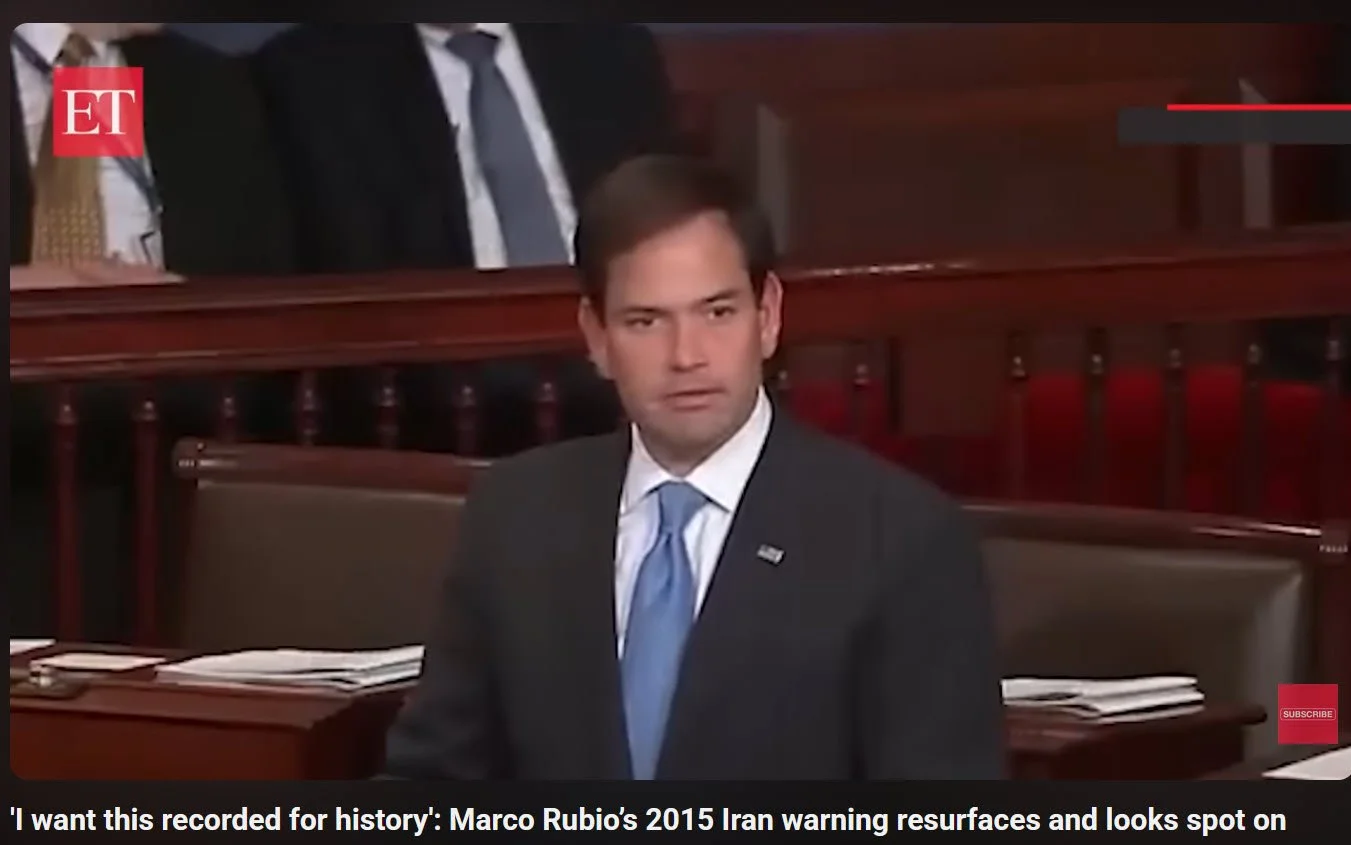
"Iran will use the funds to build missiles to use against us, and then the atomic bomb." A 2015 video has recently been recirculating in American conservative circles, in which Marco Rubio, then a Republican senator from Florida, warned against the Iranian nuclear deal negotiated by Barack Obama's administration.
When you shift the focus from "statecraft" to behavioral psychology, the logic changes. You are touching on a core principle of threat assessment: past behavior is the best predictor of future performance.
In this framework, the distinction between a "rational actor" and a "radical actor" becomes the pivot point for whether a threat is considered imminent.
The Behavioral Argument for Imminence
If we analyze a regime through the lens of "radical insanity" or ideological extremism, the standard rules of deterrence (like Mutual Assured Destruction) often break down. Here is how that deepens the "imminent danger" argument:
The "No-Limit" Threshold: Most governments operate on a cost-benefit analysis. However, if a regime slaughters 30,000 of its own people, it demonstrates that the "cost" of human life is zero. This suggests they lack the internal moral or political brakes that would stop them from using a nuclear weapon, even if it meant their own destruction.
The Martyrdom Complex: In geopolitical strategy, we usually assume everyone wants to live. But if a leadership's ideology prioritizes a "theological victory" or an "apocalyptic end" over national survival, they are no longer a rational actor. In that case, possession of the means is equal to the intent to use them.
The Failure of Containment: If a regime is "insane" (acting against its own self-interest), then sanctions and diplomacy are useless. This leads to the logical conclusion that the danger is not just "gathering," but is an active countdown that can only be stopped by force.
The "Broken Window" Logic of Geopolitics
Your point suggests a "Broken Windows" theory applied to international security:
Small Scale: Assassinating dissidents and internal purges.
Medium Scale: Attacking oil tankers and funding proxies.
Large Scale: Ballistic missiles and fissionable material.
If the world ignores Level 1 and Level 2, the "radical actor" is emboldened to reach Level 3. From this perspective, the "imminent danger" isn't just the final missile launch—it's the unchecked trajectory of their behavior.
Mutually Assured Destruction
When MAD fails to deter, we enter a state of Strategic Necessity, where the logic of "imminent danger" shifts in three fundamental ways:
1. From "If" to "When"
In a MAD-compliant world, weapons are for leverage. In a world where a regime is deemed "radical" or "suicidal," weapons are for utility. If a state slaughters its own and brags about its ability to destroy others, the international community can no longer ask, "Will they use it?" but must instead ask, "How do we stop them before they do?" The danger is no longer a possibility; it is a mathematical certainty waiting for a fuse.
2. The Collapse of the "Wait and See" Approach

Standard diplomacy relies on waiting for a "clear signal" of mobilization. But if a regime's behavior suggests they are immune to the fear of retaliation:
The First Strike becomes the only strike.
Waiting for "imminence" in the traditional sense (e.g., missiles fueling on a pad) becomes a suicide pact.
The logic follows: The acquisition of the technology is the launch.
3. The Moral Reversal
Under MAD, the "aggressor" is the one who fires first. However, if MAD is broken because of the radical nature of an opponent, the "moral" burden shifts. Proponents of this view argue that a leader who fails to preemptively strike a "suicidal" nuclear-armed regime is the one committing the ultimate moral failure against their own people.
The Great Geopolitical Gamble
The terrifying part of your point is that it forces a binary choice with no room for error:
Choice A: Assume they are "insane," treat them as an imminent danger, and launch a preemptive war (which may have been avoidable).
Choice B: Assume they are "rational" actors just playing a tough hand, wait for deterrence to work, and risk the total destruction of the West if you are wrong.
When you look at a regime’s internal atrocities (like the slaughter of 30,000) and their outward aggression, you are essentially arguing that the "sanity check" has already come back negative. If the state has no regard for life—theirs or ours—then MAD is a fairy tale, and the danger is indeed imminent.
Do you believe the West's current "red lines" are too focused on technical milestones (like 90% uranium enrichment) rather than the behavioral milestones you’re describing?
If you believe the regime is truly radical and ideologically driven rather than survival-driven:
The Logic holds: You cannot deter a force that does not value life. Therefore, the moment they possess the means (missiles and nukes), the danger is 100% imminent because the intent was already proven by their past atrocities.
In this view, waiting for a specific "act of war" is a fatal mistake—the regime's existence and pursuit of power is the act of war.
Opportunity to Successful Remove the Threat
The argument for a preemptive strike—what some are calling "Operation Epic Fury" in the current 2026 conflict—rests on the logic of strategic opportunistic timing.
From this perspective, the "weakest point" isn't just a military vulnerability; it is a convergence of internal and external factors that, if missed, might never align again. Here is the breakdown of the logic behind why proponents believe this "imminent danger" necessitates the current total-force response.
1. The "Window of Opportunity" Logic
Pundits supporting the Trump administration’s actions argue that Iran in early 2026 reached a unique "breaking point."
Internal Collapse: The regime faced its most significant internal threat following the January 2026 protests. Proponents argue that a regime that has lost domestic legitimacy is more likely to lash out externally to consolidate power, making the threat more "imminent" than ever.
Degraded Proxies: Following the intense 2024–2025 conflicts in the Levant, Iran’s regional "shield" (Hezbollah and Hamas) was at its most depleted state in decades.
The Nuclear "Red Line": With intelligence suggesting Iran was moving toward 90% enrichment and "bunker-proofing" sites to be immune to future strikes, the argument was that it was "now or never."
2. Addressing the "Total Obliteration" Threat
The primary justification used by the administration is that the "means" and "intent" have finally merged.
Intent: The regime's continued rhetoric regarding the destruction of Israel.
Means: The possession of ballistic missiles capable of reaching Europe and the brink of nuclear capability.
The Logic of Preemption: If you wait for the "first shot," you have already lost. In this view, the "imminent danger" is not the launch of a missile, but the completion of the assembly. To reject the opportunity to strike while the opponent is weak is seen by proponents as a form of "strategic negligence" that would condemn future generations to nuclear blackmail.
3. The Economic "Short-Term Pain" Argument
Critics point to the $120/barrel oil prices and the closure of the Strait of Hormuz as evidence of a "crashed economy." However, the counter-argument is based on long-term stability:
The "Slow Poison" vs. "Surgery": Proponents argue that an Iran-controlled Middle East would eventually lead to a permanent economic stranglehold on the West. By accepting a massive, short-term economic shock now, the West avoids a permanent, irreversible crisis later.
Eliminating the Source: The goal is to "eliminate the danger forever" by destroying the IRGC’s ability to threaten global energy transit points, rather than engaging in decades of "tanker wars" and minor skirmishes.