Segment #1100
Jovan Hutton Pulitzer and Election Fraud: Why the Resistance to Forensic Examination Deserves Scrutiny
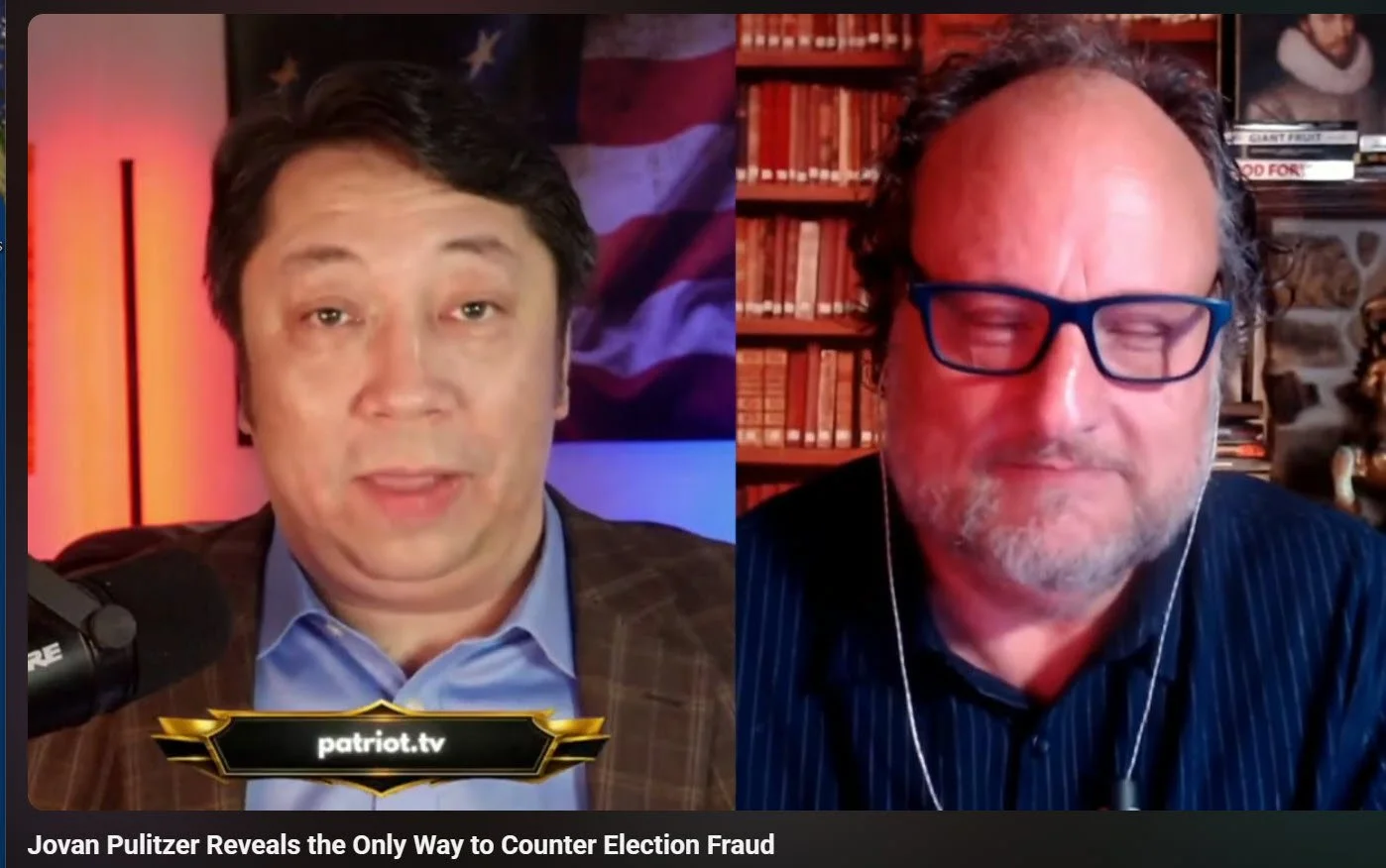
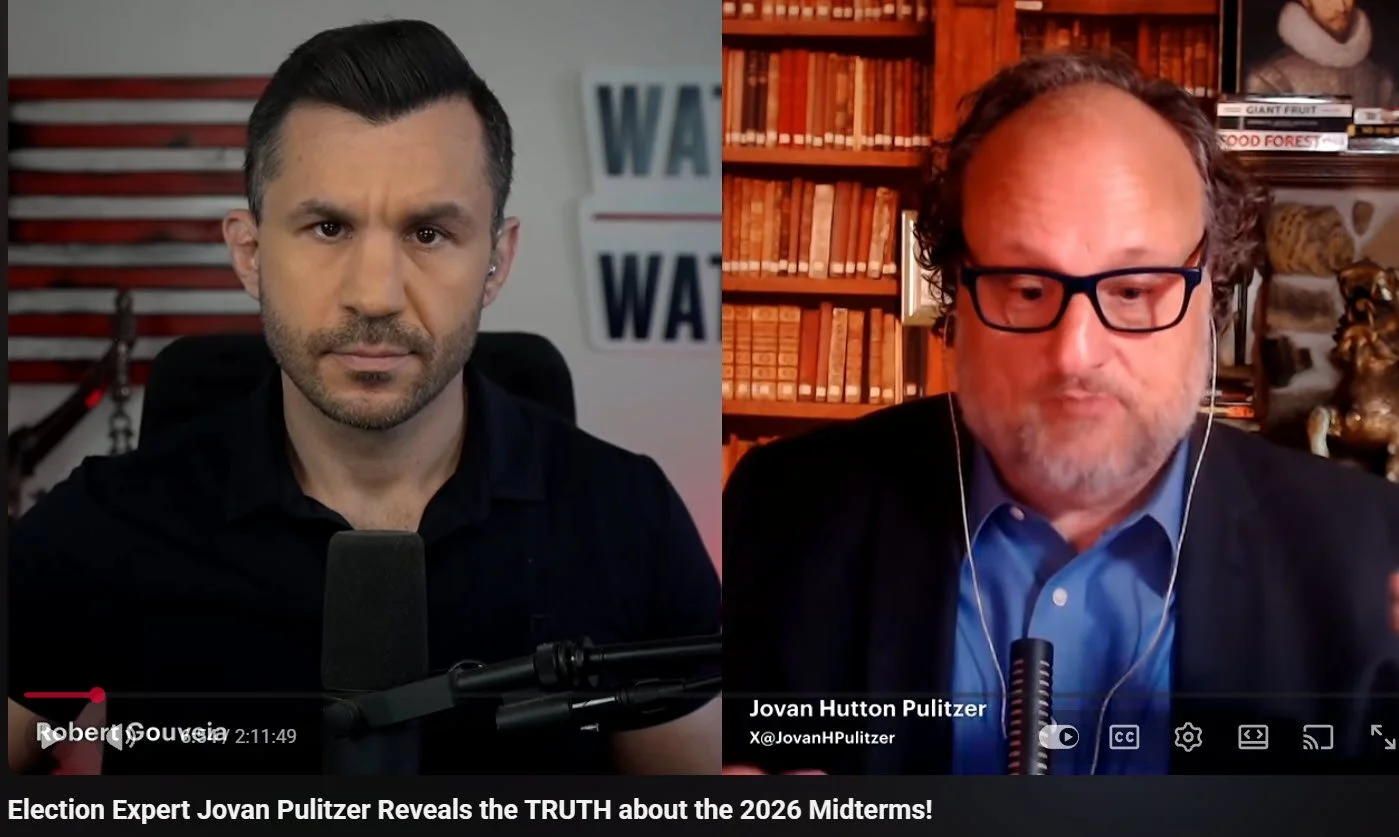
The Robert Gouveia interview with Jovan Hutton Pulitzer raises an issue that goes beyond the conventional debate over election fraud: Why should obtaining independently verifiable evidence about the integrity of an American election be so difficult?
There is an important distinction between proving election fraud and documenting institutional resistance to investigating potential election fraud. The latter deserves scrutiny regardless of whether the former is ultimately established.
Election officials should be able to defend their procedures through documentation, physical evidence, independent examination and transparent reconciliation of voting records. Simply certifying an election does not answer every legitimate question about how it was conducted.
Fulton County: Six years of documented roadblocks
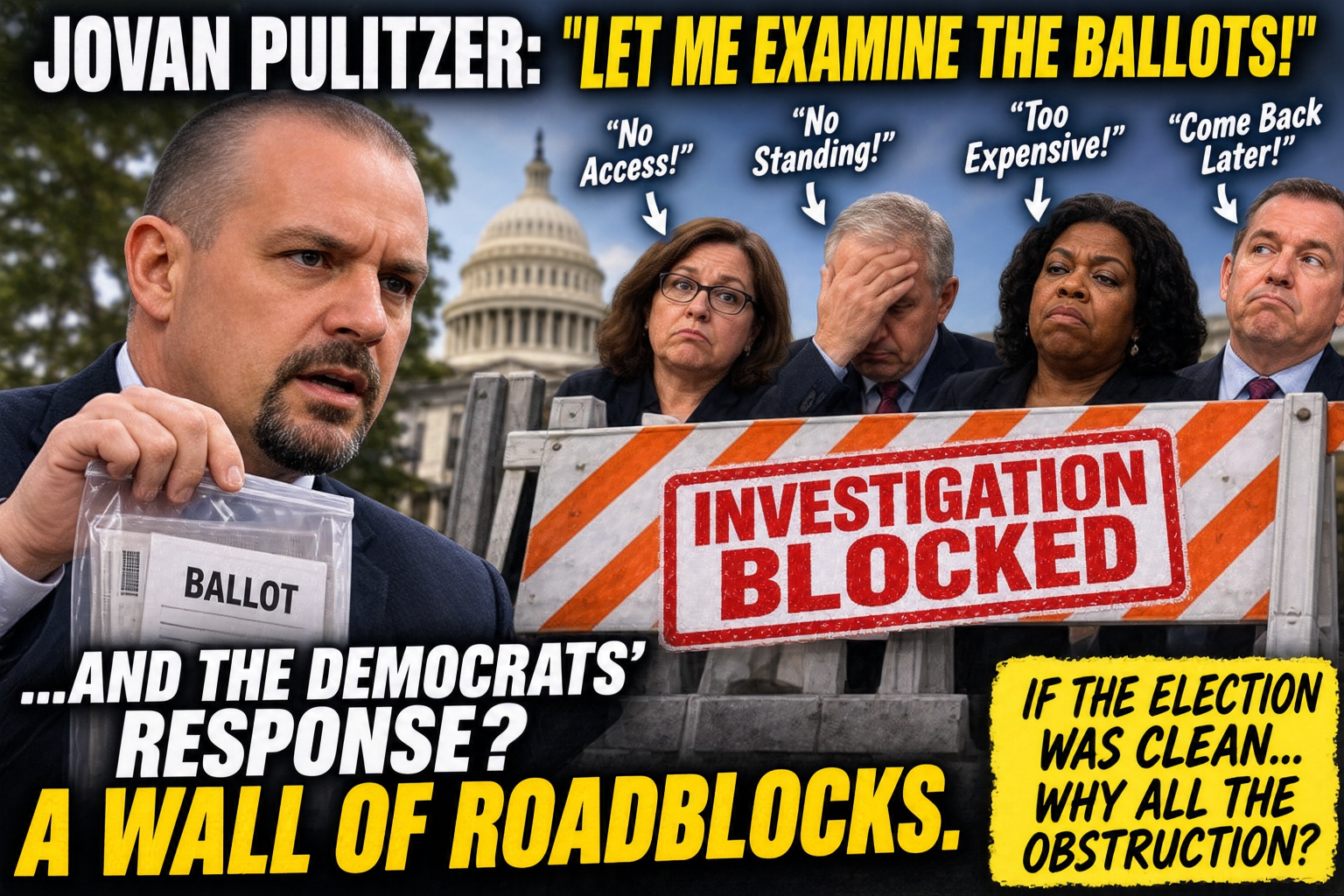
Perhaps the strongest support for Pulitzer's argument is the actual litigation history in Fulton County, Georgia. This is not speculation. The court records document repeated efforts to prevent or restrict outside examination of the original ballots.
December 2020 - Citizens file suit seeking access to original absentee ballots.
May 21, 2021 - Judge Brian Amero authorizes unsealing and inspection of ballots, subject to forensic examination protocols.
May 26–27, 2021 - Respondents file motions to dismiss, invoking sovereign immunity.
October 13, 2021 - Lawsuit dismissed on grounds of standing, preventing the proposed outside examination.
May 11, 2023 - Georgia Court of Appeals revives the ballot inspection lawsuit.
2024–2025 - Disputes continue over access to election records.
January 28, 2026 - FBI seizes election materials from Fulton County.
February 4, 2026 - Further judicial proceedings address outstanding claims and access to records.
November 25, 2026 - Judge orders Fulton County to provide the Georgia State Election Board with digital copies of seized election records.
Courthouse News+4
Particularly revealing is the language used by Fulton County Superior Court Judge Robert McBurney in his February 4, 2026, order. He characterized the litigation as involving:
“convoluted procedural wrangling”
Respondents “consistently and persistently seeking dismissal of all claims”
These are the words of a sitting judge, not Pulitzer or a political commentator.
Favorito MTD order
Read the actual February 2026 court order
Actual documented irregularities in Fulton County
Separate from Pulitzer's allegations, government investigations and court records have identified significant problems.
Double-scanned ballots during a recount - More than 3,000
Missing ballot images from the original count - Approximately 377,000
Missing ballot images from the recount - Approximately 18,000
Original absentee ballots sought for outside examination - Approximately 147,000
State investigators attributed the problems to human error, inadequate record-keeping and improper procedures. They did not conclude that these discrepancies changed the election outcome.
Nevertheless, the magnitude of these record-keeping failures warrants examination in its own right. Human error is an explanation that should be supported by evidence, not an exemption from accountability.
Dismissal on procedural grounds is not forensic exoneration
One of the most consequential distinctions in this controversy is between a court determining that a plaintiff has no legal standing and a forensic investigator determining that a ballot is authentic.
They are entirely different determinations.
Arguments involving sovereign immunity, jurisdiction and standing may be legally legitimate, but they do not establish the authenticity of the evidence that investigators are seeking to examine.
In the Fulton County case, forensic expert testimony specifically addressed the necessity of examining original physical ballots and obtaining higher-resolution images to conduct meaningful testing. The initial court order recognized the need to establish examination protocols. Subsequent litigation prevented that inspection from proceeding as originally contemplated.
Courthouse News
Georgia's own investigators separately reported finding no counterfeit ballots. That finding deserves consideration, but it is not equivalent to independent replication of Pulitzer's proposed examination.
Pulitzer's Maricopa County allegations
In his November 24 interview with Gouveia, Pulitzer described what he maintains are serious physical and administrative discrepancies in Arizona's election materials.
These include improperly secured ballot containers, different paper stocks, insufficient chain-of-custody documentation and unaccounted-for undeliverable ballots.
If these allegations can be substantiated, several questions become unavoidable:
Who was responsible for maintaining the security of the ballots?
Were statutory election procedures violated?
Can every discrepancy be reconciled against original records?
Were potentially compromised materials identified and isolated?
Were responsible officials disciplined or otherwise held accountable?
Has an independent forensic laboratory been invited to verify or refute Pulitzer's findings?
The appropriate response to a disputed forensic claim is a better forensic examination.
Pulitzer should likewise be required to produce his raw data, photographs, testing protocols, control samples and complete findings for independent review.
The difference between counting and authenticating
Consider the parallel with forensic art authentication.
An auction house could count 10,000 paintings three separate times and arrive at precisely the same number. That would establish the accuracy of its inventory. It would establish absolutely nothing about whether those paintings were genuine or counterfeit.
The same distinction applies to election auditing. A recount tests tabulation accuracy. A comprehensive election-integrity investigation must also address eligibility, ballot issuance, authenticity, custody and reconciliation.
One does not necessarily accomplish the objectives of the other.
The latest development – November 25, 2026
Just two days ago, a Fulton County judge ordered the county to provide the Georgia State Election Board with digital copies of election materials previously seized by the FBI.
The State Election Board had been seeking access to these records since 2024. Access will be restricted to authorized officials and approved experts. The FBI investigation remains without announced criminal charges.
AP News
This development is consequential because it creates another opportunity for examination after years of litigation.
It remains unclear, however, whether Pulitzer or another independent forensic specialist will receive access to the original physical ballots.
The accountability questions
The investigation should focus not exclusively on whether fraud occurred but also on the conduct of the institutions responsible for investigating it.
There are questions concerning who opposed examination, what legal arguments they employed, how much taxpayer money was spent fighting disclosure, whether election records were properly preserved and whether less restrictive alternatives could have permitted legitimate forensic testing while protecting ballot secrecy and evidence integrity.
Those questions can be investigated without presuming anyone's criminal guilt.
Conclusion
The documented history of Fulton County establishes that substantial procedural resistance to outside ballot examination has occurred. What it does not yet establish is that this resistance was a coordinated effort to conceal fraudulent ballots, or that all of Pulitzer's allegations are scientifically substantiated.
I have verified the litigation history and recent disclosure order, but have not independently verified Pulitzer's underlying forensic data, his claim concerning the involvement of more than 1,000 Democratic attorneys, or his allegations of deliberate interference with his broadcast.
The most effective way to resolve this controversy is to permit a properly supervised, scientifically rigorous and independently reproducible forensic examination, with the findings made public.
Election integrity should not depend on which political party wins, who requests an investigation, or whether election officials find the questions inconvenient. It should depend on evidence capable of withstanding independent scrutiny.
Where election fraud has been most frequently documented in the United States
An important addition to the Pulitzer analysis is the geographical concentration of documented election fraud, historical election manipulation and significant administrative irregularities.
The conservative Heritage Foundation has maintained a database of proven election fraud cases since 2014. In December 2024, it reported 1,567 documented instances and approximately 300 additional cases under investigation or prosecution. Its database includes criminal convictions, judicial findings and elections overturned because of irregularities.
The Heritage Foundation
Documented election fraud cases by state
The following figures come from a 2026 published analysis of the Heritage Foundation database. They are cumulative historical case counts, not population-adjusted estimates of current fraud.
Historical documented cases
Selected states from 1,619 nationwide database entries
Minnesota - 138
North Carolina - 123
Illinois - 117
Texas - 113
Florida - 93
California - 71
Wisconsin - 68
Ohio - 63
Kentucky - 62
Indiana - 59
New Jersey - 53
Mississippi - 45
Pennsylvania - 45
Alabama - 41
Arizona - 40
Source: Published analysis of Heritage Foundation election fraud data, October 2026.
The BRAD BLOG
These 15 states account for approximately 70% of the database's recorded cases. However, differences in prosecutorial activity, historical coverage and population prevent us from treating these numbers as reliable measurements of the actual prevalence of fraud.
A more recent statistical analysis
A separate 2026 investigation examined 513 proven instances of election fraud occurring since 2016.
Share of documented cases since 2016
Florida - 12%
North Carolina - 11%
California - 7%
Pennsylvania - 5%
Wisconsin - 4%
Approximate percentages. Source: National Investigative Unit analysis, 2026.
KCRA
The concentration is worth examining, particularly because the same states appear repeatedly in different historical datasets.
Specific geographical areas warranting attention
The following are examples of jurisdictions with documented cases, judicial findings or unresolved controversies relevant to Pulitzer's investigative approach. They are not a statistical ranking of cities.
Harris County, Texas - Illegal votes sufficient to overturn a judicial election.
Fulton County, Georgia - Ballot reconciliation, missing images, record preservation and prolonged litigation over access.
Maricopa County, Arizona - Ballot handling, chain of custody and disputed forensic allegations.
Bladen County, North Carolina - Absentee ballot manipulation resulting in a new congressional election.
Milwaukee, Wisconsin - Fraudulent requests for military absentee ballots by an election official.
Compton, California - Fraudulent voter registrations in a closely contested municipal election.
Lodi, California - Fraudulent registrations associated with a city council election.
New Jersey - Thousands of erroneous noncitizen voter registrations attributed to administrative failures.
Harris County, Texas — a particularly significant example
In 2024, a Texas judge overturned the 2022 election for the 180th District Court in Harris County after determining that 1,482 illegal votes had been counted in an election decided by only 449 votes.
Illegal votes identified
1,482
Margin of victory
449
Illegal votes
Margin of victory
The number of illegal votes exceeded the margin of victory by approximately 3.3 times.
Source: Heritage Foundation, judicial finding, 2024.
Not every illegal vote was necessarily intentionally fraudulent. Nevertheless, this is an actual judicial finding demonstrating that sufficiently serious election irregularities can invalidate an election.
The emerging problem of noncitizen voter registration
A September 23, 2026, Reuters investigation identified more than 30,000 potentially erroneous noncitizen registrations across at least 12 states since 2000.
States identified included California, Texas, Virginia, Iowa and New Jersey.
New Jersey reportedly experienced a registration error involving approximately 6,600 noncitizens. Iowa ultimately confirmed that 35 ballots cast by noncitizens were counted in the 2024 election. Investigators could not establish how many of the incorrectly registered individuals nationwide actually voted.
Reuters
This reinforces one of Pulitzer's central points: election integrity begins with the accuracy of the registration system, not with the tabulation machines.
The fundamental weakness in national election fraud statistics
A major methodological problem with using criminal convictions as the exclusive measurement of election fraud is that convictions depend on several preceding events:
The irregularity must be detected.
Someone must report it.
Investigators must obtain the necessary evidence.
Prosecutors must decide to pursue the case.
The evidence must satisfy the applicable judicial standard.
A low conviction rate cannot, by itself, establish that detection procedures are effective. Conversely, the possibility of undetected fraud does not establish that widespread fraud has occurred.
This is why independent auditing is important.
The absence of a comprehensive, standardized forensic auditing system also makes it difficult to determine which jurisdictions have the highest underlying incidence of fraud, as opposed to those that are most successful at detecting and prosecuting it.
Where Pulitzer's investigative methodology could be tested
A national election-integrity investigation could examine jurisdictions with documented failures using uniform procedures covering:
Voter eligibility - Citizenship, residency and duplicate registrations
Physical ballot authenticity - Paper, printing, ink and documented ballot specifications
Mail-in voting - Issuance, delivery, returns and acceptance records
Chain of custody - Seals, transportation logs and authorized access
Ballot reconciliation - Registered voting histories versus ballots counted
Digital records - Missing images, duplicate scans and audit logs
Institutional accountability - Record preservation, disclosure and compliance with court orders
The methodology should apply equally to Republican- and Democratic-controlled jurisdictions, with independent experts validating the findings.
Conclusion
The most compelling argument arising from the Gouveia–Pulitzer interview is that election transparency should not depend upon years of expensive litigation to obtain evidence that government agencies are already legally responsible for preserving.
There are documented instances of election fraud, judicially overturned elections, erroneous voter registrations and substantial failures in election record management across the United States. These are legitimate subjects for investigation.
I would distinguish three independent measurements: proven fraud, administrative irregularities and resistance to independent investigation. Combining them into a single national fraud ranking would be misleading, and no reliable comprehensive dataset currently establishes the true geographical prevalence of undetected fraud.
Nevertheless, the proper response to credible allegations of election irregularities is to produce the evidence, facilitate independent examination and publish reproducible findings. That standard should apply regardless of who won the election.