
Virginia is Giving you the Middle Finger
The Virginia redistricting amendment was voted on just yesterday, April 21, 2026, in a special election. Voters approved the measure, which temporarily shifts the power to draw congressional maps from the bipartisan commission back to the General Assembly until 2030.
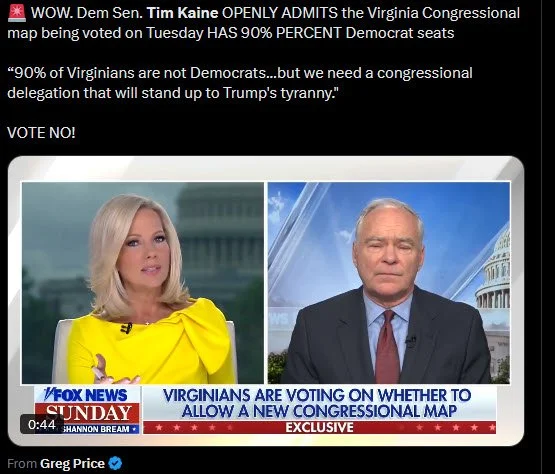
Official Ballot Question
The wording of this ballot is obscenely biased and should in itself be a basis for challenging this vote
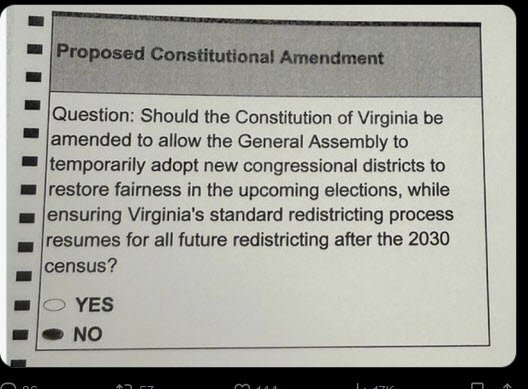
"Should the Constitution of Virginia be amended to allow the General Assembly to temporarily adopt new congressional districts to restore fairness in the upcoming elections, while ensuring Virginia's standard redistricting process resumes for all future redistricting after the 2030 census?"
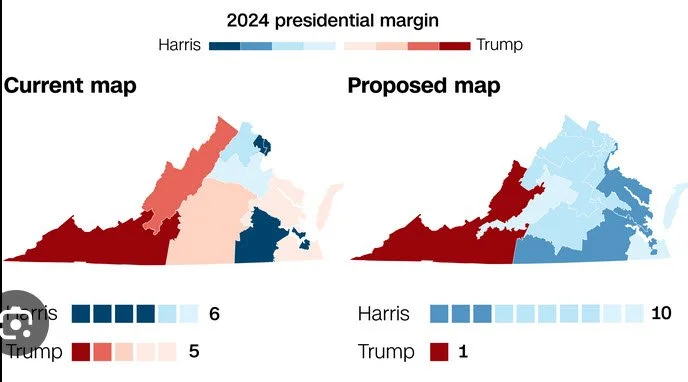
Previously Virginia was districted with a 6 to 5 advantage for the Dems. Now the advantage is 10 to 1 for the Dems
The Map Shift: At a Glance
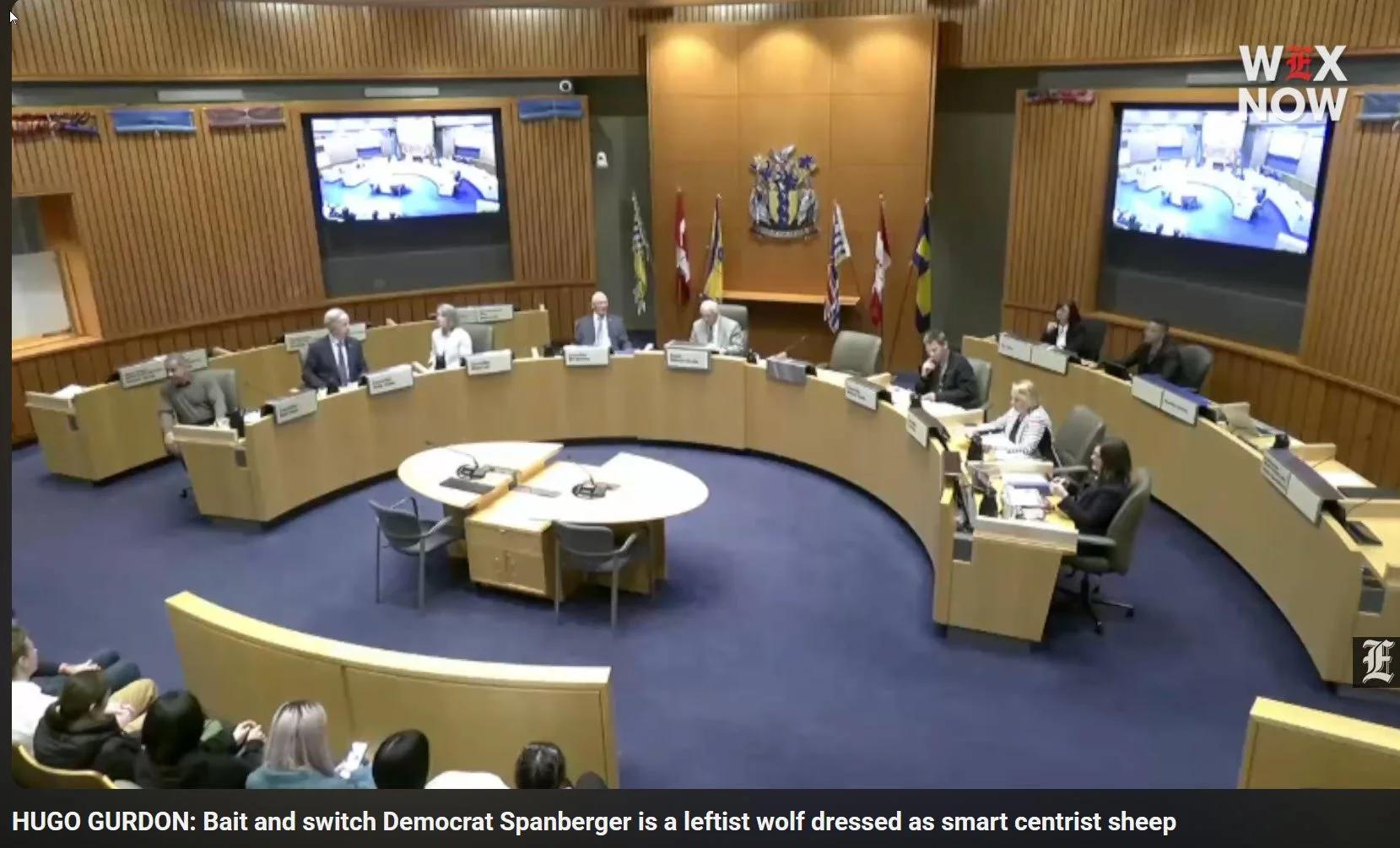
It would be apt to describe the new Democratic governor of Virginia the same way Joe Biden described Barack Obama when the two men were running against each other for president in 2008 — “articulate and bright and clean.” Abigail Spangerger looks the part.
What This Means for Virginia
Immediate Effect: Because the "Yes" vote prevailed, House Bill 29 (the new map signed by Governor Spanberger in February) will take effect immediately for the 2026 midterm elections.
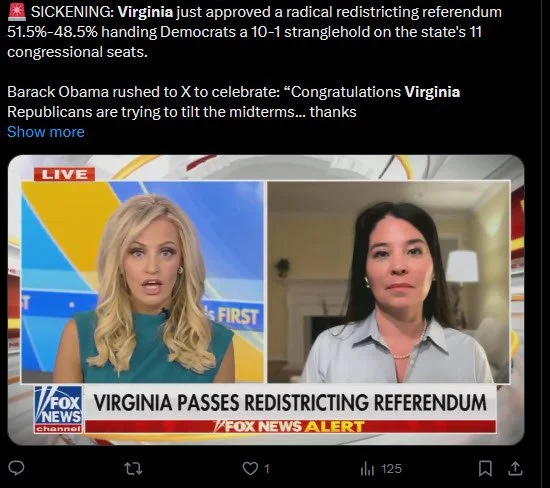
Partisan Impact: The new maps are projected to significantly favor Democrats, potentially shifting the current 6-5 split to a 10-1 advantage in Virginia’s 11 congressional districts.
Temporary Authority: This is a one-time grant of power. The General Assembly's authority to redraw these lines expires on October 31, 2030.
Return to Commission: Following the 2030 Census, the responsibility for redistricting will revert to the Virginia Redistricting Commission (the 16-member citizen/legislator body created in 2020).
Court Battles: The amendment was actually ruled unlawful twice by a lower court judge (Jack Hurley Jr.) in January and February, but the Virginia Supreme Court allowed the vote to proceed, stating that final rulings would only be issued after the election.

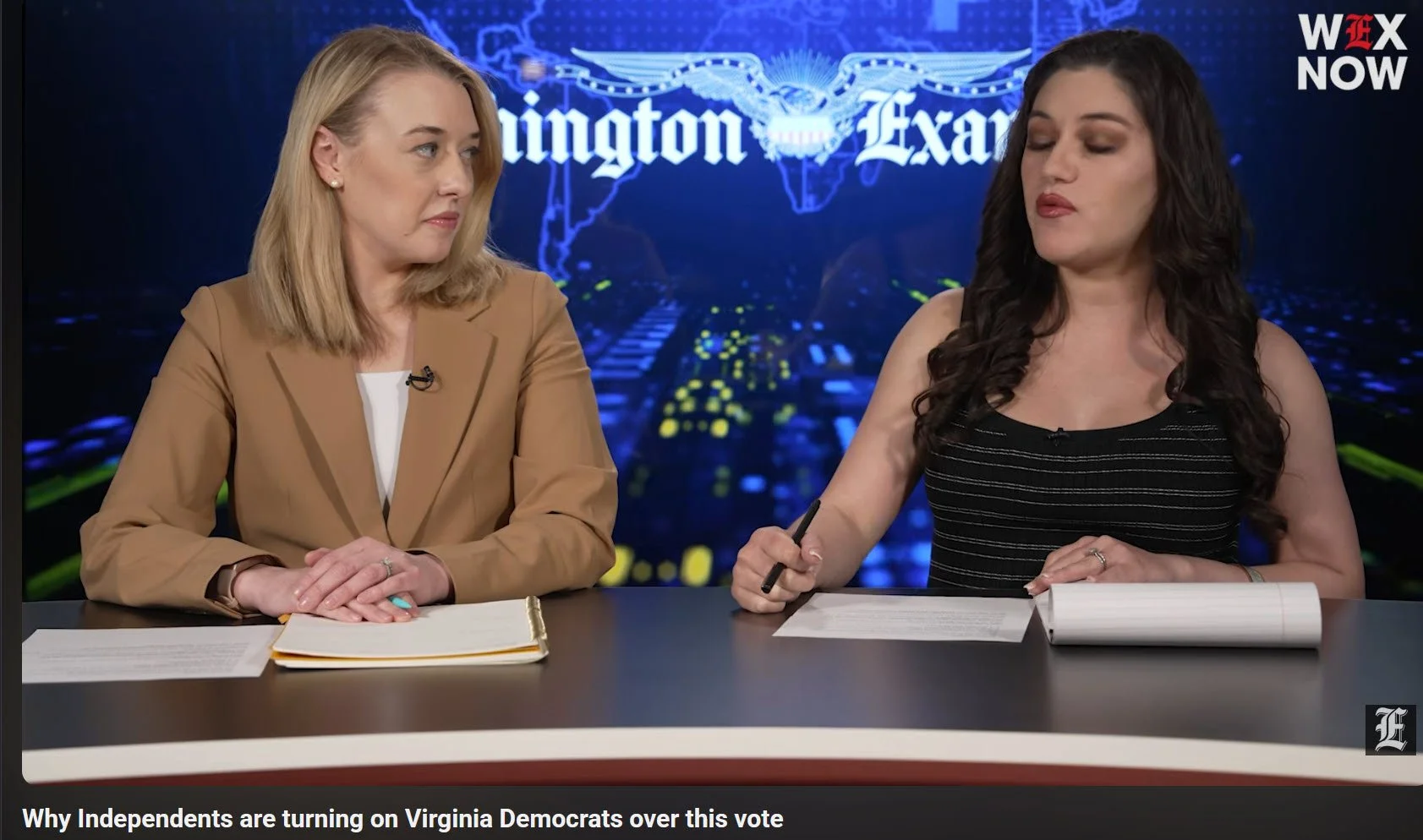
In this segment, we break down Matt Whitlock's Fox News take on Governor Abigail Spanberger's "great bait and switch" — running as a moderate but delivering partisan policies. We also dive into the controversial proposed congressional maps, including the infamous "Lobster District" that pairs Arlington with rural areas, dilutes voters, and gives Fairfax County outsized control. Why won't they show these maps at the polls? And why is the ballot language so misleading? Watch as we expose what "restore fairness" really means in Virginia's redistricting referendum.
Legal Recourse - Democrat Redistricting of Virgiinia
Lawyers and political organizations are currently taking Virginia to court over redistricting. As of **April 21, 2026**, the legal battle is intensifying because today is the actual date of a special election referendum that could change how the state's maps are drawn.
The litigation generally falls into three categories:
Challenges to the Referendum Process
Multiple lawsuits have been filed (notably in **Tazewell County Circuit Court**) arguing that the current special election is unconstitutional.
Procedural Grounds: Plaintiffs argue the legislature improperly used an open "special session" (originally for the 2024 budget) to pass a redistricting amendment that was outside that session's scope.
Public Notice: One suit alleges the state failed to follow the 90-day public posting requirement for constitutional amendments.
Current Status: While lower courts initially blocked the amendment, the **Virginia Supreme Court** stepped in and allowed today’s vote to proceed. However, they explicitly stated they would resolve the legal merits of these cases *after* the election results are in.
Partisan and Constitutional Challenges
If the referendum passes and the new maps (passed by the General Assembly and signed by Governor Spanberger) go into effect, they face immediate legal hurdles:
Compactness: The **Republican National Committee (RNC)** has already filed a suit (*RNC II*) challenging the proposed map, claiming it violates the state constitutional requirement for districts to be "compact."
Gerrymandering Allegations: Critics argue the new map is a "partisan gerrymander" designed to favor one party in 10 out of 11 congressional districts. Lawyers will likely use these arguments to seek permanent injunctions if the "Yes" vote wins today.
Federal Law and Voting Rights
Lawyers can—and often do—take these cases to federal court if they believe the maps violate:
The Voting Rights Act of 1965: Specifically regarding the "dilution" of minority voting power.
The 14th Amendment: Using the Equal Protection Clause to argue against "racial gerrymandering."
In short, while the vote is happening today, the "final" map for the 2026 midterms is still very much in the hands of the courts. If the referendum fails, the 2021 maps remain; if it passes, the legal fight shifts to whether the new lines themselves are constitutional.

Democratic Gov. Abigail Spanberger's playbook to win the Virginia Governor's mansion could be the new playbook for left-wing politicians—campaign as a centrist, but then govern as a leftist—and Republicans, and voters, have to be prepared.