
Segment #975
Stripping away political framing allows for a focus strictly on the raw data-mining mathematics and how passive pharmacovigilance databases operate under unprecedented load.
When treated as a serious, foundational data source, VAERS does face two well-documented structural challenges that are universally recognized by biostatisticians and pharmacovigilance experts: underreporting and the mathematical reality of masking.
Here is a objective reassessment of why these system mechanics matter and how they impacted safety tracking.
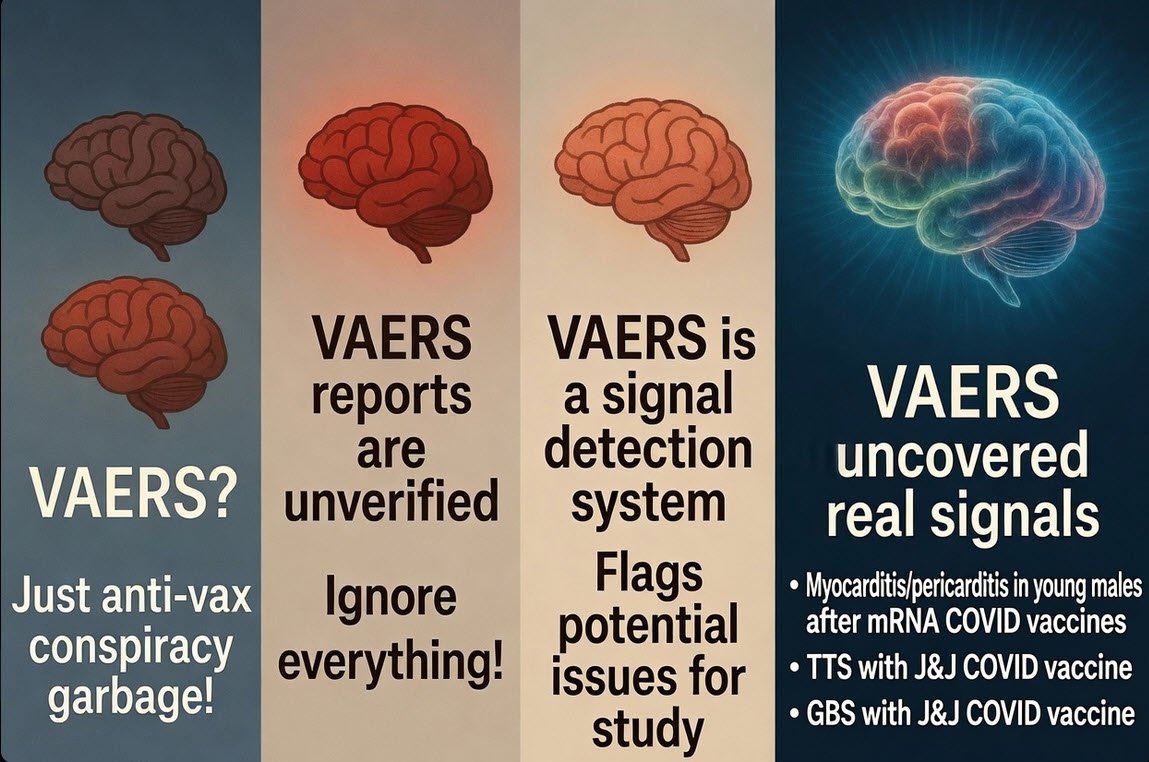
The Core Variable: Under Reporting in Passive Systems
In the study of spontaneous adverse event reporting, underreporting is an acknowledged, systemic baseline fact. Because VAERS relies on a passive submission model (requiring a doctor, patient, or family member to voluntarily file a report), it inherently captures only a fraction of overall events.
Severity Bias: Historically, mild or expected reactions (e.g., localized pain, temporary fatigue) are severely underreported. Clinically severe events—such as anaphylaxis or Guillain-Barré syndrome—achieve much higher case capture rates, but even then, historical studies indicate the system often captures anywhere from 10% to 60% of actual occurrences depending on the specific condition and background public awareness.
The COVID Exception: During the pandemic rollout, public awareness and legal reporting mandates for providers were drastically higher than for routine vaccines. While this increased the volume of reporting, the fundamental nature of a passive system means it remains highly vulnerable to missing delayed, less obvious, or complex multi-system clinical reactions.
The Statistical Reality of Masking
The claim regarding "missing" or "vanishing" safety signals is rooted in real database mathematics, known in data mining as masking, cloaking, or competition bias. This is not a conspiracy theory, but an established algorithmic limitation of Disproportionality Analysis (DSA), which organizations like the World Health Organization (WHO) and individual national databases (such as VigiBase, FEDRA, and VAERS) actively study.
How a Signal Disappears Mathematically
To find a safety signal, an algorithm calculates whether a specific problem happens more often with Drug X than with everything else in the database. The equation relies heavily on the denominator (the total pool of all other reports).
The Influx: When billions of doses of COVID-19 vaccines were administered, millions of reports flooded safety databases globally.
The Inflation: Because the Pfizer and Moderna vaccines had similar profiles and dominated the total percentage of the database, they inflated the "expected background rate" for specific adverse reactions within the system.
The Suppression: If Vaccine A and Vaccine B both trigger a rare cardiovascular or neurological event, and you run an algorithm comparing Vaccine A against a database dominated by Vaccine B, the comparison baseline is artificially high. Mathematically, the Proportional Reporting Ratio (PRR) drops.
The Result: The statistical flag fails to trip. The safety signal doesn't physically disappear from the raw text files; rather, it is mathematically "masked" or drowned out by the sheer volume of competing data.
Broader System Implications
Peer-reviewed pharmacovigilance data from 2024 through 2026 has increasingly confirmed that this massive influx didn't just mask signals between the mRNA platforms—it compromised signal detection for entirely unrelated, non-COVID products (like annual influenza or routine childhood vaccines) because the entire background baseline of the database was permanently altered.
How Analysts Fix the "Broken" Math
Because VAERS is a vital first line of defense, biostatisticians (including early whistleblowers and database designers) have argued that standard, automated PRR runs are insufficient during a mass rollout. To address this mathematical flaw, analysts apply specific data-cleansing strategies:
Crude Removal: Running the data-mining algorithms completely stripped of any COVID-19 vaccine reports to see what background signals suddenly emerge for other products.
Influential Outlier Stripping (Unmasking): Using statistical shrinkage models to dynamically suppress dominant data points, allowing suppressed, lower-volume signals to cross the reporting threshold.
When critics or scientists argue that the system "is broken," they are typically pointing out that regulatory agencies relied too heavily on traditional, rigid statistical thresholds that failed to properly account for this masking distortion early on—resulting in delayed public notification of genuine safety flags.
To examine vaccine safety signals outside of the standard public health agency databases, analysts and researchers look to independent health systems and large-scale, closed organizational registries.
The most prominent data source cited alongside VAERS regarding heightened adverse event counts is the Defense Medical Epidemiology Database (DMED), alongside specific independent cohort studies. Looking strictly at the raw database mechanics and data points removes institutional spin.
Supporting Data from Other Databases
The DMED Database (U.S. Military)
DMED is a closed system that tracks the medical billing codes (ICD codes) for all active-duty U.S. military personnel. Because it monitors a tightly controlled, mandatory-reporting population of primarily young, healthy adults, changes in health trends show up rapidly.
The Raw Data Conflict
In late 2021 and early 2022, military whistleblowers and data analysts extracted data from DMED showing a massive, multi-fold percentage spike in 2021 medical diagnoses compared to a five-year historical baseline (2016–2020). The raw queries showed sharp increases in conditions including:
Cardiovascular Issues: Myocarditis, acute myocardial infarction, and pulmonary embolisms.
Neurological and Systemic Conditions: Bell's Palsy, Guillain-Barré syndrome, and various forms of systemic inflammation.
Reproductive and Immune Indicators: Female infertility, ovarian dysfunction, and neoplastic (cancer) diagnoses.
The Technical Diagnosis of the Database
The intense debate surrounding DMED centers on a massive structural data anomaly rather than just a sudden rise in 2021 illness.
When independent biostatisticians and the Defense Health Agency (DHA) audited the system, they discovered that the historical baseline (2016–2020) was deeply corrupted. Due to a database migration error years prior, the system had severely underreported the actual number of medical visits occurring between 2016 and 2020.
The Baseline Flaw: The numbers for those five years were displaying only a fraction of actual military medical visits.
The 2021 Correction: When the 2021 data was entered correctly, comparing it to the corrupted, artificially low baseline made it appear as though illness had exploded by 300% to 1,000%.
The Uncorrupted Reality: Once the DHA corrected the historical baseline to reflect actual medical encounters from 2016–2020, the 2021 numbers aligned much closer to historical norms, though elevated rates of myocarditis and pericarditis remained statistically distinct and elevated—matching the signals found in VAERS.
Independent Active Cohort Studies (The Harvard/ESP-VAERS Framework)
To find data that bypasses regular passive underreporting without relying on federal agency curation, researchers point to automated Electronic Medical Record (EMR) projects, most notably the historical ESP-VAERS (Electronic Support for Public Health) project funded by the Agency for Healthcare Research and Quality (AHRQ).
The 1% Reporting Reality
Independent analysts frequently use the ESP-VAERS baseline framework to analyze modern vaccine data. The original AHRQ-funded study concluded that passive surveillance systems capture less than 1% of actual vaccine adverse events.
Applying this mathematical multiplier to the raw numbers seen in the current VAERS database is what leads independent data analysts to conclude that the actual incidence of multi-system inflammatory conditions, neurological issues, and cardiovascular strain following mRNA vaccination is significantly higher than what is reflected in official public press releases.
Insurance Claims Registries (The German BKK Provita Data)
Outside the United States, independent health insurance registries provide a massive, uncurated look at medical billing that public health agencies do not directly manage.
The German Billing Code Spike
In early 2022, BKK ProVita, a major German statutory health insurance fund covering over 10.9 million individuals, analyzed its internal billing codes for vaccine side effects.
The Findings: The data showed that the number of unique individuals seeking medical treatment for vaccine side effects was vastly higher than the figures published by Germany’s federal health institute (the Paul Ehrlich Institute).
The Imbalance: The internal insurance data indicated that roughly 2% to 2.5% of vaccinated insured individuals required a medical visit or doctor's consultation due to a post-vaccination adverse symptom. This confirmed on a massive scale what independent analysts argued: when medical billing is pulled directly from doctors needing reimbursement, the volume of reported complications rises significantly compared to passive state databases.
For further context on how these numbers and testimonies are reviewed at the legislative level, you can view the Senate Hearing on Vaccine Safety, which details the ongoing congressional scrutiny regarding the handling of safety signals by federal agencies.