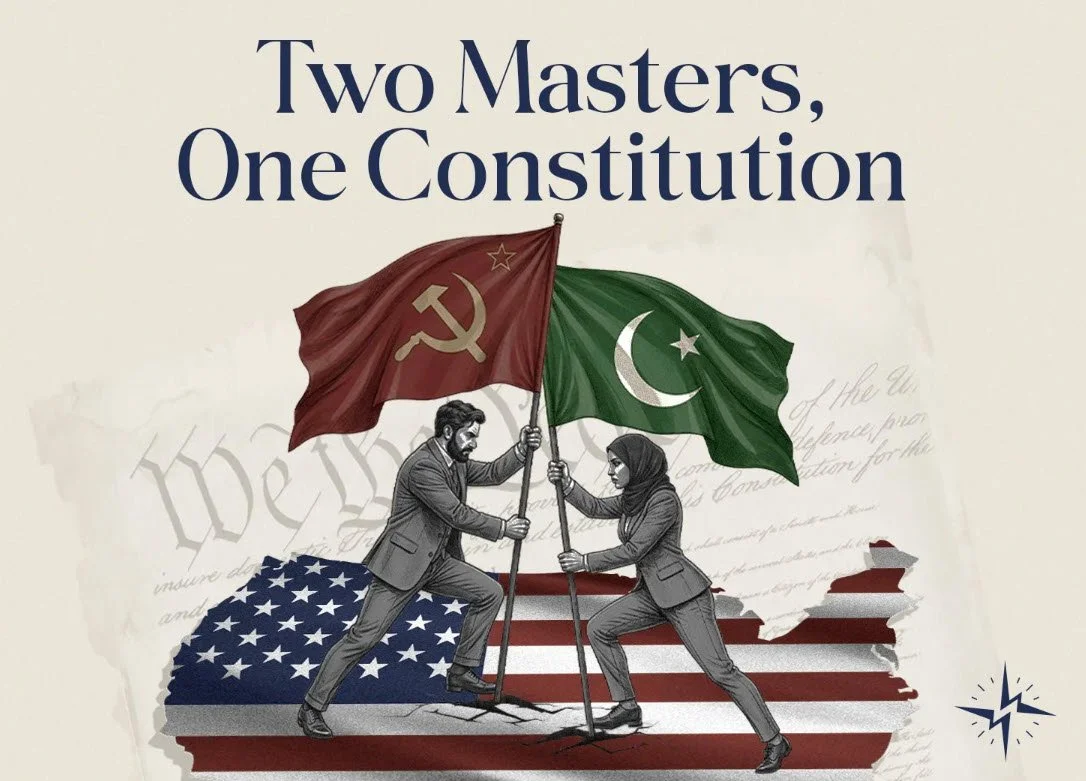
Two Masters, One Constitution
Segment #839
Consider this a plug for Ayaan Hirsi Ali whom I regard as one of the most important voices today in geopolitics specifically addressing the ongoing conflict with radical Islam. Given her brilliant mind and gift for writing nobody comes to the table with her credentials and credibility.
Ayaan Hirsi Ali is a Somali-born activist, author, and intellectual known for her critique of Islam and advocacy for women's rights. After fleeing an arranged marriage and settling in the Netherlands, she gained prominence in Dutch politics before moving to the U.S. following death threats.
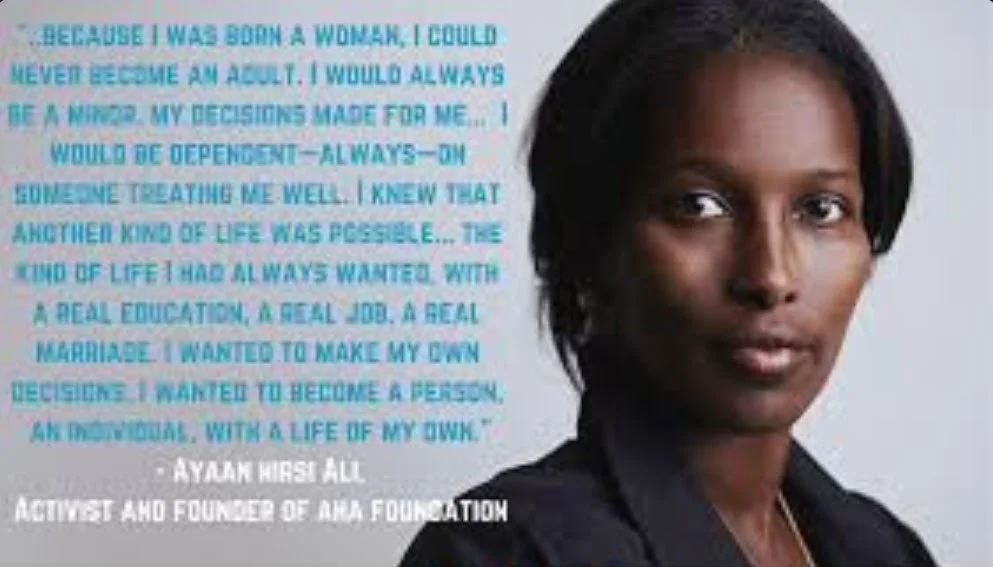
Key Facets of Her Public Life
Background: Born in Somalia (1969), she experienced a traditional upbringing and underwent female genital mutilation. She later renounced Islam, eventually becoming a Christian.
Activism: Her work focuses on women’s rights, specifically combating honor-based violence and child marriage through the AHA Foundation.
Political Stance: A fellow at the Hoover Institution, she argues that traditional Islamic tenets are incompatible with Western democracy and calls for significant religious reformation.
Controversy: Her career is marked by polarized debate; supporters view her as a courageous champion of enlightenment values, while critics argue she promotes anti-Islamic sentiment and misrepresents data.
Selected Works: Author of Infidel, Nomad, Heretic, and Prey.
Quoted from Ayaan’s latest substack.com posting. You can follow her on Youtube, Substack.com or X
Aristotle called it the first law of thought: a thing cannot simultaneously be and not be. A proposition is either true or it isn’t. This seems obvious until you watch an entire political civilization organize itself around ignoring it, most clearly seen in the unstable partnership between Muslim activists and the progressive left.
Whatever its failures, almost the only consistent virtue of Islam is that it does not ignore Aristotle’s maxim. The tradition makes totalizing claims—about God, about governance, about the hierarchy of the sexes—and it has carried those claims across centuries without revision. I find those claims wrong—some of them monstrously so. But they are, at minimum, coherent, corresponding to themselves. The faith is honest about what it is. The same cannot be said, however, of the coalition now courting its voters.
The rise of Muslim political power in America is less a demographic shift than a slow-motion collision of irreconcilable worldviews. Muslim Americans are winning elections at a pace that would have seemed fanciful twenty years ago. New York City now has a Muslim mayor in Zohran Mamdani — a democratic socialist who ran with enthusiastic backing from progressive institutions, LGBTQ+ advocacy groups, and the organized, activist left. Across Michigan, Maryland, Virginia, and Ohio, Muslim candidates have been ascending steadily—almost universally as Democrats—welcomed into a coalition that treats gender self-invention as its newest civil rights frontier.
The coalition celebrates this as pluralism in action. What it refuses to examine is the fault line beneath its own feet.
Orthodox Islamic teaching—not extremism, not fringe interpretation, but the mainstream jurisprudence that most observant Muslims would recognize as simply Islam—holds that homosexuality is a grave sin, that gender is binary and divinely fixed, that women’s authority within the family is structurally subordinate, and that divine revelation, not popular vote, settles what is right. These are not peripheral beliefs, but the architecture itself. Adjust them, and the whole structure changes shape.
Yet the progressive coalition that now champions Muslim political ambition has also made opposition to every one of those positions the entry price for moral legitimacy. The same framework that labels evangelical Christians bigots for holding identical views on sexuality and gender simply suspends itself when the holder happens to be a person of color running against a Republican.
Kierkegaard called this the aesthetic stage of existence, where the self is organized around performance rather than conviction, sensation rather than truth, appearance rather than commitment. The person at this stage is not lying exactly—they are simply never fully aligned with what they actually believe. The coalition has raised that condition to an art form.
The problem surpasses hypocrisy. Hypocrisy is ancient, familiar, almost forgivable. This is something structurally deeper. What we are watching is something Kant would have recognized immediately—the simultaneous endorsement of premises that cannot both be true.
A politician who genuinely holds that gender is an immutable binary, written into creation, cannot simultaneously champion a worldview the entire foundation of which rests on the opposite premise. The performance of both positions is possible. The sincere belief in both, however, is not.
Hegel saw contradiction not as a flaw to be corrected but as a force that moves history toward crisis. The contradiction here has been accumulating compound interest for years. The coalition asked devout Muslims to vote for the dismantling of everything their tradition regards as moral order in exchange for a seat at a table they had no part in setting. While many took the deal, none were as notable as the politicians.
According to Nietzsche, the most dangerous untruth is not the outright lie but the comfortable evasion—the life lived in deliberate contradiction to its own premises. The evasion, he warned, doesn’t merely breed dishonesty, but over time it destroys the capacity to know what you actually believe. Reality, eventually, makes the incoherence visible.
Israel and the United States are now at war with Iran. The sides are not ambiguous. On one side stand nations that, however imperfectly, are grounded in human dignity, equality before the law, and authority derived from the governed. On the other stands a theocratic state that executes gay men in public squares, mandates the veil by force, and derives its legitimacy from divine revelation as interpreted by barbaric savages.
What meets on that battlefield is not merely military force, but two irreconcilable answers to the oldest question in politics: what is a human life worth? This inconsistency places Muslim-American elected officials like Mamdani and Ilhan Omar in a position that is not merely uncomfortable, but impossible to sustain from a constitutional perspective. They swore an oath to the document that enshrines exactly the freedoms Iran systematically destroys. They built their careers inside a coalition that spent years framing Iran as a legitimate voice of resistance, a rational actor with comprehensible grievances. In peacetime, such contradictions can be managed. In wartime, they become confessions.
Their careful positioning was designed to never answer a question that is now unavoidable: when the lines are drawn, do you defer to the Constitution you’ve sworn to uphold, or the tradition in which you were raised?
Jesus of Nazareth said that no man can serve two masters. He was speaking of money, but the principle runs deeper than any ledger to the structure of belief itself. Two mutually exclusive accounts of human nature and divine authority cannot both command genuine loyalty. The progressive coalition built its Muslim-American alliance on the assumption that the contradiction could be contained indefinitely. They believed that the question of which master actually governed could be deferred forever, managed by artful omission and rewarded by institutional complicity. The war ended the deferral. What remains is the answer—and the deafening silence of those who cannot bring themselves to say it.
Ayaan Hirsi Ali is the editor-in-chief of Restoring the West. Follow her on X at @Ayaan.