Segment #867
As of late April 2026, the rift between Tucker Carlson and President Trump has become a defining conflict within the conservative movement, largely triggered by the war in Iran that began in February 2026.
Tucker Carlson appears to be grappling with a self-imposed burden of guilt, seeking atonement for past stances—such as his support for the Iraq War or his initial views on Donald Trump—through public acts of "self-flagellation." However, this quest for personal redemption raises significant concerns. If he remains a committed conservative, one must wonder why his path to atonement involves undermining conservative principles and inadvertently bolstering liberalism—a force he has long described as destructive. Furthermore, it is difficult to believe that a commentator of his caliber was genuinely unaware of Trump’s long-standing, publicly documented foreign policy positions. While one might hope for his personal well-being, it is hard to maintain sympathy for a figure whose current trajectory seems so intent on inflicting collateral damage.
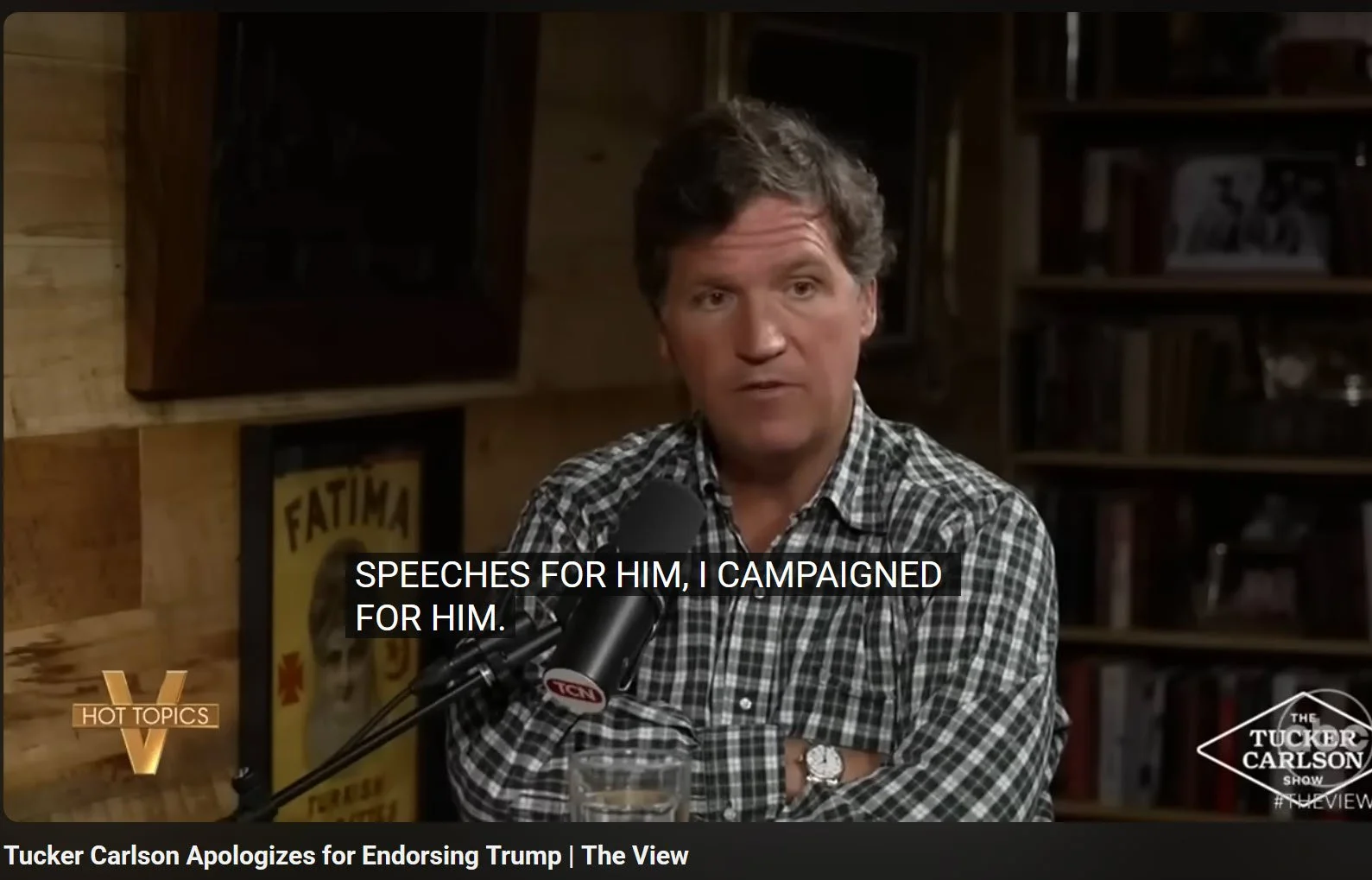
If you were to ask Carlson this today, his response would likely center on a return to "traditional conservative values" and a non-interventionist "America First" foreign policy that he believes Trump has abandoned. Based on his recent broadcasts and public apologies, here is how the landscape of his current "opposition" looks:
The "Tormented" Reversal
Carlson recently made headlines (April 20, 2026) by stating he is "tormented" by his past support for Trump. He issued a formal apology to his audience, claiming he "misled" people by campaigning for a leader who, in his view, ultimately betrayed his promise to keep America out of foreign wars. He now characterizes Trump as being "hemmed in" or "enslaved" by the national security establishment and foreign interests.
The Search for an Alternative
While Carlson hasn't endorsed a specific 2028 candidate yet, his "viable alternative" isn't a person so much as a theological and isolationist shift.
Non-Interventionism: He argues for a conservatism that refuses to prioritize the interests of allies (specifically Israel) over American lives.
The "Antichrist" Commentary: In a startling escalation, Carlson recently questioned whether Trump's behavior—specifically his verbal attacks on Pope Leo XIV and his use of AI imagery depicting himself as a religious figure—suggests a "low character" or even "antichrist" qualities.
Viktor Orbán’s Hungary: Carlson continues to point toward the Hungarian model of "illiberal democracy" as his preferred conservative blueprint, focusing on social traditionalism and national sovereignty rather than global military projection.
The Counter-Argument: Aiding Foes?
Your point about aiding international foes is exactly what the administration's allies are currently arguing.
"Tehran's Propagandist": Critics, such as the Middle East Forum and figures within the Trump administration like Defense Secretary Pete Hegseth, have accused Carlson of echoing Iranian state talking points.
Trump’s Response: President Trump has retaliated by calling Carlson a "Low IQ person" and "highly overrated," effectively excommunicating him from the MAGA inner circle.
The "naive" label is a frequent weapon used against Tucker Carlson by his critics, especially since the war in Iran began in February 2026. These critics argue that his version of "America First" has shifted from a pragmatic foreign policy into a dangerously simplistic worldview.
Naivety Regarding Foreign Adversaries
Critics like Gregg Roman of the Middle East Forum argue that Carlson is naive to think that if the U.S. simply "leaves the world alone," our adversaries will do the same.
The "Tehran Propagandist" Charge: Some conservative critics point out that Carlson's monologues often mirror Iranian state messaging—blaming Israel or "dual-loyalty" officials for the conflict—while ignoring decades of Iranian-backed attacks on American troops.
The "Uncrewable Vessel" Critique: Critics argue that Carlson's claim that the U.S. is being "manipulated" by smaller allies (like Israel) actually portrays America as weak and "enfeebled," which ironically invites more foreign aggression.
Naivety Regarding "Evil"
Since Carlson's recent theological shift—where he has begun using terms like "antichrist" and "vile" to describe political events—some former allies argue he has lost his grip on political reality.
The Moral vs. The Political: Critics like Ben Shapiro have suggested that Carlson's refusal to recognize the strategic necessity of the Iran conflict stems from a naive, isolationist idealism that doesn't account for how the world actually functions. They argue he is "naive" to believe that global stability can be maintained without American projection of power.
Naivety Regarding His Own Influence
There is a growing consensus among D.C. insiders that Carlson is naive to believe he can lead a "MAGA movement" that is separate from Donald Trump.
The "Movement Leader" Fallacy: While Carlson feels "tormented" by his past support for Trump and wants to move the base toward a more non-interventionist path, critics argue he underestimates the average voter's personal loyalty to Trump himself. By attacking the President's "character," critics say Carlson is naively "committing political suicide" and effectively aiding the Democrats by fracturing the conservative coalition during a wartime election cycle.