
Why Western Societies Are Becoming Less Tolerant of Dissent
Segment # 1062
The Psychology of Political Manipulation
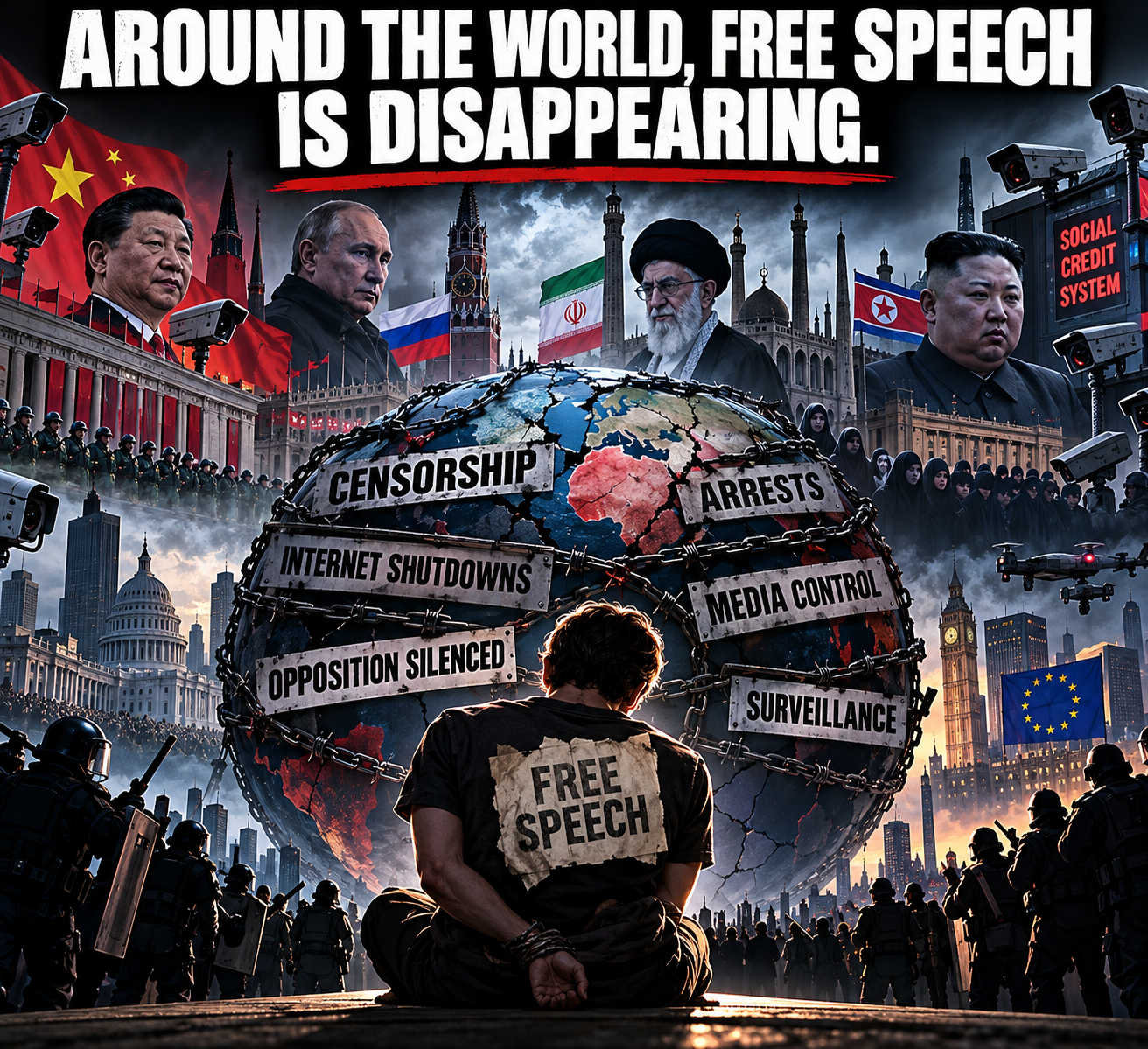
How Western Democracies Are Sacrificing Free Speech, Independent Thought, and Personal Relationships
Western democracies face a disturbing contradiction. Societies founded on individual liberty and freedom of expression increasingly tolerate censorship, ideological conformity, and the punishment of political dissent.
Equally disturbing is the willingness of intelligent, educated people to abandon lifelong friendships and family relationships over political disagreements, frequently without discussion.
The underlying problem is psychological as much as political. Fear, propaganda, social pressure, and tribal loyalty can overwhelm independent judgment. Intelligence offers no immunity. Intelligent people may simply become more sophisticated at rationalizing beliefs they have never seriously questioned.
Free Speech: A Right Increasingly Subject to Conditions
Pew Research Center found that the median share of respondents across comparable countries who considered free speech very important declined from 63% in 2019 to 58% in 2024.
The greater concern is not whether people claim to support free speech. It is whether they defend that freedom for people whose opinions they despise.
Western governments increasingly justify speech restrictions through public safety, combating extremism, preventing misinformation, and protecting vulnerable groups. Some restrictions address legitimate threats. Others risk granting governments dangerous discretion over acceptable opinion.
The international picture is revealing:
United States: Strong First Amendment protections coexist with political pressure, institutional conformity, government involvement with social-media platforms, and attempts to suppress dissent.
United Kingdom: The Online Safety Act expands government oversight of digital platforms, raising concerns about excessive restrictions on lawful expression.
Germany: Despite 87% of respondents considering free speech very important, laws governing extremist expression and political insults permit prosecutions that would often violate American constitutional protections.
France: Restrictions involving hate speech, immigration, religion, and public order create friction between individual liberty and state authority. Only 61% of respondents considered themselves at least somewhat free to speak openly.
Canada: Hate-speech regulation and online-harms proposals expose tensions between protecting vulnerable groups and protecting dissent.
Australia: Extensive digital regulation reflects a willingness to accept government intervention in the name of public protection.
Sweden: Strong constitutional protections coexist with social pressures discouraging opinions outside the prevailing consensus.
These nations remain democracies, not totalitarian states. But authoritarian practices can develop within democratic institutions without abolishing elections.
Freedom of speech becomes meaningless when it protects only approved opinions.
Why Intelligent People Are Vulnerable to Propaganda
Effective psychological manipulation rarely requires convincing someone of an obvious lie. It exploits existing fears, grievances, loyalties, and prejudices.
Six psychological mechanisms are particularly effective:
Confirmation bias: People embrace information supporting existing beliefs while rejecting contradictory evidence.
Repetition: Familiar claims begin to feel true, regardless of their accuracy.
Social conformity: Fear of rejection makes agreement more attractive than independent thought.
Authority bias: Government officials, journalists, academics, and celebrities can influence beliefs through perceived credibility.
Fear manipulation: Threats to safety, livelihood, children, or national identity make restrictions on freedom seem reasonable.
Artificial consensus: Algorithms, bots, selective reporting, and coordinated messaging manufacture the appearance of widespread agreement.
The result can be a population convinced it is thinking independently while responding to an information environment engineered to influence its conclusions.
The most effective propaganda does not eliminate intelligence. It exploits human psychology to redirect it.
Political Manipulation: Different Ideologies, Similar Vulnerabilities
Neither the political left nor the right possesses a monopoly on manipulation, intolerance, or authoritarian behavior. Both are susceptible, although their methods, priorities, and institutional influence differ.
The political left: Progressive movements often justify restrictions through combating hate speech, misinformation, discrimination, and perceived social harm. These objectives can serve legitimate purposes but can also encourage institutional censorship, ideological conformity, and the moral condemnation of dissent. Disagreement over immigration, race, gender, or social policy may become grounds for questioning someone's character rather than debating the issue.
The political right: Conservative and nationalist movements can demonstrate comparable intolerance through loyalty tests, conspiratorial thinking, hostility toward critics, and restrictions justified by patriotism, religious values, national security, or traditional morality. Appeals to public order and cultural preservation can also become instruments of government overreach.
The evidence is not necessarily symmetrical. A 2026 study drawing on four American datasets found that Democrats reported ending relationships over political disagreements more frequently than Republicans and were more often the initiators. That finding deserves acknowledgment, although it does not establish universal differences in tolerance or authoritarianism.
Both political camps exhibit confirmation bias, selective outrage, moral absolutism, and a willingness to excuse misconduct by their own side.
The relevant question is not which party claims moral superiority. It is which individuals and institutions are restricting freedoms, manipulating information, or punishing disagreement—and whether those actions withstand impartial scrutiny.
Political balance does not mean pretending both sides behave identically. It means holding both to identical standards.
Why Politics Is Destroying Lifelong Relationships
Perhaps the most disturbing consequence of polarization is the destruction of personal relationships
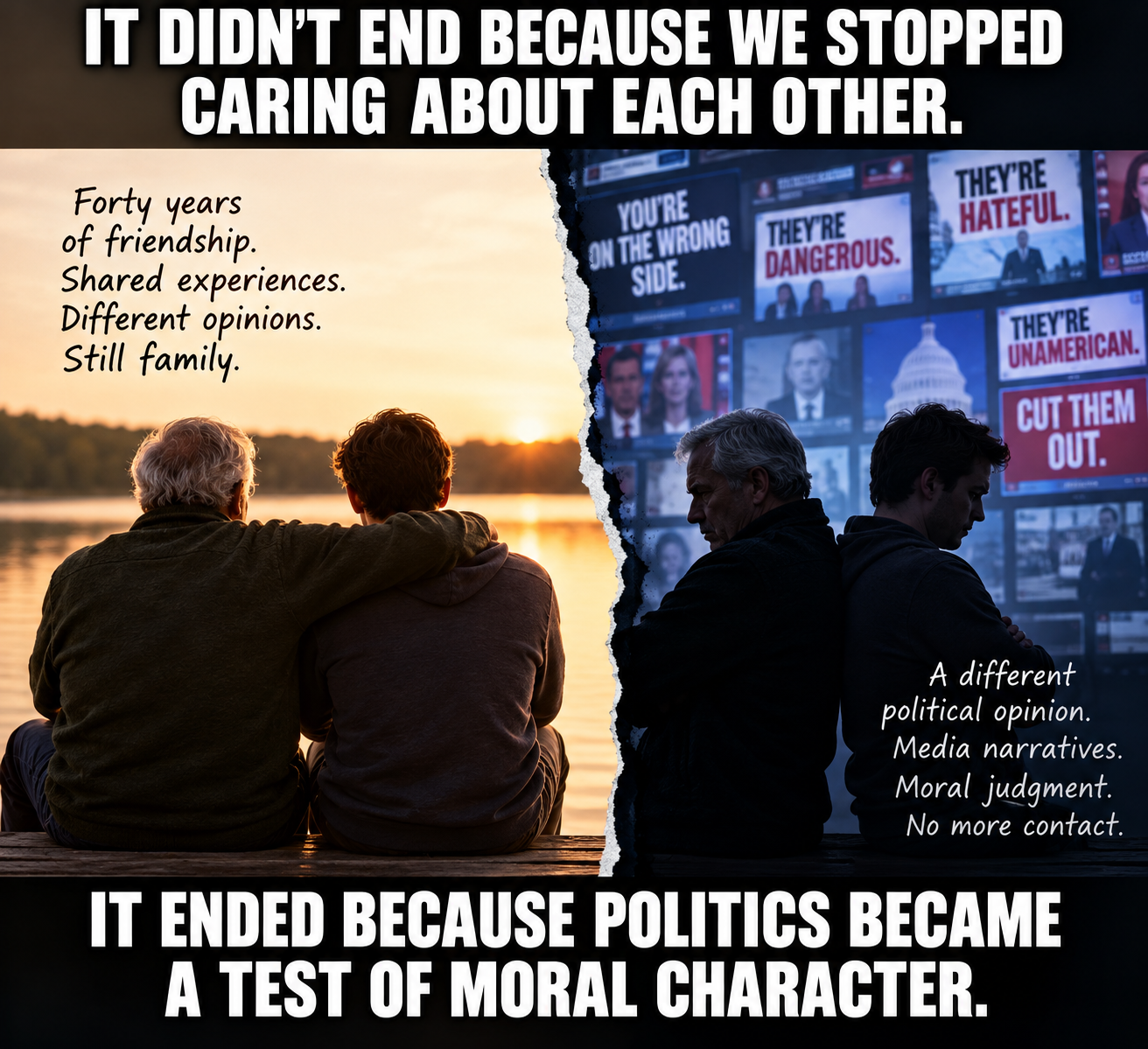
Research published in 2026, drawing on four American datasets involving 3,791 participants, included an April 2025 survey in which 37% reported losing a relationship over politics, including 15% reporting a family relationship breakup.
How does someone abandon a friend of forty years over a political disagreement? Because political affiliation has increasingly become a test of moral character. Once a person labels another racist, fascist, hateful, or dangerous, discussion may become unnecessary. The accusation replaces investigation, and rejection becomes an expression of moral superiority.
Five psychological forces help explain this:
Identity replaces judgment. Political disagreement becomes evidence of defective character.
Social approval rewards exclusion. Rejecting dissenters demonstrates loyalty to one's political tribe.
Cognitive dissonance discourages examination. Condemning a friend is easier than reconsidering a cherished belief.
Media stereotypes replace personal knowledge. Someone trusted for decades becomes associated with the worst caricatures of an opposing movement.
Avoidance replaces discussion. Ending a relationship requires less intellectual effort than listening, debating, or admitting uncertainty.
Some relationships end for legitimate reasons, including threats or abusive behavior. The troubling phenomenon is the abandonment of otherwise healthy relationships over ordinary political differences.
When someone trusts a political narrative more than forty years of personal experience with a friend, ideological loyalty has displaced independent judgment.
From Political Disagreement to Censorship
Government censorship and personal ostracism are different forms of control, but both can emerge from the belief that opposing opinions are inherently dangerous.
The progression is predictable:
An opinion is considered wrong. It becomes offensive. Its author becomes morally suspect. Listening becomes unacceptable. Eventually, exclusion or suppression appears justified.
Within families, this destroys relationships. Within universities and workplaces, it can punish dissent. Within government, it can encourage restrictions on lawful expression.
Three developments deserve particular scrutiny:
Government overreach: Public safety, extremism, misinformation, and social harmony can become elastic justifications for regulating political expression.
Outsourced censorship: Regulatory pressure and government cooperation with private platforms can suppress lawful speech without explicit legislative prohibitions.
Social intolerance: Citizens increasingly treat disagreement as moral contamination, making them less willing to defend the rights of political opponents.
Freedom House reported in 2025 that global internet freedom had declined for fifteen consecutive years. This does not establish that Western democracies are becoming totalitarian, but it documents substantial pressure on digital expression.
The danger is not merely government censorship. It is citizens becoming willing participants in suppressing one another.
The Real Threat: Intellectual Surrender
Three statements illustrate the psychological divide:
I believe you are wrong.
I believe your opinion is harmful.
I believe you should not be allowed to express your opinion.
These are fundamentally different judgments.
The first represents ordinary democratic disagreement. The second requires evidence. The third introduces coercion and demands exceptional justification.
When those distinctions disappear, people can sincerely believe they are defending tolerance while practicing intolerance.
The same psychological process can persuade someone that ending a decades-long friendship demonstrates moral courage rather than an unwillingness to tolerate disagreement.
Conclusion: When Conviction Becomes Intellectual Captivity
The greatest danger to Western democracy may not be an openly authoritarian government. It may be a population increasingly willing to surrender independent judgment, tolerate censorship, and punish dissent while believing it is defending freedom.
Political manipulation succeeds when people confuse repetition with truth, conformity with morality, and disagreement with personal evil.
Its most revealing consequence may be the destruction of lifelong relationships. A person who has known and trusted someone for decades suddenly allows political commentators, social media, or partisan narratives to redefine that person's character.
This vulnerability exists across the political spectrum, even when its manifestations and prevalence differ.
A democracy cannot sustain meaningful freedom when citizens refuse to tolerate disagreement within their own families, friendships, and communities.
The ultimate triumph of propaganda is not convincing people what to think. It is convincing them they are thinking independently while making them incapable of tolerating anyone who thinks differently.
And the ultimate failure of independent judgment is allowing political ideology to outweigh a lifetime of personal knowledge, experience, and human relationships.