
THE NEW AGE OF HACKING
From Stolen Passwords to the Sabotage of Modern Civilization
The reported cyberattack on French supermarket refrigeration systems illustrates a fundamental change in the nature of hacking. What began decades ago as computer trespassing, information theft, and financial fraud has evolved into something considerably more dangerous: the ability to disrupt, manipulate, or destroy the physical infrastructure on which modern society depends.
The real threat is no longer simply that someone can steal your credit card number. It is that someone thousands of miles away may be able to interfere with your electricity, water, food supply, transportation, medical care, or financial system without ever setting foot in your country.
And increasingly, attackers do not need the resources of a major government to cause serious damage.
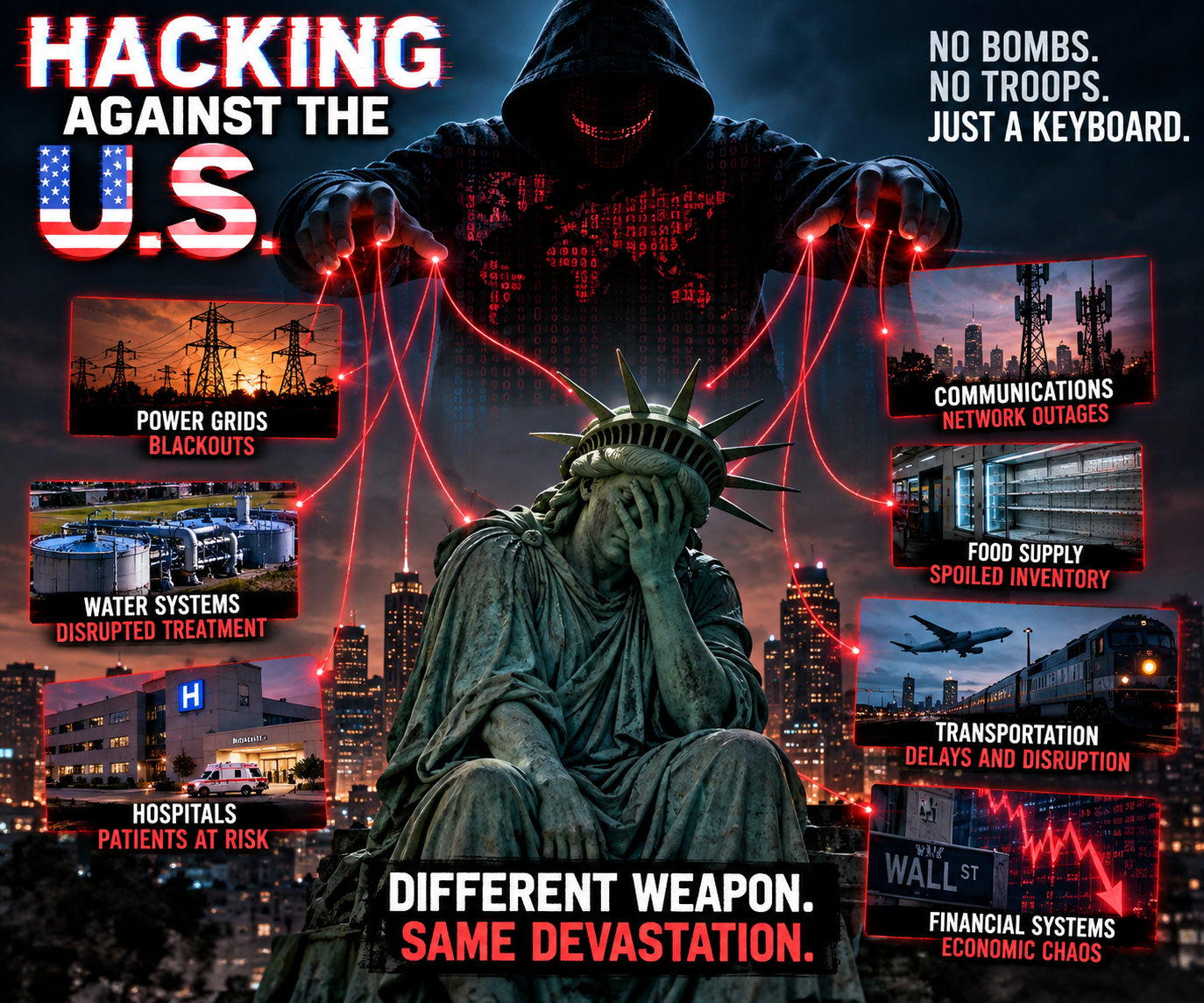
The broad spectrum of modern cyber threats
Banking and finance - Frozen accounts, stolen funds, interrupted payments - Economic disruption
Electrical grids - Blackouts, equipment damage - Infrastructure sabotage
Water utilities - Disrupted treatment, compromised operations - Public health
Hospitals - Disabled records, delayed surgery, disrupted equipment - Patient safety
Food and agriculture - Spoiled inventory, disrupted processing and distribution - Supply-chain damage
Transportation - Airport delays, logistics failures, railway disruptions - Economic paralysis
Telecommunications - Network outages, interrupted emergency communications - Loss of coordination
Government systems - Espionage, stolen records, disabled services - National security
Personal devices - Identity theft, fraud, extortion - Individual financial harm
Media and elections - Disinformation, impersonation, stolen communications - Erosion of public trust
Factories and industry - Production shutdowns, damaged equipment - Industrial sabotage
Military and defense - Intelligence theft, operational disruption - Strategic vulnerability
The crucial distinction is between stealing information, disrupting a service, and manipulating machinery in ways that can cause physical harm.
The French refrigeration example belongs to that last and particularly troubling category, assuming the reported technical details are confirmed.
Who is doing the hacking?
There are four major categories of attackers, and their motivations are very different.
Nation-state intelligence agencies: China, Russia, Iran, North Korea, and other governments maintain cyber capabilities for espionage, disruption, and strategic advantage.
Organized cybercriminals: Criminal enterprises operate ransomware networks, steal credentials, extort businesses, and sell access to compromised systems.
Ideological hackers and terrorist sympathizers: Their objectives may include publicity, political intimidation, disruption, or retaliation.
Insiders and contractors: Employees, vendors, and former personnel can exploit legitimate access, intentionally or accidentally.
A particularly dangerous development is the overlap between these groups. Governments can benefit from criminal networks or loosely affiliated hackers while maintaining some distance from their activities.
The French attack demonstrates the attribution problem. The damage is real, but as of October 15, 2026, the perpetrators have not been publicly identified.
The most dangerous development: hacking becomes physical
Critical infrastructure increasingly depends on connected industrial control systems.
Industrial control systems are different from ordinary business computers. They operate valves, pumps, motors, heating systems, cooling equipment, and manufacturing machinery.
A compromised office computer may expose confidential files. A compromised industrial controller can potentially change what a machine physically does.
The French refrigeration incident is an unusually clear example. Reuters reports that attackers manipulated cooling equipment at roughly 350 supermarkets, raising temperatures to 122°F and causing major losses. The financial consequences may be compounded because conventional cyber insurance often excludes physical damage.
There is also evidence that the danger is not hypothetical in the United States. In July 2026, CISA and the FBI warned that Iranian-affiliated actors were targeting internet-connected industrial controllers across American critical infrastructure.
AI changes the economics of cybercrime
Artificial intelligence introduces another dimension. It can reduce the cost and effort of certain attacks while increasing their scale and persuasiveness.
Deepfake impersonation - Convincing fraudulent voice and video calls
Phishing - Personalized fraudulent messages at enormous scale
Malware development - Faster adaptation of malicious software
Vulnerability discovery - More automated identification of weaknesses
Disinformation - Mass production of convincing false content
Automated intrusion - Faster reconnaissance and repetitive attack activity
AI does not automatically make every attacker technically sophisticated. However, it can make deception cheaper and some existing attack techniques more efficient.
The NSA and CISA have also warned about introducing AI into operational technology without adequate safeguards, because automated decisions can affect real-world safety.
What happens if several systems are attacked simultaneously?
The scenario that deserves the greatest attention is a coordinated cyberattack against a major metropolitan area, triggering a cascading breakdown of essential services. Imagine hackers disrupting electrical distribution, causing widespread power outages that cripple communications networks, interfere with water pumping and treatment facilities, and place enormous pressure on hospitals dependent on backup generators. Food distribution would suffer as refrigeration systems fail, warehouses lose power, and deliveries are interrupted. Businesses would close, emergency services would become overwhelmed, and public anxiety could escalate into widespread disorder. The economic consequences could be staggering, particularly if multiple systems were attacked simultaneously and recovery took days or weeks. Although hypothetical, this scenario illustrates how a relatively small number of coordinated cyberattacks could potentially paralyze a modern American city without a single bomb being dropped or a shot being fired.
No single cyberattack necessarily produces this sequence. Backup power, manual operations, independent networks, and emergency planning can interrupt the chain. Nevertheless, interdependence means an attack on one system can create consequences elsewhere.
How vulnerable is the United States?
My assessment is that America's greatest vulnerability is not a lack of sophisticated cybersecurity technology. It is the enormous number of older, interconnected systems that were never designed to withstand hostile internet access.
Three structural problems stand out.
First, fragmented responsibility. Electricity, water, transportation, food distribution, and healthcare are operated by thousands of different public and private organizations. Their resources and security standards vary enormously.
Second, aging technology. Many industrial systems remain in service for decades. Some cannot be updated easily without interrupting operations.
Third, dependence on outside vendors. A compromised supplier or service provider can potentially expose many customers simultaneously. The French attack shows how a weakness in shared technology can have consequences across multiple retail chains.
CISA's August 2026 vulnerability review emphasizes that many successful compromises still exploit known weaknesses and basic security failures rather than extraordinary technical breakthroughs.