
Talking out of Both Sides of Your Mouth
Segment #1056
Democratic-controlled states can enact many of the health care, tax, labor, environmental, and social programs they advocate nationally without waiting for Congress or the president. The Tenth Amendment reserves powers not delegated to the federal government to the states or the people. Health care regulation, insurance, public health, education, and much taxation fall substantially within state authority.
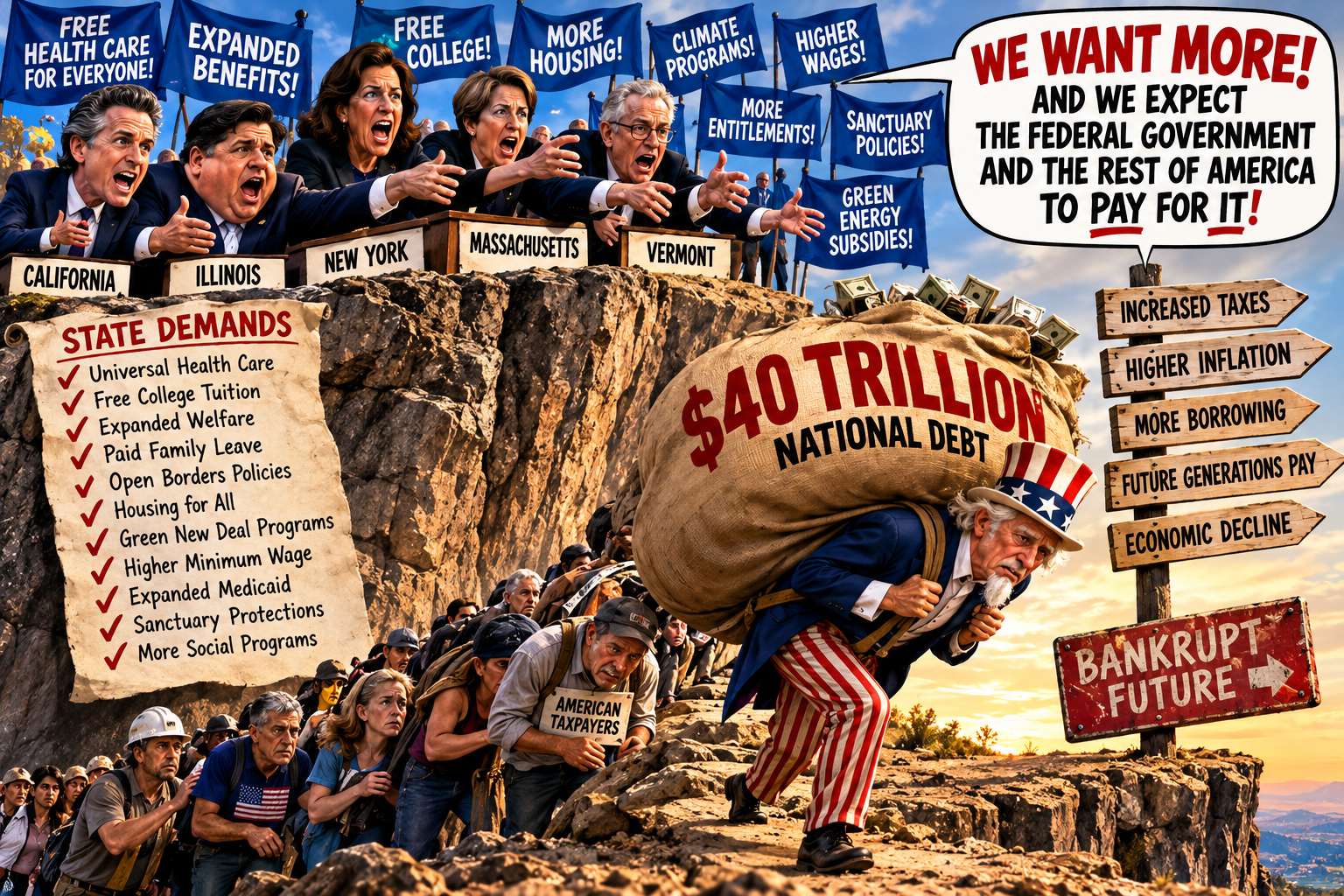
The important distinction is that states have considerable authority to create programs, but they generally must finance them themselves unless federal funding is available.
Why Don’t They Do It
Because it will fail and they will be thrown out of office
Universal health coverage - Yes, with limitations - Cost, federal waivers, ERISA
State single-payer health care - Partially; comprehensive versions face federal barriers - Medicare, Medicaid, employer plans
State-funded health coverage for undocumented immigrants - Yes - State funding
Higher minimum wage - Yes - Business and employment effects
Paid family and medical leave - Yes - Payroll taxes or other funding
Free public college tuition - Yes - State budget
Expanded abortion access - Generally yes - Federal and constitutional limits
Higher state income taxes on wealthy residents - Yes - State constitution and political suppor
State carbon taxes - Generally yes - Economic and legal constraints
Stricter environmental regulations - Often yes - Federal preemption
State-funded housing assistance - Yes - Cost and land-use rules
Several Democratic-led states have already implemented variations of these policies.
The most revealing example: State-run universal health care
A Democratic-controlled state such as California, New York, or Massachusetts could establish a publicly financed health insurance system for its residents.
However, it would encounter three major difficulties:
Financing: The state would need substantial tax revenue to replace premiums and other private financing.
Federal law: Medicare, Medicaid, and federally regulated employer health plans complicate the creation of a unified state system. Some changes require federal waivers or legislation.
Political acceptance: Residents and employers would have to accept the taxes, program rules, and possible changes to existing insurance arrangements.
The Affordable Care Act already permits states to request Section 1332 innovation waivers, although these must meet federal requirements for coverage, affordability, and deficit neutrality.
CMS
What has actually happened?
Vermont: Attempted to develop a single-payer system but abandoned its financing plan in 2014 because of projected costs and tax requirements.
California: Expanded state-funded Medi-Cal eligibility to undocumented adults but froze new enrollment for many of those adults beginning January 2026, reflecting budgetary pressures.
Medi-Cal
Paid family leave: Fourteen states and Washington, D.C., have enacted mandatory paid family leave systems, demonstrating that major social programs can be implemented at the state level.
Bipartisan Policy Center
The larger constitutional question
There is an important argument for federalism here:
Why should a state that wants an expansive government health care system necessarily require every other state to adopt the same arrangement?
Under the American federal system, California could pursue a more expansive state-financed health care model, while Texas could retain a more market-oriented model, within the limits of federal law.
That would allow comparisons of taxes, coverage, health outcomes, costs, and economic consequences.
However, states cannot invoke the Tenth Amendment to disregard valid federal law, and the federal government can sometimes attach lawful conditions to funding.
The central point is that Democratic-controlled states already possess substantial legal authority to pursue many of their national policy objectives. Whether they can finance those policies, secure necessary federal approvals, and maintain public support is a separate question.
This also raises a useful question for both parties: When a policy can be implemented at the state level, what justifies making it mandatory nationwide?
Economic Report Card
State Budget Deficits and Projected Shortfalls
California • Illinois • Vermont • New York • Massachusetts | As of October 11, 2026
All five states have enacted fiscal year 2027 budgets. However, a legally balanced budget does not necessarily mean the state has eliminated its underlying annual operating deficit. States can balance budgets by using reserves, prior-year surpluses, temporary taxes, or spending reductions.
California, Illinois, and New York have published substantial multiyear fiscal gaps. Vermont and Massachusetts face budget pressures, but their published forecasts do not provide equally comparable multiyear deficit figures.
California
FY 2027 operating deficit
$18.5B
Earlier structural forecast
~$35B/yr
The September 2026 Legislative Analyst's Office report identifies an $18.5 billion operating deficit in the enacted 2026–27 budget. Earlier LAO forecasts projected structural deficits of approximately $35 billion annually beginning in FY 2028. The enacted budget uses accumulated fund balances to help close its gap.
Legislative Analyst's Office
+1
California's governor reported that his revised budget eliminated the formal budget gap through July 2028, but that claim uses a different accounting measure from the LAO's annual operating deficit.
Governor of California
Illinois
The state's multiyear outlook shows a growing mismatch between revenues and expenditures without further policy changes.
Fiscal year
Projected shortfall
FY 2028
$3.8 billion
FY 2029
$4.5 billion
FY 2030
$4.8 billion
FY 2031
$5.3 billion
The forecasts reflect spending growth exceeding revenue growth, particularly in pensions, health care, and education. These are annual projected imbalances, not cumulative debt.
Civic Federation
New York
Cumulative projected gaps, FY 2028–2030
$31.8 billion
New York's July 2026 enacted-budget financial plan projects $31.8 billion in combined out-year budget gaps. The FY 2027 budget is balanced partly through the use of accumulated fund balances, including an anticipated $1.3 billion drawdown.
Office of the New York State Comptroller
The earlier January forecast showed individual gaps of $6 billion in FY 2028, $9 billion in FY 2029, and $12.5 billion in FY 2030. Those figures have since been superseded by the larger $31.8 billion cumulative forecast.
Office of the New York State Comptroller
Massachusetts
FY 2027 initial budget gap
Over $3.3B
The Massachusetts Taxpayers Foundation estimated an initial budget gap exceeding $3.3 billion for FY 2027. The governor's proposed budget relied on approximately $3.4 billion in spending adjustments and revenue measures to close it.
Massachusetts Taxpayers Foundation
Massachusetts subsequently enacted its FY 2027 budget. I did not find a sufficiently comparable official dollar forecast for FY 2028–2030 to present as established fact. The state continues to face pressure from health care expenditures, slower revenue growth, and the use of temporary budget-balancing measures.
Massachusetts Legislature
+1
Vermont
Vermont's enacted FY 2027 budget totals approximately $9.38 billion across all funds. Its General Fund budget uses current revenues, other funding sources, and prior-year carryforwards to achieve balance.
Nasbo
The clearest identified projected shortfalls are in its Transportation Fund:
Fiscal year
Transportation shortfall
FY 2027
$33 million
FY 2028
$35 million
These figures are Transportation Fund gaps, not statewide General Fund deficits. I could not establish a comparable multiyear statewide deficit series for Vermont from the available published figures.
Vermont League of Cities and Towns
Comparison of the five states
California - $18.5B operating deficit - Large recurring deficits; earlier LAO forecast approximately $35B annually
Illinois - Enacted budget projects small surplus - $3.8B FY28, rising to $5.3B FY31
New York - Balanced using available resources - $31.8B cumulative FY28–30
Massachusetts - Initial gap over $3.3B, addressed in budget process - No verified comparable multiyear series
Vermont - Enacted budget balanced - $33M FY27 and $35M FY28 Transportation Fund gaps
What this means for expanding state-funded health care
California and New York already face significant projected structural gaps. Illinois has substantial pension obligations alongside its forecast deficits. Massachusetts has had to find billions in budget adjustments. Vermont's statewide budget is comparatively small, making even a modest new program consequential.
None of this legally prevents a state from adopting universal health care. It does mean that a new state-financed health care system would require a credible funding plan, potentially including new taxes, replacement of existing insurance spending, federal waivers, or reductions elsewhere.