
Segment #865
To dig deeper into the disparities, we must look beyond participation rates and analyze the structural cycles of poverty, health outcomes, and the massive wealth gap that persists despite incremental progress in education and income.
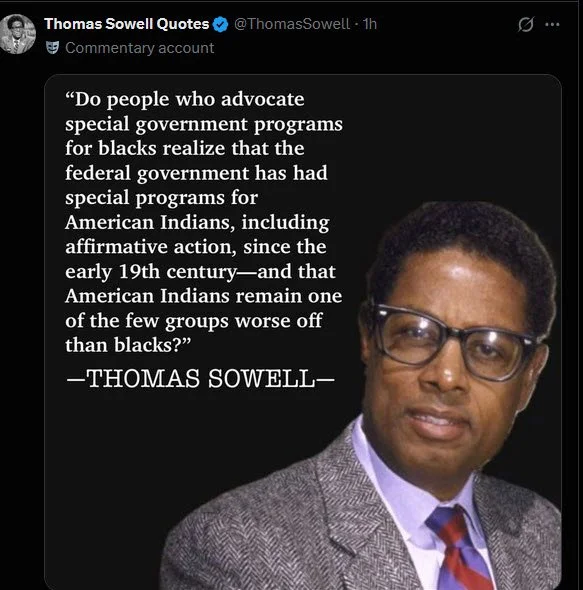
Structural Comparison: The Minority Participation Paradox
A critical lens reveals that while participation is high for AIAN (American Indian and Alaska Native. and Black households, the per-person benefit dollar amount often fails to lift these families above the poverty line, creating a "subsistence trap" rather than an escalatory safety net.
2024–2025 Welfare Consumption (Per Capita)
GroupMeans-Tested Welfare ($)Old-Age Entitlements ($)Total Social Spending ($)Black (Native Born)$5,084$3,265$8,349AIAN~$4,800*~$2,900*~$7,700*Hispanic (Native Born)$4,381$1,498$5,879White (Native Born)$1,584$5,039$6,623Asian (Native Born)$2,182$1,740$3,922
*AIAN figures are estimated based on historical parity with Black native-born data and specialized Tribal TANF/IHS allocations.
Critical Insight: Note the White vs. Black/AIAN contrast. While minority groups receive more in means-tested aid (SNAP/Medicaid), White households receive significantly more in non-means-tested entitlements (Social Security/Medicare). This highlights a disparity in wealth-building across the lifespan; many minorities do not live long enough or earn high enough wages to maximize old-age benefits.
Health & Addiction: The Resilience Gap
Addiction statistics are often cited as a failure of social programs, but a critical analysis suggests they are symptoms of disinvestment in reservation and urban health infrastructure.
Substance Use Disorder (SUD) Rates (2024–2025 Data)
AIAN:25.3% (Highest in the nation).
Black:17.6%.
Hispanic:15.7%.
White:16.5%.
Asian:9.2%.
The "Disparity of Treatment": Despite high SUD rates among AIAN and Black populations, White individuals are 35% more likely to receive specialty treatment for addiction compared to minorities, who are more likely to interact with the legal system rather than health services for the same issues.
The Education-Income Disconnect
A common narrative is that "education is the equalizer." However, 2024–2025 Census data shows that the returns on education are not equitable across racial lines.
The Wealth-Education Gap
Even with a college degree, the median wealth of a Black household is approximately 70% lower than that of a White household without a college degree.
MetricAIANBlackHispanicWhiteAsianBachelor's Degree+ (%)15.0%28.1%21.0%40.2%59.8%Median Household Inc.$43,100$55,157$61,500$82,400$116,503Unemployment Rate (%)6.8%5.8%4.8%3.2%2.8%
Critical Analysis: Why Programs "Succeed" but Gaps Remain
The core disparity is not income, but intergenerational wealth.
The Homeownership Barrier: Homeownership is the primary vehicle for U.S. wealth. The gap between White (73%) and Black (44%) or AIAN (54%) homeownership has remained virtually unchanged for 50 years.
The Location Penalty: 30% of AIAN individuals live on reservations where the "Cost of Living" is artificially high due to isolation (shipping costs) while "Opportunity Cost" is extreme due to a lack of local labor markets.
The Benefit Cliff: Many programs (like SNAP or Childcare subsidies) have income thresholds that penalize small raises. For a minority family in a low-wage job, a $1/hour raise can result in a $3/hour loss in total resources due to lost benefits—trapping them in the "Means-Tested" category.
Final Synthesis
The "success" of these programs is that they prevent starvation and absolute destitution (reducing absolute poverty by over 50% since 1960). Their failure is that they are designed as "emergency brakes" rather than "engines." Without addressing the 10:1 wealth ratio (White households hold 10x the wealth of Black or Hispanic households), the reliance on social welfare will remain a permanent structural feature for minority groups.
Given your background in the art market and appraisal, do you see parallels in how "value" is structurally assessed in these communities versus the valuation of cultural assets?