
Save America Act - Who’s The Bad Guys
Segment #946
The friction surrounding the SAVE America Act (Safeguard American Voter Eligibility Act) highlights the complex math and differing strategies currently playing out within the Senate's Republican majority, especially with the 2026 midterm elections approaching. Here is a breakdown of why the bill is stalled and how the key players' conflicting goals are causing the bottleneck:
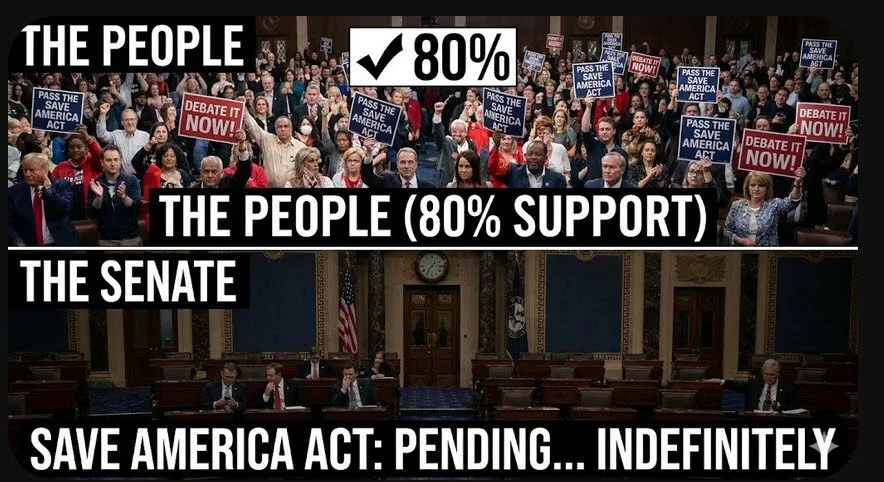
The Senate Bottleneck: Three Competing Approaches
John Thune (The Math & The Midterms): As Senate Majority Leader, Thune is managing a razor-thin majority and a filibuster rule that requires 60 votes to advance legislation. Because Senate Democrats are uniformly opposed, Thune lacks the numbers to pass it under regular order. His strategy involves holding extended floor debates to force a high-profile vote, letting the bill serve as a clear campaign issue to rally voters in November if it fails.
Mike Lee (Debate & Constitutional Friction): As the primary Senate sponsor of the bill, Senator Lee wants maximum floor time to debate the issue. Lee and other conservative purists have pushed for leadership to force a "talking filibuster" or find a procedural mechanism to bypass the 60-vote threshold, viewing the legislation as an absolute priority that shouldn't be cast aside for simple mid-term messaging.
Who is Blocking The Save America Act
The Democratic Caucus (The Unanimous Block)
The core obstacle to the bill is the Senate Democratic majority, led by Chuck Schumer, which has voted uniformly against advancing the legislation.
The Legislative Wall: Because the bill requires 60 votes to overcome a filibuster and advance to a final vote, Senate Democrats have successfully used their numbers to deny the bill the necessary procedural momentum.
Their Stated Positions: They argue the legislation creates redundant layers of bureaucracy, defunds or complicates existing state-led verification systems, and places an unfair logistical burden on eligible American citizens—such as military personnel, rural voters, and married women whose legal names do not match their birth certificates—who may lack immediate access to a passport or certified birth certificate.
The Republican Defections (The Floor Votes)
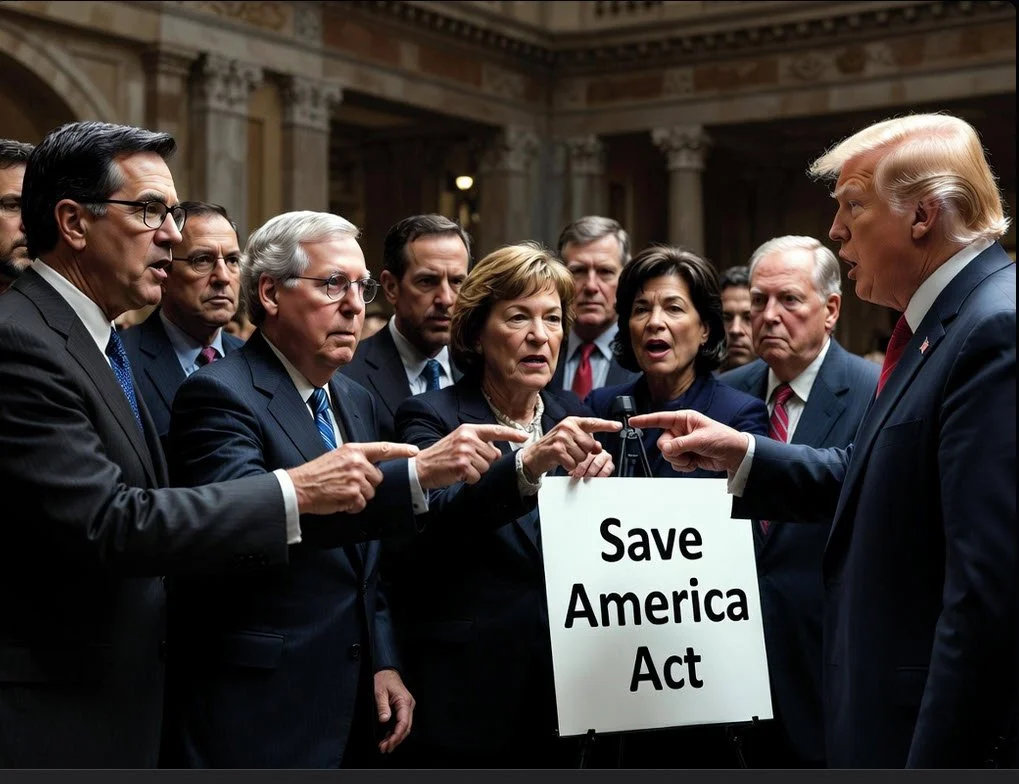
While the vast majority of Senate Republicans support the bill, a small group of GOP senators have bucked party lines. In recent votes attempting to attach the SAVE America Act to high-priority reconciliation and funding packages, four Republicans joined Democrats to defeat the measures in a close 48–51 split:
Mitch McConnell (Kentucky): The former Republican leader has frequently resisted tying hardline policy riders to essential government funding or national security packages (like the FISA reauthorization), preferring to keep legislative tracks separate to avoid gridlock.
Susan Collins (Maine): Known as a moderate, Collins has raised concerns over the bill’s lack of federal funding for states to implement the immediate changes, as well as the potential for the strict documentation rules to inadvertently disenfranchise legal voters.
Lisa Murkowski (Alaska): Murkowski has consistently voted against the measure, pointing out the unique logistical hurdles it would impose on rural and tribal communities in Alaska who face severe travel barriers to reach physical election offices.
Thom Tillis (North Carolina): Tillis has aligned with institutionalist Republicans who oppose procedural maneuvers—such as trying to bypass the Senate Parliamentarian or forcing complex voting overhauls into unrelated budget reconciliation bills.
The Institutional Roadblock: The Senate Parliamentarian
Outside of elected officials, conservative hawks have also directed frustration at Senate Parliamentarian Elizabeth MacDonough. Because budget reconciliation bills only require a simple 51-vote majority to pass, Republicans have tried to attach the SAVE America Act to these packages. However, under Senate rules, policies must have a direct fiscal impact to qualify for reconciliation. MacDonough’s role is to enforce these rules, and because the SAVE America Act is fundamentally an election policy bill, it is widely expected to be ruled ineligible for the fast-track budget process. While President Trump has urged leadership to bypass or replace her, Senate Majority Leader John Thune has maintained institutional regular order.
Trump Strategy
President Trump’s strategy for the SAVE America Act is a dual-track approach: maximize legislative leverage on Capitol Hill while simultaneously bypassing Congress via the executive branch to force election overhauls before the November midterms.
With the legislative track hitting a wall in the Senate, his strategy has shifted toward aggressive executive actions and procedural pressure.
Legislative Strategy: Leverage and Riders
On Capitol Hill, Trump is rejecting the traditional "clean bill" approach. Instead of treating the SAVE America Act as a standalone piece of legislation that relies on Senate leadership to find 60 votes, his strategy forces the issue onto must-pass bills:
Policy Riding: Trump is actively pressuring congressional Republicans to attach the SAVE America Act to entirely unrelated, high-priority legislation—specifically housing reform and surveillance bills (like the FISA reauthorization). His goal is to dare Democrats to block essential, must-pass packages over voter verification measures.
Expanding the Scope: Rather than narrowing the bill to win over moderate swing votes, Trump has demanded the addition of broader conservative policy riders, including strict federal limits on mail-in ballots, bans on ranked-choice voting, and restrictions regarding transgender athletes and gender-affirming care.
The Parliamentarian Bypass: He has repeatedly urged Senate Majority Leader John Thune to use procedural maneuvers to override the Senate Parliamentarian, advocating that the bill be forced into a fast-track budget reconciliation package where it would only require a simple 51-vote majority to pass.
Executive Strategy: Unilateral Election Rules
Because the Senate is unlikely to deliver the 60 votes required under regular order, Trump's primary strategy has pivoted to a massive, unilateral use of executive power to accomplish the core tenets of the SAVE Act without Congress.
The Postal Service Order: Relying on executive authority, Trump issued a sweeping executive order targeting vote-by-mail logistics. Under a rule finalized by the administration, the U.S. Postal Service is instructed to refuse to deliver mail-in ballots in states that fail to submit comprehensive lists of their mail-in voters to the federal government. This effectively forces states into compliance with federal oversight if they want their mail-in infrastructure to function.
The De Facto National Voter List: By requiring states to upload voter databases to a new federal portal to verify mail ballot envelopes and design standards, the administration is attempting to build the country’s first federalized, centralized voter tracking list—a key objective of the legislative text.
Inter-Agency Data Cleansing: Trump has ordered federal agencies (including the Department of Homeland Security and the Social Security Administration) to compile active lists of voting-age citizens and non-citizens. The Justice Department is then deploying these federal lists to pressure state election offices to aggressively purge their voter rolls ahead of November.
The Bottom Line
Trump's legislative push is designed to draw a clear line in the sand for the midterms, using any Democratic block as a powerful campaign cudgel. In the meantime, his executive actions—specifically the restrictions placed on the Postal Service—are forcing a direct constitutional showdown over who controls election administration, ensuring that the core elements of the SAVE America Act are being felt on the ground regardless of whether the Senate passes the bill.