
Tucker and Candace in a Career Death Spiral
Segment #987
The observation that Tucker Carlson and Candace Owens are spiraling together—or operating in a mutual ideological drift—captures a major fault line tearing through independent right-wing media. Rather than a traditional career decline caused by a loss of audience, what’s occurring is an escalating dynamic where both figures are alienating their traditional institutional allies, pulling each other further into an isolated echo chamber.
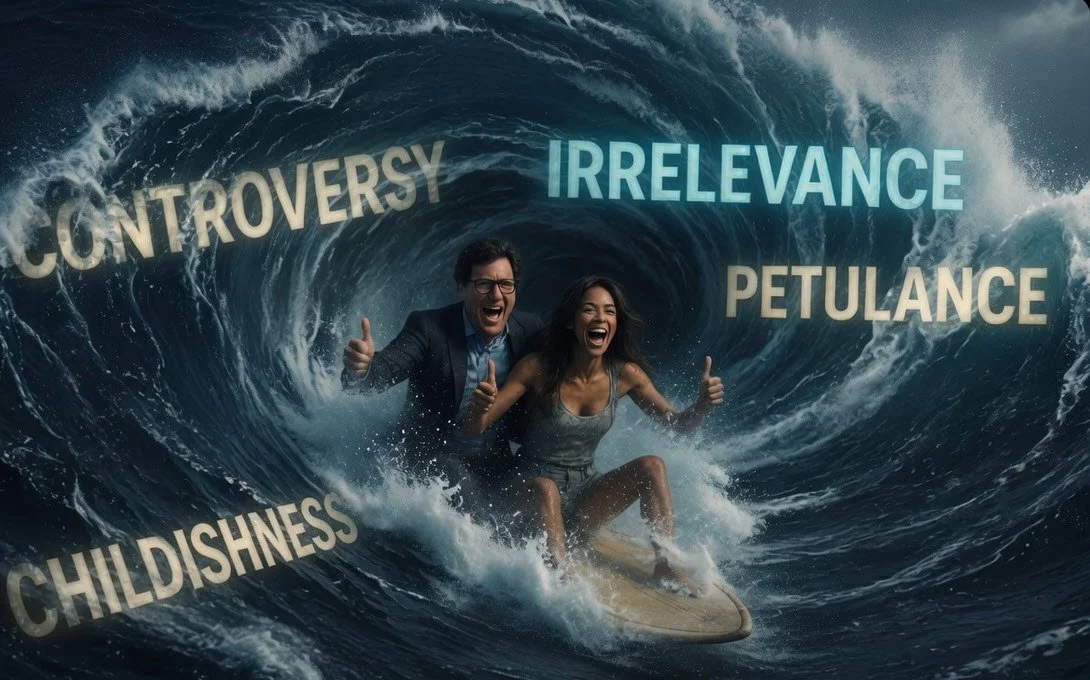
The Feedback Loop of Independent Media
When commentators leave legacy platforms or establishment outlets (like Carlson leaving Fox News or Owens leaving The Daily Wire), they lose executive guardrails, institutional legal oversight, and mainstream advertisers. To survive in the independent ecosystem, creators rely entirely on subscription models and direct-to-consumer algorithms.
This creates a self-reinforcing loop:
Algorithmic Escalation: To keep direct-funding audiences engaged without the massive baseline traffic of cable TV, content must become progressively more sensational, contrarian, and shocking.
Cross-Validation: By aligning closely, Carlson and Owens validate each other’s increasingly fringe narratives. When mainstream commentators or conservative peers push back, they retreat into joint appearances, framing external criticism as proof of a "coordinated attack" or "censorship" by elites.
Fracturing from the Republican & MAGA Mainstream
While both figures built their brands as core voices of the modern conservative movement, their recent trajectories have alienated significant portions of their original base:
Foreign Policy Splits: Both Carlson and Owens have taken hardline non-interventionist stances that frequently cross into hostility toward traditional American foreign alliances. Their sharp increase in anti-Israel rhetoric, open skepticism of US intelligence, and willingness to platform extreme anti-Western conspiracists have drawn fierce condemnation from mainstream Republicans, pro-Israel conservative groups, and figures like Ben Shapiro.
Rift with Trump and Establishment Figures: Carlson’s public criticism of Donald Trump's foreign policy actions and military stances marked a notable rupture with the core Republican political establishment. In response, Trump publicly attacked both Carlson and Owens as "losers" operating on bad information, signaling that the institutional center of the MAGA movement is actively distancing itself from them.
Tucker - What Are You.. 15 Years Old?

Stripping away standard partisan talking points from the Left, the trajectory of Tucker Carlson and Candace Owens is best understood through the lens of independent media incentives, conservative movement mechanics, and the breakdown of editorial guardrails.
The critique you are describing—that both figures have drifted into conspiratorial, personal, and counterproductive behavior—is actually shared by many prominent constitutional conservatives, right-leaning intellectuals, and former allies.
The Shift from Populism to Esoterica
Historically, both Carlson and Owens gained massive followings by championing relatable populist themes: skepticism of Washington foreign policy, frustration with corporate media, and defense of working-class families against cultural overreach.
However, conservative critics note that their recent output has shifted away from coherent populist policy and toward conspiratorial rabbit holes:
Candace Owens has increasingly ventured into historical revisionism, esoteric religious theories, and grand-cabal narratives (e.g., alleging occult involvement, secret historical lineages, or shadow control).
Tucker Carlson has frequently given uncritical, platform-expanding interviews to fringe influencers and controversial revisionists without applying basic journalistic rigor or challenge.
When political commentary swaps evidence-based debate for grand conspiracy theories, it stops offering real solutions and becomes pure entertainment driven by paranoia.
Personalization and "Petulance" in Rhetoric
A primary critique from within the Right is that both hosts have turned serious ideological debates into personal feuds.
Rather than engaging in principled arguments over foreign aid, national sovereignty, or free-market economics, their content often features:
Attacks on former allies: Mocking former colleagues, questioning their personal motives, or labeling anyone who disagrees a "traitor" or "shill."
Defensiveness: Responding to valid ideological pushback not with reasoned counterarguments, but with dismissive insults, grievance-building, or claims of being targeted by shadow forces.
This style undermines their own stated goals. It converts what could be a serious conservative debate over American foreign policy into a spectacle of digital infighting.