Power At Any Cost for America
Segment #1020
Both political parties often attempt to obscure their true agendas behind carefully crafted rhetoric and an endless stream of talking heads. Yet in our system, the bottom line is usually clear and self-evident. Voters frequently hear calls to "put politicians on the record" by forcing votes on legislation that may have significant consequences for ordinary Americans. Rather than focusing on political messaging, it is worth examining the voting record itself. The votes cast often reveal far more about a party's priorities and direction than campaign speeches or public statements ever will. Those who are concerned about where Democratic policies may lead the country should look closely at the legislative record and draw their own conclusions. During the Biden years you didn’t hear all this talk of fraud investigations because they were covering it up. Now that you have DOGE and a very active DOJ Democrat leaders are calling the Trump administration the most corrupt in history. The only way they will stop the investigations is to win the midterms and impeach Trump again to tie him up for his last two years
Voter Fraud
Election integrity/noncitizen voting — SAVE Act, H.R. 8281 (July 10, 2024). The bill required documentary proof of U.S. citizenship for federal voter registration. It passed the House 221–198; 193 Democrats voted against it and only five Democrats voted for it. From a conservative perspective, this is probably the cleanest vote for arguing that most congressional Democrats opposed an additional statutory safeguard against noncitizen registration.
Illegal immigration/criminal aliens
Laken Riley Act (2024). The House legislation required detention of certain unlawfully present aliens charged with theft-related offenses. 37 House Democrats joined Republicans, meaning most House Democrats opposed it. More significantly, when Republicans attempted to obtain Senate consideration in March 2024, every Senate Democrat voted against consideration. The politics changed dramatically after the 2024 election: in January 2025 the Senate ultimately passed the legislation 64–35, with 12 Democrats voting for final passage. That reversal itself could be an important part of a conservative argument.
Illegal immigration
Sanctuary cities — March 23, 2024. Senate Democrats unanimously voted to table an amendment that would have prohibited federal funding for sanctuary jurisdictions that refused to notify DHS before releasing illegal immigrants from custody. A conservative critique can therefore accurately say Senate Democrats blocked that particular attempt to financially penalize sanctuary jurisdictions.
Illegal Immigration
Physical border barriers — August 7, 2022. Every Senate Democrat opposed an amendment providing $500 million for construction of fences and barriers along the southern border. This is a particularly straightforward border-security vote.
Illegal Immigration
2025 Laken Riley Act. Even after the election, opposition remained substantial. On cloture, the Senate voted 61–35, with only ten Democrats supporting cloture; 35 senators opposed it. On final passage, however, Democratic support increased and the measure passed 64–35. A rigorous critique should acknowledge that change rather than characterize the entire party as opposing the law in 2025.
Fraud
H.R. 8464 — Stopping Fraudulent Payments Act. On June 10, 2026, it passed the House 218–200. Republicans voted 211–0 for it; Democrats voted 6–200. (Clerk of the House) The bill would allow agencies to pause, condition, or partially disburse a payment when there are documented indicators of elevated fraud risk, and Treasury could return suspicious payment requests using its existing Do Not Pay system. The safeguards matter: CBO says delays would generally be limited to 30 days, affected recipients would have to be notified, and there would be a formal contest process. (Congressional Budget Office) From a conservative perspective, that vote is difficult to dismiss as merely opposition to spending cuts. The legislation did not principally reduce benefit programs; it attempted to change the federal government's longstanding “pay first, chase the fraudster later” model into a preventive one. Conservatives therefore argue that a 200-to-6 Democratic rejection shows an institutional preference for minimizing barriers to payment even where fraud indicators exist. Republican proponents explicitly described the legislation that way. (House Republicans)
Fraud
H.R. 8312 — Fraud Prevention and Accountability Act. This passed 240–181, with 28 Democrats voting yes and 181 voting no; Republicans were 211–0 in favor. (Clerk of the House) The legislation would establish a permanent Treasury Inspector General for Fraud, Accountability, and Recovery, preserve and expand pandemic-era anti-fraud analytics, administer the Do Not Pay system, create broader governmentwide data-sharing capabilities, and help identify suspicious federal awards and payments. (Cloud) This vote may be even more interesting politically because the bill largely involved creating institutional anti-fraud infrastructure rather than restricting any single welfare benefit. The pandemic exposed how quickly enormous amounts of federal money could disappear when government distributed funds before establishing adequate verification systems. Conservative sponsors consequently argued that the analytical capabilities developed in response to COVID fraud should become permanent rather than disappear when the temporary Pandemic Response Accountability Committee winds down. (House Oversight Committee) A conservative critic can therefore ask a fairly pointed question: If the government already possesses data capable of identifying duplicate identities, fictitious recipients, suspicious payment patterns and known fraudulent entities, why would Congress oppose permanently coordinating those tools? The 181 Democratic “no” votes provide legitimate material for that criticism.
Education
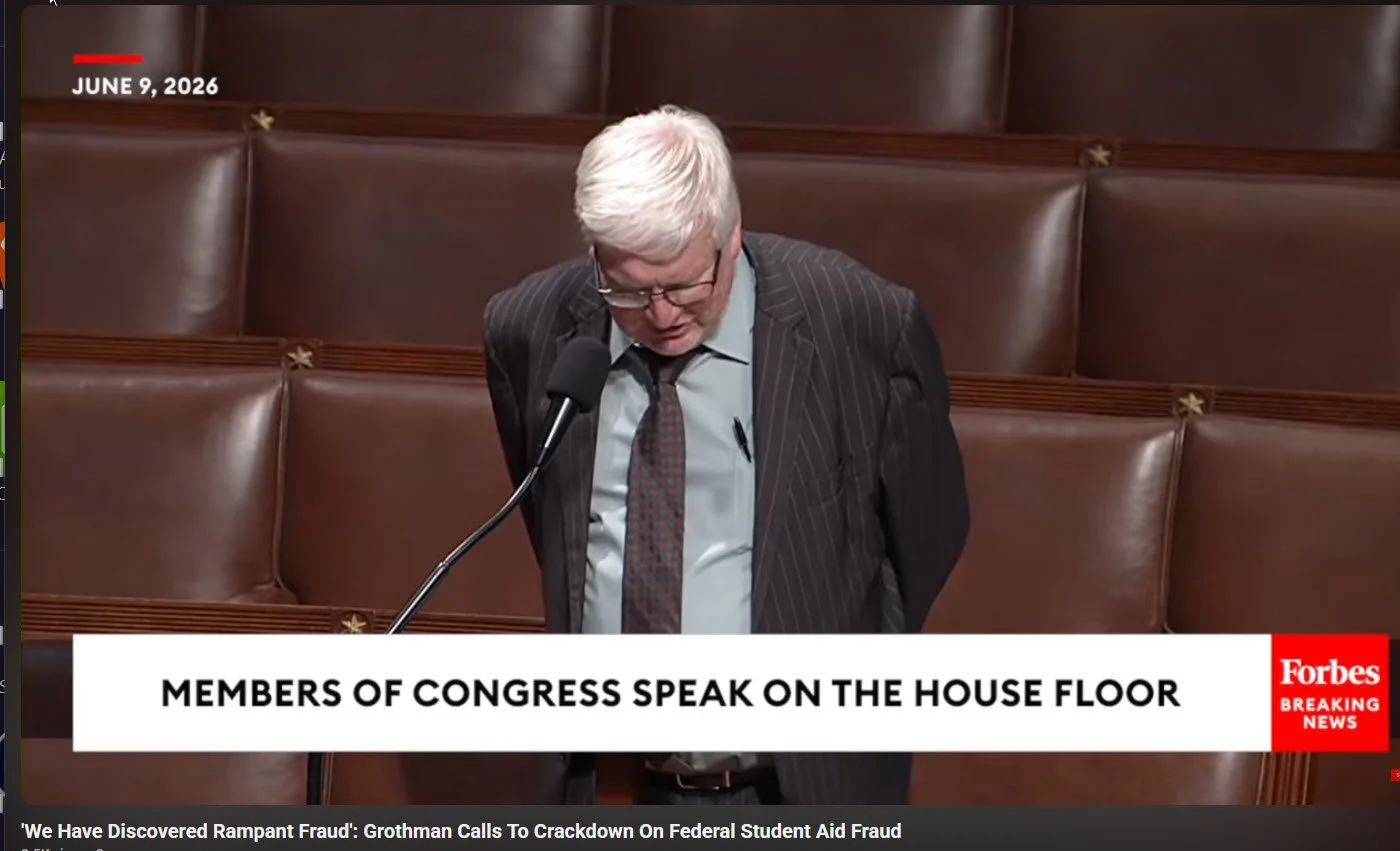
H.R. 7892 — No Aid for Ghost Students Act. Here the record is especially concrete. The House passed it 249–172 on June 10, with 36 Democrats voting yes and 172 voting no; every Republican voting supported it. (Clerk of the House) The bill requires the Department of Education to screen FAFSA applications for identity fraud. Where an application raises reasonable suspicion, the institution could not distribute federal financial aid until the applicant's identity had been verified, including through in-person or live-video procedures. (Cloud). The underlying problem is not hypothetical. The Education Department said that fraud rings had used fake or stolen identities to obtain federal student assistance and that enhanced screening under the administration had already blocked more than $1 billion in attempted fraudulent student-aid claims. That $1 billion figure is an administration claim, and should be identified as such rather than presented as an independently adjudicated loss. (U.S. Department of Education)
This vote exposes a recurring philosophical divide: verification before payment versus access first and enforcement afterward. If the applicant is genuine, proponents ask, why should confirming the applicant's identity before taxpayers send thousands of dollars be considered unreasonable?
Fraud
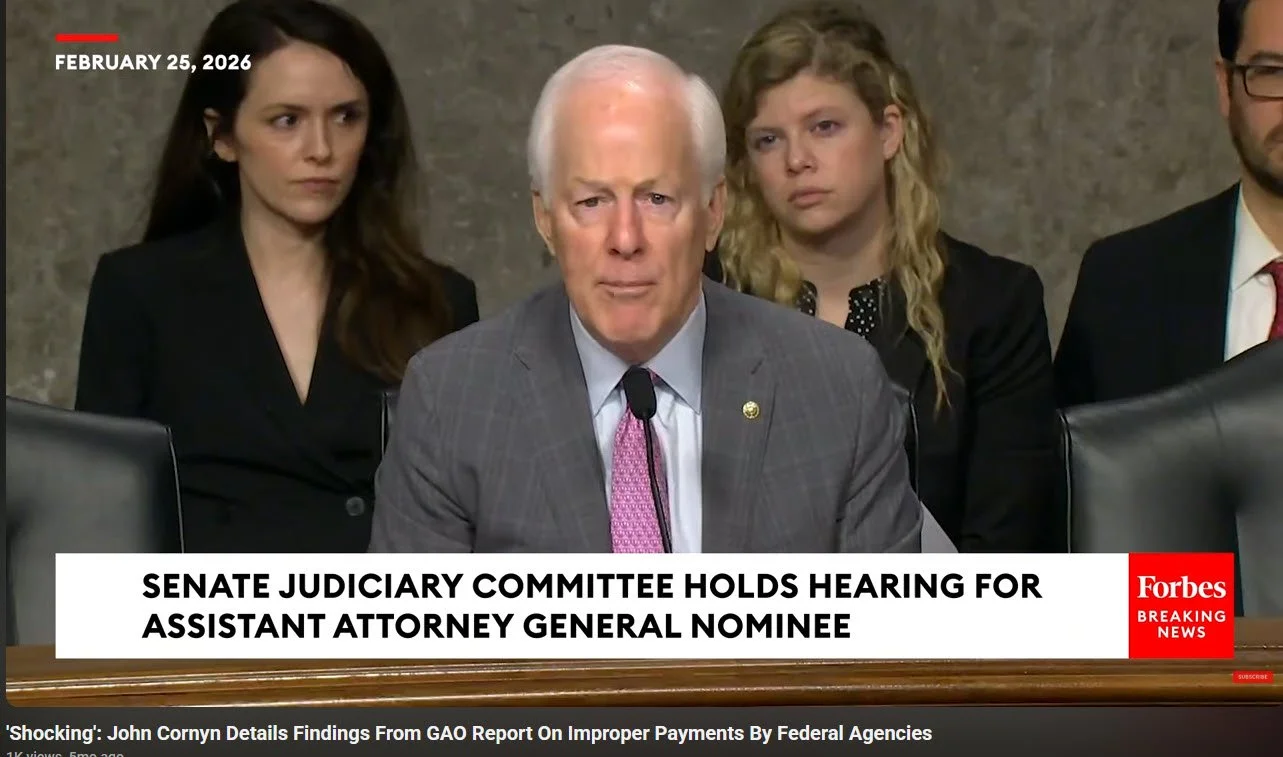
There is also H.R. 8872, the Preventing Waste, Fraud, and Abuse in TANF Act, which deserves attention because TANF is much closer to traditional welfare policy. CBO says the bill would require states to identify and reduce improper TANF payments, apply federal payment-integrity requirements, require HHS to develop an improper-payment reduction plan, restrict TANF assistance to families below 200% of the federal poverty level, limit accumulated reserves, and prevent federal TANF money from merely replacing state spending. (Congressional Budget Office) The Ways and Means Committee approved it 23–19 in May 2026. (House Document Repository) This is a case where the conservative argument must be more nuanced because some provisions go beyond fraud detection and alter substantive TANF policy. It therefore should not be characterized simply as an anti-fraud vote.
Democrats repeatedly resist Republican attempts to make eligibility verification, identity confirmation, pre-payment screening, interagency data matching and payment holds more stringent. The recurring conservative response is that those arguments have effectively created a government culture in which speed of payment is treated as more important than verification of eligibility.
That distinction matters because the strongest argument is about incentives and governing philosophy, not about proving corrupt intent. A factually supportable conservative formulation would be: The dispute is no longer whether fraud exists. Washington knows it exists, possesses increasingly sophisticated tools to detect it, and has documented enormous improper-payment losses. The political question is whether government should verify eligibility before taxpayer money leaves the Treasury. On several significant 2026 bills designed specifically to do that, overwhelming majorities of House Democrats voted no.