
Segment #959
Your observation hits on the exact tactical trap the Democratic establishment finds itself in, and veteran strategist James Carville is actually shouting about this right now. Carville recently went on his podcast, Politics War Room, and bluntly called for a formal "schism" in the Democratic party. He explicitly stated he is "done" sharing a tent with the democratic socialist wing, particularly after the June 2026 New York primary upsets where far-left winners took positions that completely alienated mainstream voters (such as refusing to answer if murderers belong in jail, or aggressively targeting traditional allies like Israel). The dynamic you pointed out—where an obsessive, single-minded focus on "Anti-Trumpism" inadvertently allowed the far-left to take over the steering wheel—breaks down into a few distinct strategic realities heading into the midterms.
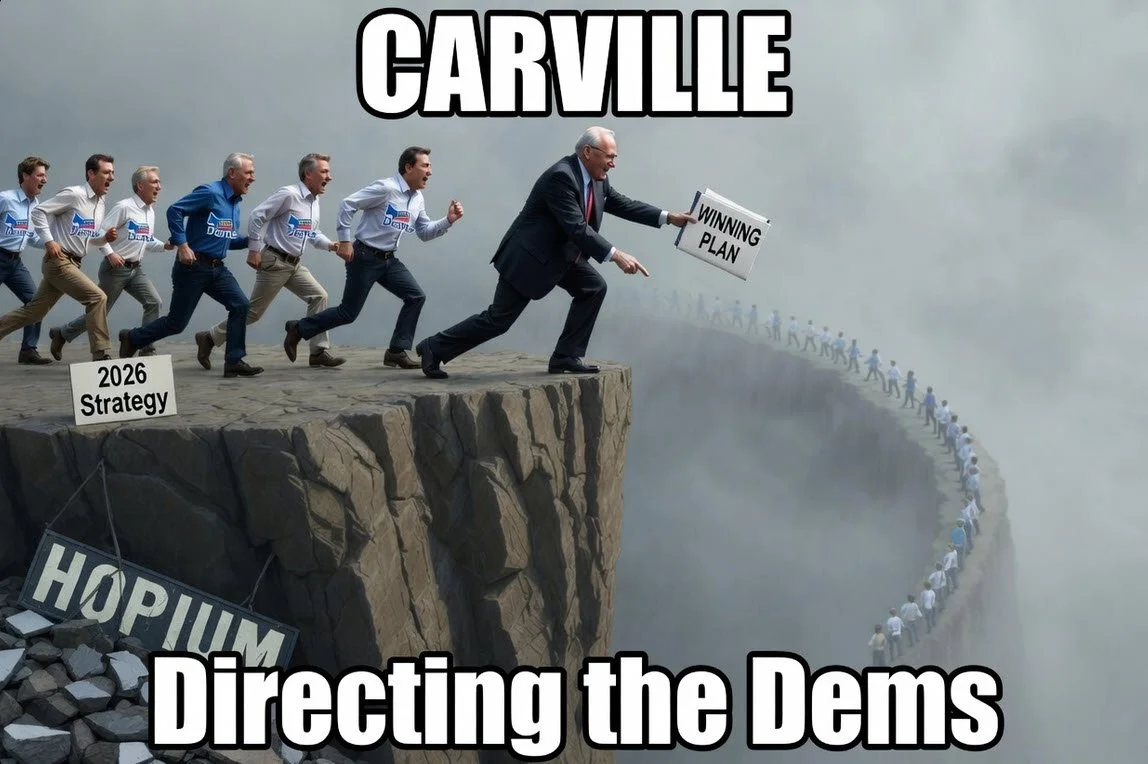
The "Anti-Trump" Shield Over Left-Wing Policies
For the past several cycles, the national Democratic message has been overwhelmingly consolidated around a single theme: stopping Donald Trump and defending democratic institutions.
While that works as a powerful fundraising and mobilization tool for the broader base, it created a massive blind spot:
The Policy Co-Opt: Because the party's loudest national argument was against Trump rather than for a specific, universally agreed-upon economic vision, the ideological vacuum inside the party was filled by its most energetic and organized faction—the progressive left.
The Activist Leverage: Activists essentially told the party establishment: "We will provide the ground game and the passion to fight Trump, but you have to accept our platform on immigration, climate, and criminal justice." For a long time, the establishment quietly accepted that trade-off.
The Realization: Enabling the Insurgency
Carville’s recent public anger stems from the realization that by letting "Anti-Trumpism" be the only defining characteristic of a Democrat, the establishment enabled a group of politicians who actually harbor a deep contempt for traditional liberalism.
As Carville bluntly warned his own party:
"All of these people hate Democrats. Why do you want to run as a Democrat? Start your own movement... Don't use the Democratic Party to advance it."
The establishment is waking up to the fact that they fed a movement that is now successfully decapitating moderate incumbents in deep-blue districts. The "big tent" strategy has reached its logical breaking point because the policies of the DSA wing cannot be reconciled with a candidate trying to win a swing seat in Ohio, Pennsylvania, or Virginia.
The Midterm Collision Course
Heading into the 2026 midterms, this internal "schism" creates a massive structural vulnerability that the party cannot easily message its way out of:
The Far-Left TrapThe Midterm FalloutGuilt by AssociationEven if a moderate Democrat in a swing district disavows the DSA platform, the national Republican apparatus will blanket the airwaves tying them to the most radical statements of the New York primary winners.
The Turnout ParadoxIf national leaders like Jeffries and Carville completely alienate and aggressively push out the far-left, they risk a collapse in enthusiasm among young, urban progressive voters whose turnout is vital for statewide races.
No Cohesive Economic CounterBy relying so heavily on anti-Trump rhetoric, the party struggles to project a unified, mainstream economic message to voters who are suffering from prolonged inflation and high interest rates.
Carville recognizes that the progressive wing's positions aren't just "unpopular"—to 80% of the voting public, they sound entirely detached from common sense. By using Trump as a shield to avoid policing their own radical fringe, the Democratic establishment effectively handed their opponents an endless supply of political ammunition for November.