
Nothing Left: Confessions of a Democratic Operative
Segment #1023
Evan Barker is interesting because Nothing Left: Confessions of a Democratic Operative is not primarily the story of a Republican criticizing Democrats. It is the account of someone who spent much of her adult life inside Democratic and progressive campaign politics, particularly fundraising, and eventually concluded that the movement she joined had fundamentally changed.
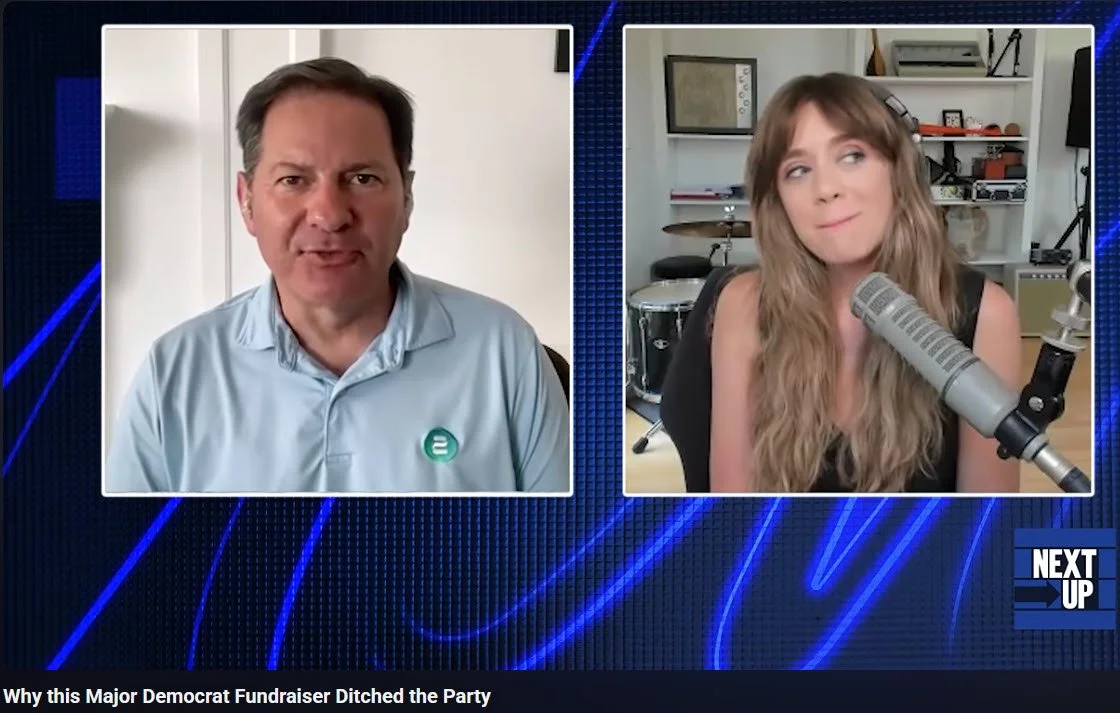
Former Democratic fundraiser Evan Barker spent years working alongside some of the biggest names in progressive politics. In this conversation with Lucy Biggers, she reveals what she witnessed behind the scenes—from campaign fundraising and donor influence to the ideological shifts that ultimately led her to walk away from the Democratic Party and write Nothing Left: Confessions of a Democratic Operative.
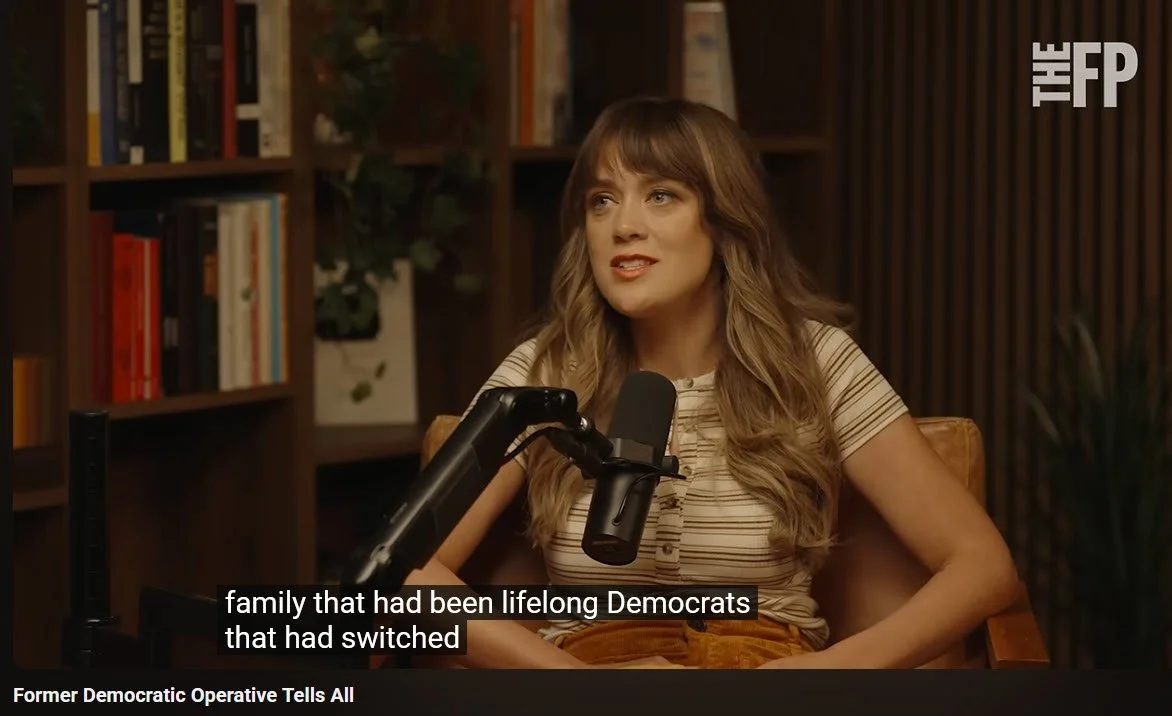
What Nothing Left argues:
Published by Threshold Editions/Simon & Schuster on July 28, 2026, the 288-page book is part memoir, part political critique. Barker says she raised tens of millions of dollars during her career and worked in the progressive fundraising ecosystem, including the Progressive Change Campaign Committee and later Left Rising. She describes working with or around campaigns involving figures such as Alexandria Ocasio-Cortez, Cori Bush and Jasmine Crockett. (Simon & Schuster)
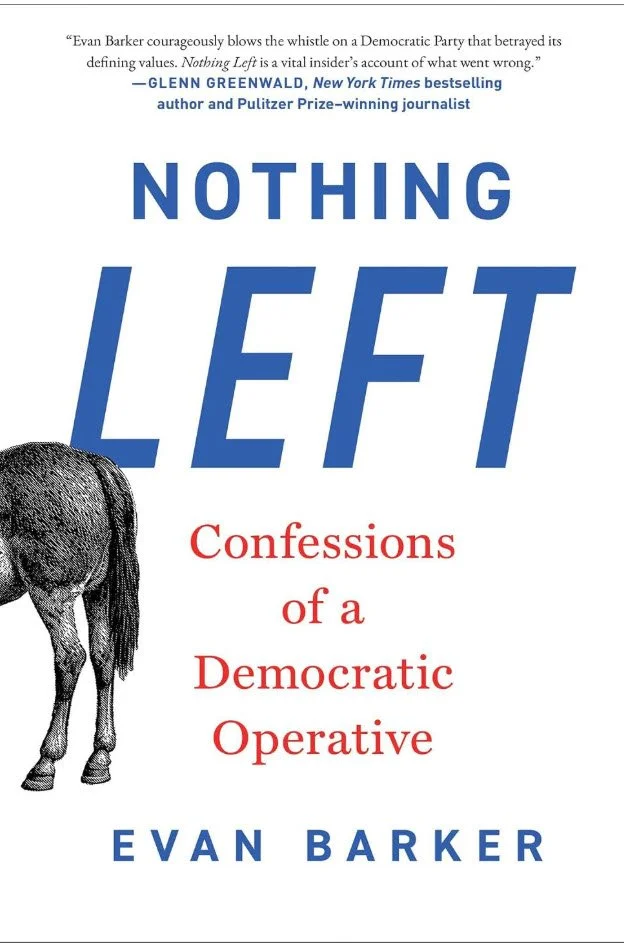
A gripping story of political idealism, disillusionment, and new hope, Nothing Left exposes how the Democratic Party was hijacked by out-of-touch activists, coastal elitists, and powerful special interests. Packed with insider revelations and razor-sharp commentary, Evan Barker takes readers deep inside the machine to show how the party that once championed the working class lost its soul.
Evan Barker had a bright future in Democratic politics. A prodigious fundraiser and relentless operator, Barker raised tens of millions of dollars for Democrat candidates. But in August 2024, standing on the floor of the Democratic National Convention, Barker hit her breaking point. In that moment, she saw what no one inside the party dared admit: the Democrats had lost their way, and there was no path back.
Born into a union family in the Kansas City heartland with a rare genetic lung disease, Barker lived and breathed Democrat. The Democratic Party, she believed, was built to help people like her. But as she rose through the ranks, she saw a movement obsessed with moral posturing and identity politics rather than with the struggles of ordinary Americans. And when she spoke up, she became a target herself.
Pulling back the curtain on the world of donors, strategists, politicians, and activists that runs the party, Nothing Left is a blistering, behind-the-scenes look at the party’s transformation from working-class champion to elite echo chamber. Candid, fearless, and impossible to put down, it’s essential reading for anyone who wants to understand how American politics really works.
####
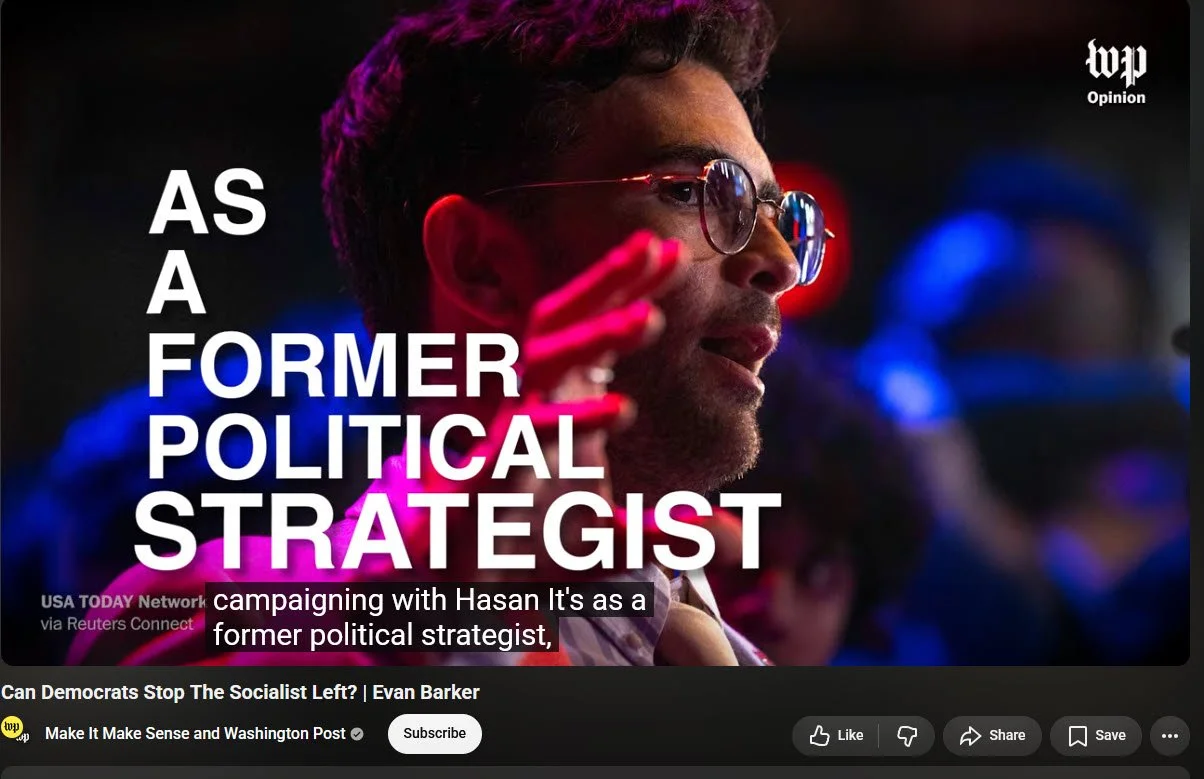
What sparked the rise of progressive candidates within the Democratic Party? In this episode of "Make It Make Sense," Kate Andrews talks with Evan Barker, author of "Nothing Left: Confessions of a Democratic Operative," about why the establishment hasn’t been able to stop DSA-aligned candidates, the controversial influence of figures like Hasan Piker and how "woke" culture issues haunt the party.
Her central argument is essentially that the Democratic Party she entered after Barack Obama's 2008 campaign was substantially different from the party she encountered by the early 2020s. She grew up in a union-oriented Midwestern Democratic family and initially saw Democrats as the political home of ordinary working people. She has a particularly powerful personal reason for that loyalty: Barker credits the Affordable Care Act with protecting her access to health insurance because of a pre-existing condition. (The Times)
But Barker says that as she moved deeper into progressive politics, three things increasingly bothered her.
First was money. Her description of political fundraising is probably one of the more revealing parts of the book because fundraising was actually her profession. Candidates can spend enormous amounts of time calling wealthy strangers and explicitly asking them for money. Barker says she became extremely good at this—reportedly helping raise roughly $50 million over her career—but concluded that the process gives donors far too much influence over politicians and their priorities. (The Times)
Second was the growing emphasis on identity politics. Barker argues that progressive organizations increasingly interpreted ordinary political questions through race, gender and identity. She particularly criticizes what she calls the Race Class Narrative, arguing that it encouraged campaigns to frame policy through racial identity even when economic or class-based appeals might have been more effective. She recounts donors explicitly prioritizing candidates according to race and gender and describes workplaces in which she felt racial identity increasingly determined who possessed legitimacy. These are Barker's allegations and interpretations, rather than independently established facts about the Democratic Party as a whole, an important distinction when reading the book. (The Times)
Third—and probably the book's most important political argument—is the abandonment of working-class voters. Barker describes a 2022 event at billionaire Tom Steyer's home at which progressive organizer Cristina Tzintzún Ramirez argued that voters who had moved to Donald Trump weren't coming back and that the political future lay with young voters of color. Barker saw the scene—wealthy San Franciscans discussing how Democrats no longer needed traditional working-class voters—as almost a caricature of what had gone wrong. (New York Post)
Her conclusion is provocative: Democrats believed demographic change could substitute for maintaining a broad working-class coalition. Barker thinks that calculation failed because Hispanic and other minority working-class voters don't necessarily behave politically according to racial categories; they can share the same economic and cultural concerns as white working-class voters.
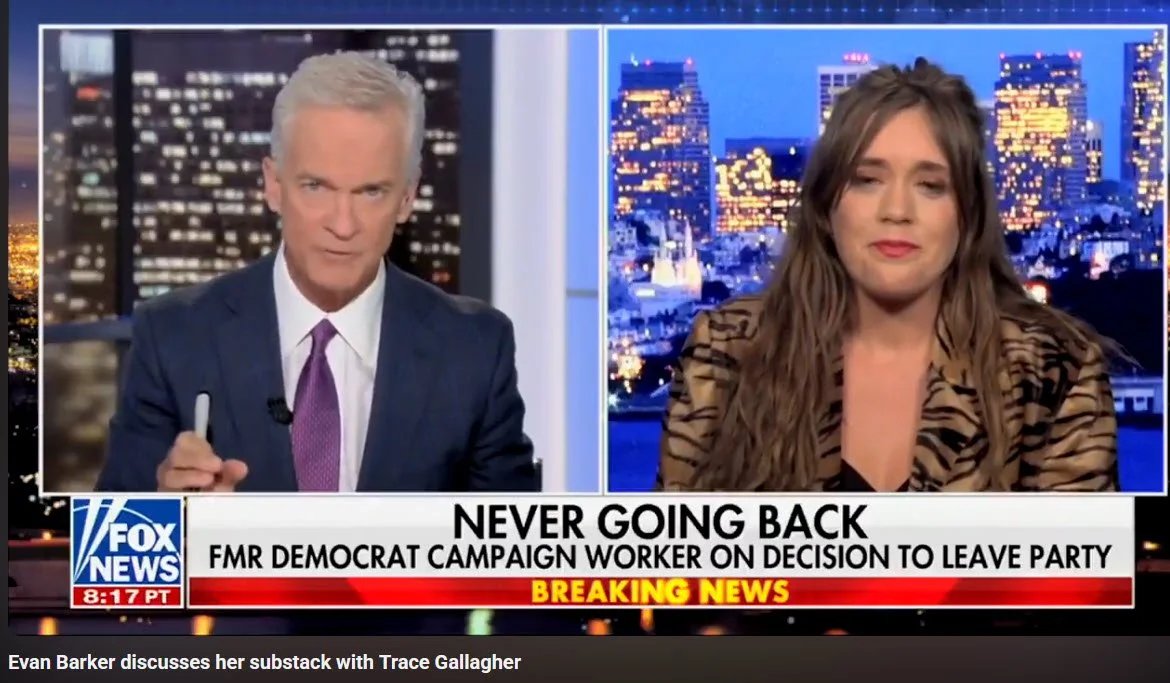
The break with Democrats
Her decisive public break occurred around the 2024 Democratic National Convention in Chicago. Barker says she went hoping that attending the convention would reconnect her with the party. Instead, she left feeling even more alienated.
She subsequently posted a TikTok saying she could not vote for Kamala Harris. Barker says she had only about 60 followers at the time; the video ultimately received millions of views. She later disclosed that she had voted for Donald Trump in 2024. (Evan Barker)
That distinction matters. Barker isn't simply saying, "Democrats have problems." She actually crossed the partisan divide electorally after having spent years raising money for progressive Democrats.
What she's doing now
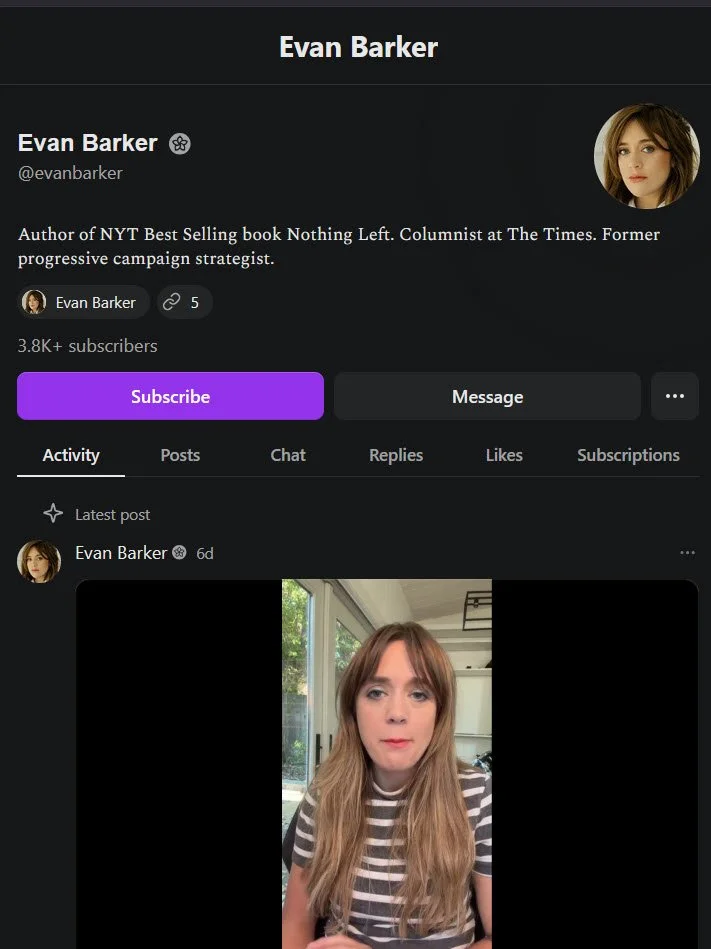
Barker appears to have transformed herself from political operative into writer/media personality. Simon & Schuster describes her today as a former Democratic campaign operative and strategist who is now a columnist, Substack writer and podcast host living in Northern California. (Simon & Schuster)
She publishes her own Substack, where she writes about Democratic politics, populism, class, identity politics and her experiences inside progressive organizations. Evan Barker's Substack
She's also been making the media circuit surrounding the book. For example, she appeared on Red Scare on August 3 to discuss Nothing Left and her political transformation. (Podscripts)
And the book has done quite well. Barker reported on August 7 that Nothing Left entered the New York Times hardcover nonfiction bestseller list in its first week, giving her a considerably larger platform than she had as a campaign fundraiser. (Evan Barker)
Simon & Schuster — Nothing Left
Why I think the book is worth paying attention to
The most consequential part of Barker's story isn't that another former Democrat voted for Trump. There are plenty of those stories.
It's that she understands the mechanics of political fundraising from inside the room.
Her argument connects two developments that are frequently discussed separately: Democrats' declining strength among portions of the working class and the enormous importance of wealthy donors, professional activists, consultants and nonprofit organizations in determining what Democratic politicians talk about.
In Barker's telling, there is a feedback loop:
wealthy donors → professional progressive organizations → campaign consultants → candidates → messaging increasingly detached from ordinary voters.
That is a much more interesting thesis than "Democrats became too liberal." Her contention is that the institutional incentives themselves changed the party.
There is also an important caveat. Nothing Left is a political memoir and polemic, not a neutral academic investigation. Some of Barker's strongest claims are based on conversations and incidents she personally witnessed. Those experiences are valuable precisely because she was inside that world, but they shouldn't automatically be treated as representative of the entire Democratic Party.
Still, her biography makes the criticism harder to dismiss. She didn't merely observe progressive politics from outside. She helped finance it.
And that makes the subtitle—Confessions of a Democratic Operative—arguably more important than the title Nothing Left. Her story is essentially: I helped build this political machine, watched how it worked from inside, and eventually decided I could no longer support what it had become. (Evan Barker)
I can also dig into who Barker actually raised that reported $50 million for—candidate by candidate and organization by organization—and identify the major Democratic donors and progressive organizations she discusses in the book. That would be a useful way to test how significant an insider she really was.
What’s She Doing Now
Yes. Evan Barker has moved from political fundraising into writing, podcasting, and political commentary, and she appears to be trying to build an independent media career around the themes in Nothing Left.
Her own podcast is The Evan Barker Podcast, previously/also described as “Not Going Back.” Apple currently lists the show as active from 2024–2026 with nine episodes, and Barker describes herself as a “writer, podcaster, and former progressive strategist turned independent.”
She is also writing regularly on Substack, where she discusses Democratic politics, the working class, political culture, and her departure from the progressive movement. Evan Barker’s Substack
More significantly, since Nothing Left came out in July, she has been doing a fairly extensive podcast/media tour. Recent appearances include The Free Press Interviews on August 4, Red Scare on August 3, Bridget Phetasy's Walk-Ins Welcome on July 30, Ryan Girdusky's It's a Numbers Game on July 29, and Meghan Daum's The Unspeakable Podcast in August.
And she hasn't disappeared after the initial book publicity. Just four days ago, August 28, she appeared on the Washington Post's Make It Make Sense discussing what she believes Democrats need to change and the continuing struggle between establishment and progressive factions.
So I think your instinct is right: Barker is positioning herself as more than a one-book author. The emerging role looks like independent political commentator/podcaster occupying an interesting niche: a former progressive insider who remains economically populist, is culturally more moderate, voted for Trump in 2024, but does not identify herself simply as a Republican.