
Looking at a Very Perverse Alex Cooper
Segment #1058
Alex Cooper, Call Her Daddy, and the Democratic Party's Endorsement of a Sexual Culture
The larger issue is not Cornell. It is the normalization of a particular set of values.
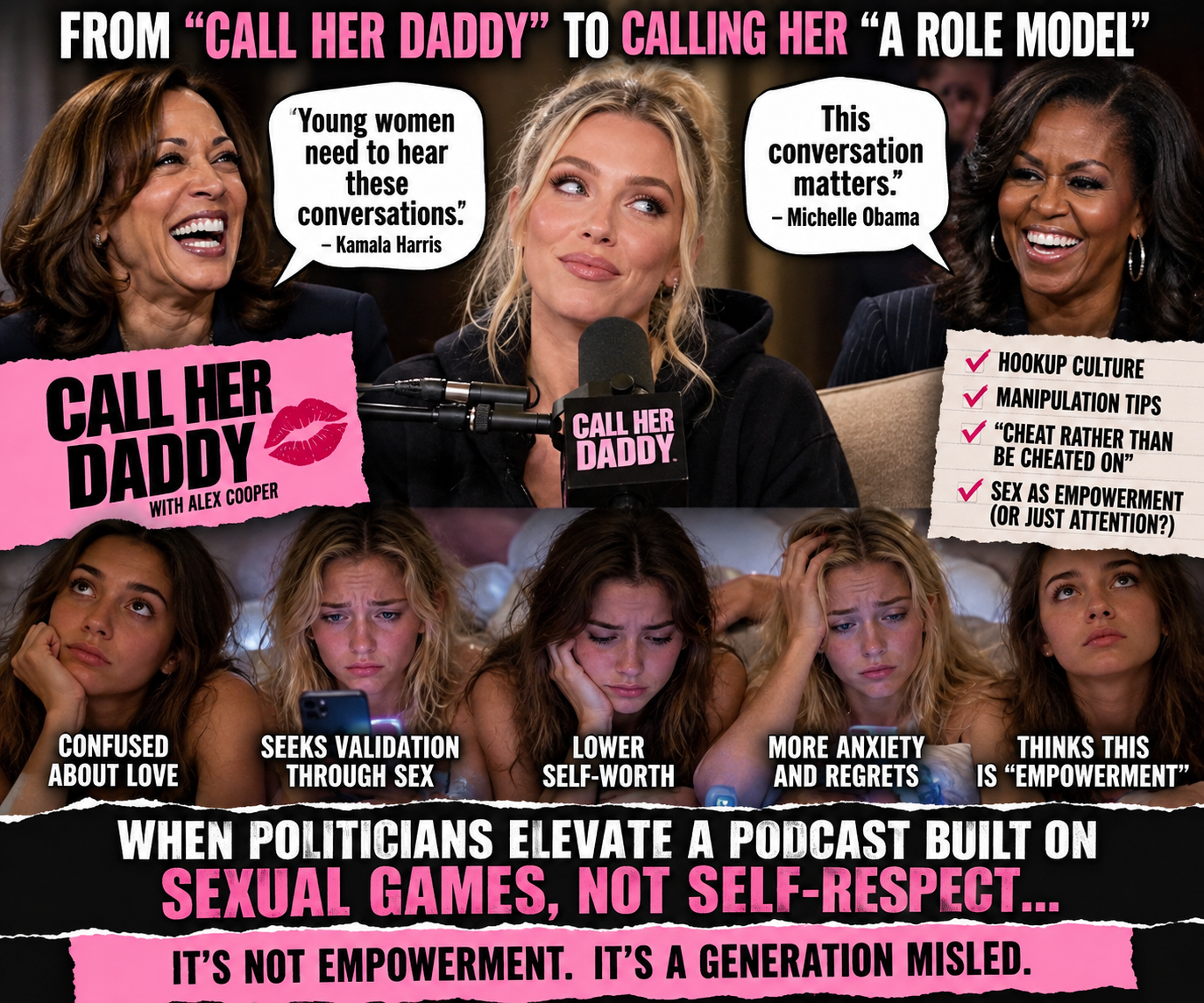
The more consequential question surrounding Alex Cooper and her podcast, Call Her Daddy, is why prominent Democratic political figures have chosen to associate themselves with an entertainment brand built originally around explicit sexual discussion, hookup culture, and deliberately provocative attitudes toward relationships.
The appearances of Kamala Harris and Michelle Obama raise a legitimate question about the relationship between political influence, celebrity culture, and the messages being delivered to young women.
The central issue deserves examination without assuming that popularity equals wisdom, sexual frankness equals empowerment, or a commercially successful entertainer is necessarily a responsible source of guidance.
Three questions deserve particular scrutiny: What values has Cooper promoted? What does the evidence show about their effects on young women? And what message do political leaders send when they give her platform their credibility?
1. What Cooper actually built
Cooper launched Call Her Daddy in 2018 with Sofia Franklyn. Its early identity was not serious journalism, clinical sex education, or thoughtful relationship counseling. It was provocative entertainment marketed through sexual candor and outrageous advice.
A June 2026 Vanity Fair investigation revisited the show's early encouragement of sexual gamesmanship, including advice to cheat rather than be cheated on.
Vanity Fair
That history matters because the show's audience included teenage girls and college students, not simply mature adults capable of recognizing every outrageous statement as entertainment.
There are several legitimate criticisms of that original model.
Sex as a competitive game. Treating relationships as exercises in manipulation or conquest can undermine honesty, trust, and respect.
Confusing attention with self-worth. A woman who is constantly encouraged to seek validation through sexual attractiveness may become more dependent on other people's approval, not less.
Commercializing intimacy. The more provocative the confession, the more engagement it can generate. That creates an incentive to reward sensationalism rather than sound judgment.
Weak standards for advice. A successful entertainer is not automatically qualified to provide psychological, medical, or relationship guidance.
The criticism is particularly compelling when advice is framed as empowerment even though its practical effect may be to encourage insecurity, manipulation, or dependence on sexual attention.
A 2021 Time profile identified precisely this tension: Cooper promoted female confidence while sometimes recommending tactics designed to provoke jealousy or attract male approval.
TIME
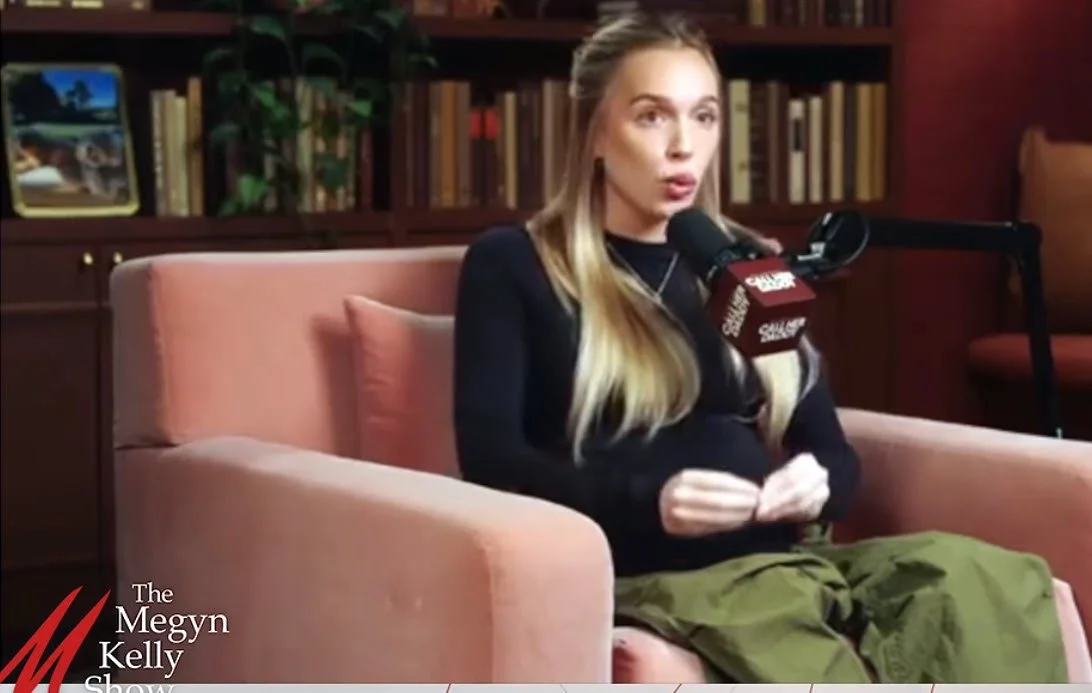
Megyn Kelly discusses Alex Cooper’s past comments on "Call Her Daddy" celebrating similar s*xual situations to the Jane Doe Cornell incident, her disgusting comments about threesomes and other types of deviant behavior, Cooper's hypocrisy in refusing to address how she led young women astray, and more.
The show has evolved, and not every contemporary episode repeats its original approach. Nevertheless, that history is inseparable from the brand that made Cooper famous.
2. Kamala Harris: From sexual entertainment to presidential politics
October 6, 2024
Harris appeared on Call Her Daddy during her presidential campaign, discussing abortion, women's rights, and personal experiences.
Her campaign deliberately sought access to Cooper's substantial audience of younger women.
The Washington Post
+1
The significance is not simply that Harris appeared on a popular podcast. Presidential candidates regularly appear on entertainment programs.
It is that a presidential campaign selected a personality whose commercial success originated in explicitly sexual content and used that platform for a serious political message.
This creates a problem of credibility and implied approval.
Harris did not explicitly endorse every episode or every piece of advice Cooper had offered. Cooper also stated that she had invited Donald Trump, so the appearance alone does not establish exclusive political allegiance.
But the interview unquestionably elevated Cooper's status as someone important enough to conduct a presidential conversation.
The legitimate criticism is that a politician can borrow an entertainer's audience while simultaneously lending that entertainer political prestige.
That exchange deserves examination even when no explicit endorsement is made.
3. Michelle Obama: A second and arguably more consequential validation
January 21, 2026
Michelle Obama appeared in an almost two-hour Call Her Daddy episode discussing misogyny, women's confidence, objectification, and her book The Look.
Apple Podcasts
Obama's appearance adds a different dimension. She is not simply a political campaigner seeking votes. She is a former first lady associated with education, youth development, and public service.
Her decision to appear with Cooper could reasonably be interpreted by audiences as a signal that Cooper's platform is a respectable venue for serious discussions about women.
The tension is striking: Cooper's original commercial identity included advice emphasizing sexual competition and attracting male attention, while Obama used the platform to discuss resisting objectification and developing self-confidence.
That is an important contradiction in the platform's history, although it is not proof that Obama agreed with its earlier messages.
Indeed, Obama's actual interview included advice about education, friendship, self-respect, and developing professional skills. Those statements should be distinguished from the podcast's earlier content.
PodScripts
The question for Obama is therefore more precise: Why choose to confer additional cultural prestige on this particular entertainment brand, given its documented history of questionable relationship advice?
4. The financial incentive behind the message
2021 Spotify agreement
$60M
2024 SiriusXM agreement
$125M
Reported contract values, not Cooper's personal net earnings.
The Guardian
These figures reveal an important economic reality: provocative sexual entertainment became an extraordinarily valuable commercial property.
That creates a broader question about the incentive structure of influencer culture.
When controversy, intimacy, and outrageous statements generate attention, platforms have commercial reasons to encourage them. Responsible advice, moderation, and nuance are not necessarily rewarded in the same way.
The concern is not that Cooper made money. It is that a commercial entertainment enterprise can gradually acquire the authority of a trusted adviser without having to satisfy the standards expected of professional educators, clinicians, or journalists.
5. Is Call Her Daddy actually harmful to young women?
This is where the criticism must be precise.
There is a credible argument that some of Cooper's early advice promoted dishonesty, emotional manipulation, and an unhealthy preoccupation with sexual validation.
There is also an important distinction between identifying objectionable messages and proving their effects.
No evidence reviewed here establishes that listening to Call Her Daddy causes young women to engage in riskier sexual behavior, experience more depression, or develop worse relationships. Those would require independent research comparing listeners and nonlisteners while accounting for other influences.
Likewise, allegations that Cooper constantly disseminates factual misinformation require specific statements and evidence demonstrating that they are false.
What can be documented is a recurring contradiction between the language of empowerment and some of the behaviors the program has promoted.
A woman does not become more independent merely because she is encouraged to behave as irresponsibly as the worst men. Nor is manipulation transformed into healthy relationship advice because it is presented as sexually liberated.
That is a substantive criticism of the message, regardless of the political identity of its audience.
6. Why Democratic association deserves particular scrutiny
The appearances by Harris and Obama demonstrate that prominent Democrats regard Cooper's audience as worth engaging.
They do not establish that the Democratic Party formally endorses the entire podcast, or that young liberal women uniformly embrace its original philosophy.
Nevertheless, they illustrate a political and cultural convergence worth examining.
The Democratic figures brought institutional recognition, national visibility, and established public reputations. Cooper supplied access to a large audience and a conversational format less adversarial than a traditional political interview.
The exchange was mutually beneficial.
The unresolved question is whether political figures adequately considered the platform's record before participating, or whether reaching a coveted audience outweighed those concerns.
There is also a wider standard worth applying consistently: political leaders of either party should be scrutinized when they associate themselves with influential personalities who have promoted irresponsible advice, misleading claims, or degrading treatment of others.
7. What a serious investigation should examine next
A more comprehensive critique should audit Cooper's actual content rather than relying only on the podcast's reputation.
Question
Evidence needed
Did Cooper promote manipulation or infidelity?
Original episode recordings and exact quotations
Did she provide demonstrably false information?
Specific claims checked against reliable evidence
Did she encourage behavior harmful to younger listeners?
Content analysis and independent research on audience effects
Did Harris or Obama challenge her earlier messaging?
Complete interview transcripts
Has Cooper publicly corrected or repudiated earlier advice?
Dated statements and subsequent episodes
This would produce a more defensible indictment of particular content and decisions than simply describing the audience or the political left as psychologically unhealthy.
Conclusion: The distinction between influence and authority
The central concern is the elevation of celebrity entertainers into trusted authorities on subjects far beyond their demonstrated expertise.
Cooper's career offers an especially revealing example. A podcast originally known for provocative sexual entertainment became a multimillion-dollar media franchise, then a platform hosting a presidential candidate and a former first lady.
That progression is documented.
What deserves criticism is the assumption that commercial popularity, cultural relevance, and access to powerful political figures automatically confer credibility.
Harris and Obama made deliberate decisions to participate. Those decisions gave Cooper's platform additional public recognition, whether or not they intended to endorse its history.
The larger issue is therefore not merely what Cooper has said about sex. It is whether America's political and cultural institutions are exercising adequate judgment when they elevate entertainment personalities into influential voices on the lives and values of young people.
That question is substantial enough to stand independently of the Cornell allegations.