
Segment #979
This video details a significant military escalation in the Middle East, focusing on a major U.S. Central Command (CENTCOM) air campaign against targets inside Iran. The video argues that the nature of the conflict fundamentally shifted during the overnight hours between July 14 and July 15, 2026, moving from a strategy of economic and political pressure to one of systematic military degradation.
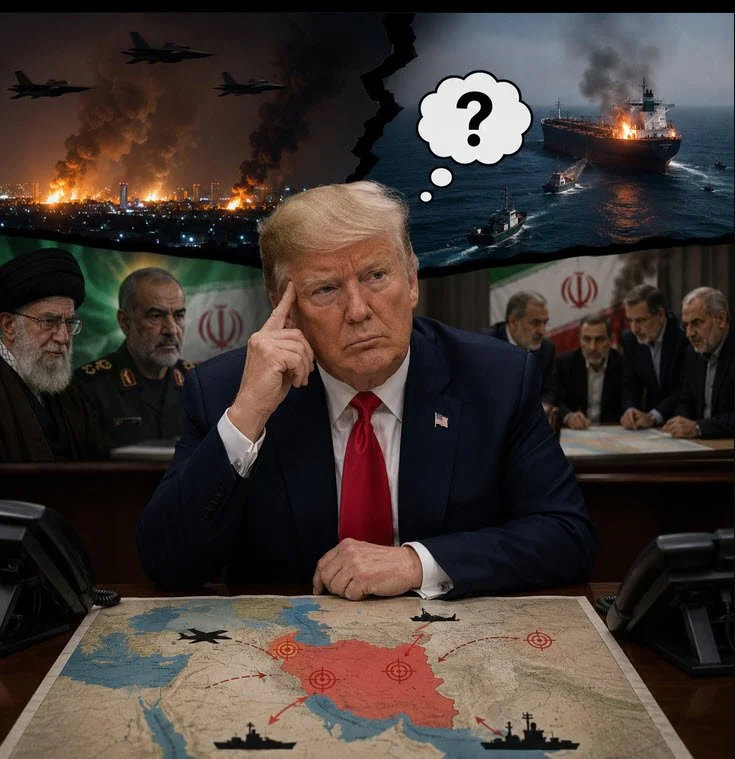
Crucially, it advances the opinion that the precise timing of the current Iranian strikes on commercial shipping is significant proof of a deeper structural fracture in Tehran. By executing these highly disruptive maritime attacks, the Islamic Revolutionary Guard Corps (IRGC) and the hardline clerics are essentially creating a situation where the United States is forced to negotiate with two entirely separate governments: a conventional state apparatus and an autonomous, ideological military shadow state.
U.S. bunker-buster bombs have just struck Iran — and this may be one of the most dramatic escalations of the entire conflict. In the hours before dawn, six Iranian cities were hit at the same time as U.S. forces launched a coordinated strike campaign across Bandar Abbas, Chabahar, Jask, Qeshm, Abu Musa, and Bushehr. In this video, we break down the latest U.S. military operation against Iran: reported GBU-57 Massive Ordnance Penetrator strikes on an underground IRGC headquarters near Tehran, HIMARS Precision Strike Missile attacks on ammunition facilities, secondary explosions near Bushehr, and continued U.S. strikes designed to degrade Iran’s missile, drone, coastal surveillance, and maritime attack capabilities. We also examine Iran’s response through tanker attacks near Oman, the renewed U.S. naval blockade of Iranian ports, the July 17 oil sanctions deadline, the pressure on Iran’s collapsing economy, and why Pickaxe Mountain may become the next major bunker-buster target. This is not just about one strike. It is about Iran, the IRGC, CENTCOM, GBU-57 bunker busters, HIMARS, B-1 bombers, the Strait of Hormuz, Iranian oil sanctions, tanker attacks, underground military facilities, and the future of the Middle East conflict. Watch the full analysis to understand why the latest bunker-buster strikes may prove that nothing Iran has built underground is truly out of reach.
The operational highlights, strategic context, and technical elements detailed in the video includ
The Strike Campaign: Night 7
The latest wave of the campaign marked the seventh consecutive night of precision strikes [13:21]. According to the video, CENTCOM executed a highly coordinated, simultaneous strike package within a five-hour window hitting six key cities along Iran’s southern maritime perimeter [02:44]:
Target Locations: Bandar Abbas, Chabahar, Jask, Qeshm, Abu Musa, and Bushehr [02:52].
Strategic Objective: These cities form the backbone of Iran's southern military architecture [03:06]. The strikes targeted coastal launch positions, naval bases, radar networks, and command nodes used by the Islamic Revolutionary Guard Corps (IRGC) to threaten shipping lanes in the Strait of Hormuz [03:13].
Simultaneous vs. Sequential: The video emphasizes that hitting all targets at once—rather than sequentially—indicates a strategy aimed at complete destruction rather than just sending a political warning [03:42]. It prevented the IRGC from hiding assets once the first bombs fell [04:03].
Penetrating "Bunker Buster" Attacks
A focal point of the report is a strike near Dezful, Iran, in the foothills of the Zagros Mountains [00:32].
U.S. F-15E Strike Eagles deployed 5,000-pound precision-guided bunker-buster bombs [00:32, 14:43].
The video notes that the bomb successfully penetrated a deeply buried, hardened facility, triggering over a minute of cascading secondary explosions [00:39, 04:44]. The narrator states this confirms the destruction of actual IRGC ballistic missile propellant and long-term inventory, bypassing the elaborate decoy structures Iran has built to fool orbital surveillance [04:15, 04:51].
The Ultimate Target: "Pickaxe Mountain"
The video concludes by looking toward the next phase of the U.S. target list, explicitly highlighting a facility referred to as "Pickaxe Mountain" (Kuh-e Olang) [12:32, 16:24].
This site represents the deepest tier of hardened Iranian military and command infrastructure—one that standard 5,000-pound munitions cannot defeat [16:24, 16:53].
The video notes that the GBU-57 Massive Ordnance Penetrator (MOP), a 30,000-pound depth-defeating weapon carried exclusively by the B-2 Spirit stealth bomber, is operationally primed and wargamed specifically to neutralize this asset [02:19, 17:36, 17:43].
Tactical Execution & Regional Alliances
Air Defense Suppression: The strikes were led by F-18 Growlers (electronic warfare) and F-16s/F-18s firing High-Speed Anti-Radiation Missiles (HARMs) [12:37, 13:47]. This forced Iranian radar operators into a fatal dilemma: turn on their systems to track incoming jets and get targeted by HARMs, or leave them off and remain completely blind [13:53].
Intelligence Fusing: Targeting solutions relied heavily on persistent loiter patterns from MQ-9 Reaper drones overlaid with U.S. Space Force satellite imagery to establish life patterns and separate real functional facilities from decoys [05:12, 06:05].
Coalition Expansion: The conflict has expanded beyond a bilateral U.S.-Iran engagement [19:08]. The video notes active participation from United Arab Emirates (UAE) fighter jets in strike operations [19:01], alongside a simultaneous Saudi Arabian air campaign against Houthi forces in Yemen following an intercepted ballistic missile salvo aimed at Jeddah [19:35, 19:42].
Naval Blockade: A strict naval blockade was reinstated on July 14, cutting off maritime access to further squeeze an economy already crippled by massive hyperinflation [18:03, 18:10].
Internal Regime Fractures
The strategic catalyst for the severe U.S. response was an IRGC cruise missile attack on two supertankers (Mombasa and Albaya) operating along a UN-designated safe transit corridor in the Omani southern corridor [06:32, 07:51].
The video highlights an apparent, severe breakdown in Iran's command structure [08:44]:
While the political layer (via parliamentary speaker Qalibaf) publicly shared safe-transit Memorandum of Understanding (MoU) language on social media, the IRGC shadow commanders simultaneously ordered the missile strikes [08:19, 08:48].
This internal friction manifested visibly when Iranian state television abruptly cut off Qalibaf's broadcast mid-sentence [09:33], while hardline clerics close to the IRGC publicly condemned the diplomatic frameworks as "treason" [09:54].
The video presents a grim outlook for the Iranian regime, suggesting its decades-old defense doctrine of "structural depth"—burying its deterrence capabilities underground—is being systematically dismantled piece by piece [01:16, 21:24].