Segment #977
Here is a polished, streamlined rewrite of the newsletter article, optimized for readability while retaining its legal and analytical precision.
Fauci Under Oath: Where the Risk Actually Lives
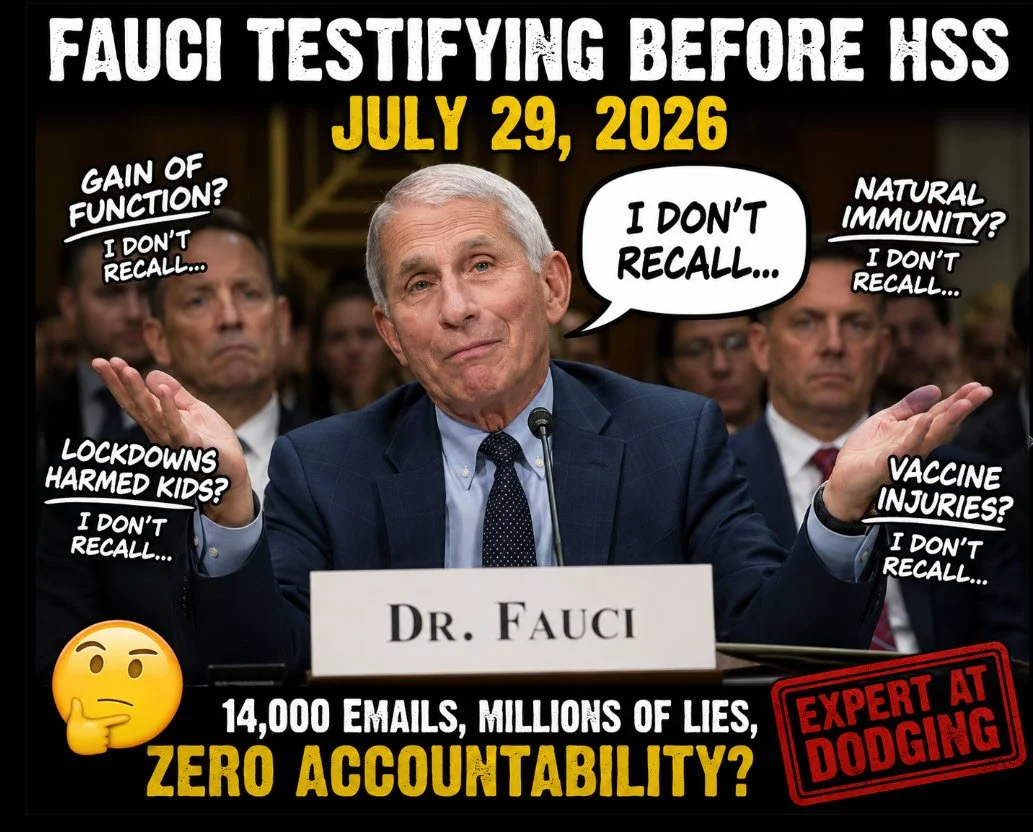
Senator Rand Paul has set the date. On July 29, Dr. Anthony Fauci will testify before the Senate Homeland Security and Governmental Affairs Committee.
While mainstream coverage frames this hearing as a grand reckoning for Fauci’s pandemic-era actions, that narrative misses the fundamental legal mechanics at play. The reality is that the door on his past conduct has already been closed by a presidential pardon and expired statutes of limitations.
The only true legal exposure Fauci faces is what he says while sitting in the witness chair.
The Pardon: A Shield That Compels Speech
President Biden granted Fauci a preemptive pardon covering any federal offenses committed between 2014 and January 2025. Additionally, the statute of limitations on his past gain-of-function testimony has run out. Consequently, past perjury—even if proven—cannot be charged.
However, a federal pardon does not extend to future crimes. Any false statement made on July 29 constitutes a fresh, unpardoned, and fully prosecutable federal offense. This single reality shifts the dynamics of the entire hearing.
Paradoxically, the pardon also strips Fauci of his strongest defense: the Fifth Amendment. The privilege against self-incrimination only applies if a witness’s answers could expose them to criminal prosecution. Because Fauci cannot be prosecuted for federal actions within the pardon window, the legal basis to refuse to answer dissolves. Under established Supreme Court precedent (Brown v. Walker), he can legally be compelled to testify about his official conduct.
The remaining legal gray zone is narrow. Fauci can only invoke the Fifth if a truthful answer exposes him to state-level prosecution or federal crimes committed after January 2025.
The Limits of Immunity: State Actions and Civil Risk
While the federal pardon closes the book on federal criminal exposure, it leaves two distinct areas wide open:
State-Level Investigations
Federal clemency applies strictly to offenses against the United States; it has no jurisdiction over state law. A coalition of 17 state attorneys general, led by South Carolina’s Alan Wilson, has already signaled that the federal pardon will not block state-level investigations.
However, states face a massive hurdle: Supremacy Clause immunity. Under the landmark 1890 case In re Neagle, state governments cannot prosecute federal officials for doing their official federal jobs. Because Fauci’s grant approvals and public statements fell squarely within his federal responsibilities, any state-level charges would likely be routed to federal court and dismissed. The state track serves primarily as a tool for public pressure and evidence collection, rather than a path to conviction.
Civil Liability
Civil lawsuits bypass the criminal system entirely, seeking financial damages under a lower burden of proof. Normally, federal officials are heavily shielded by three distinct layers:
The Westfall Act (1988): Substitutes the United States government as the defendant in place of the individual employee.
The Bivens Doctrine: Substantially limits the ability of citizens to sue federal officials individually for constitutional violations.
Qualified Immunity: Protects officials unless they violated a clearly established legal rule.
For plaintiffs, the strategy hinges on proving Fauci acted outside the scope of his employment. Critics point to the April 2026 indictment of Fauci’s senior adviser, David Morens, for allegedly concealing and deleting public records, attempting to frame these actions as a private scheme rather than official duty.
While plaintiffs’ attorneys float massive civil conspiracy theories involving trillions in aggregate pandemic damages, the immediate civil consequence of the hearing is the creation of a permanent sworn record. Every statement Fauci makes can be used as cross-usable evidence and impeachment material in ongoing or future civil litigation.
Gain of Function and the "Definitional Fog"
Senator Paul’s most frequent public accusation—that Fauci lied about funding gain-of-function research—remains his weakest legal argument.
The legal definitions governing this research rely on the Department of Health and Human Services (HHS) P3CO Framework adopted in 2017. Under these rules, research is only classified as gain-of-function if it enhances a pathogen already known to be transmissible and virulent in humans.
When the EcoHealth Alliance used NIH grants to fund chimeric coronavirus research at the Wuhan Institute of Virology, the resulting chimeras replicated at 1,000 to 10,000 times the baseline rate. However, because the source bat viruses had not yet been proven to infect humans, the NIH technically ruled the research outside the P3CO framework.
While independent scholars argue this interpretation relies on slick semantic loopholes, navigating a strict regulatory definition does not constitute perjury. In court, "misleading" is not the same as a lie. Fauci’s exposure on this front is entirely reputational, not criminal.
The Trap: Erdman's Timeline
The real legal danger for Fauci lies in specific, dated interactions where regulatory definitions cannot hide the facts.
In May 2026, CIA operations officer James Erdman III testified under subpoena that Fauci actively intervened in the intelligence community's COVID-19 origin reviews on two specific dates: February 3, 2020, and June 4, 2021. Erdman alleges that Fauci pushed a curated list of natural-origin experts to steer analysts away from the lab-leak hypothesis.
Though the CIA officially dismissed Erdman’s framing as political theater, the specificity of the dates creates a rigid box for Fauci:
Concede and Reframe: Acknowledging the meetings while framing them as routine scientific input protects him legally, but destroys the narrative that he was a passive, hands-off recipient of intelligence briefings.
Protect the Narrative: Denying or downplaying the meetings protects his public image, but if Erdman’s testimony is backed by hard documentation, that denial becomes a brand-new, unpardoned false statement under oath.