
I Just Love Yellow Buses - Another Dem Square Peg
Segment #785
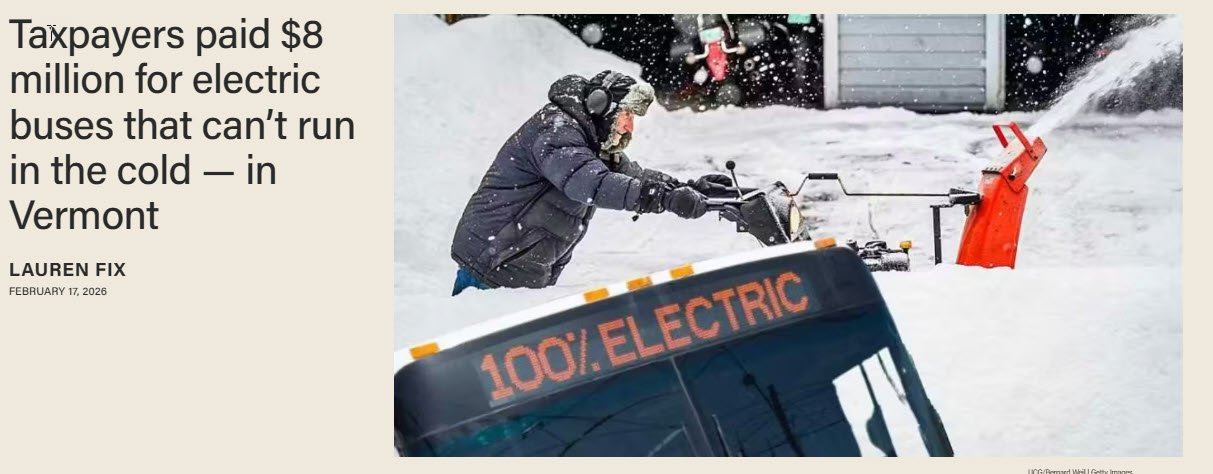
Taxpayers paid $8 million for electric buses that can’t run in the cold — in Vermont
February 17, 2026
Turns out winter doesn't care about political posturing.
Here we go again.
Another expensive lesson in what happens when political ambition outruns engineering reality — this time playing out in the dead of winter in Burlington, Vermont.
Electric buses may perform adequately in mild environments, but expecting them to replace diesel buses in northern states with long, cold winters ignores basic physics.
Electric buses unveiled with great fanfare as symbols of progress and climate virtue are now sitting idle in the snow, while the supposedly outdated diesel fleet does the actual work of moving people. Taxpayers paid millions for these vehicles, and right now, they can’t do the job they were purchased to do.
Green Mountain Transit added five new electric buses to its fleet last year, announcing the move in the warmth of summer. Officials praised the decision as a major step toward Burlington’s net-zero energy goals and reduced carbon emissions. The buses were billed as modern, clean, and capable, each equipped with a 520-kilowatt-hour battery and a theoretical range of up to 258 miles on a single charge.
Electric Buses - A Little More Background
Electric buses in Vermont face significant challenges during winter, particularly due to the state's cold climate (with average winter lows often in the teens to 20s °F in places like Burlington, and colder in mountainous areas).Recent Issues with Transit Buses (Green Mountain Transit - GMT)As of early 2026, Green Mountain Transit (which serves Chittenden County, including Burlington) has five relatively new electric buses (New Flyer models, delivered around 2025 and costing taxpayers about $8 million total, largely federally funded) that are currently unreliable or out of service in cold weather.
A battery recall in November 2025 flagged a fire hazard risk.
Manufacturer software updates to mitigate the risk limit charging: buses can only charge to 75% capacity and not at all when battery temperature is below 41°F (about 5°C).
The GMT garage lacks fire mitigation equipment for safe indoor charging/storage of these EVs, so buses must stay outside.
With Vermont's frequent sub-41°F (and often sub-freezing) temperatures this winter, the buses can't reliably charge overnight, rendering them unusable for service much of the time.
They were reportedly operating well prior to the recall but are now sidelined, forcing reliance on the diesel fleet to maintain routes.
This has drawn criticism as an example of electrification challenges in harsh winters, with some sources calling it a predictable mismatch between ambitious green policies and real-world conditions.
Earlier Pilot Programs and School Buses
Prior evaluations (e.g., a Vermont DEC/VEIC pilot from around 2022–2023 involving school and transit buses in districts like Barre and others) showed more positive results:
Electric school buses in Barre (with average winter lows around 12°F and heavy snow) performed adequately on typical routes.
Range dropped about 25% in real-world cold conditions (e.g., down to 74–78 miles per charge vs. higher nominal ratings), but this was still sufficient for average daily trips (around 30–40 miles).
They delivered emissions reductions, fuel/maintenance savings (up to $8,000–$15,000/year per bus vs. diesel in some cases), and worked on hilly/rural routes.
General cold-weather adjustments (like preconditioning batteries, heated garages, or route planning) help mitigate range loss (which can be 30–40% or more at 0°F in some models, though not always as extreme as 80% in outlier reports).