Segment #1091
THE RACHEL MADDOW ACCOUNTABILITY REPORT
A chronological examination of incorrect statements, failed predictions, and unsubstantiated allegations, 2016–2026
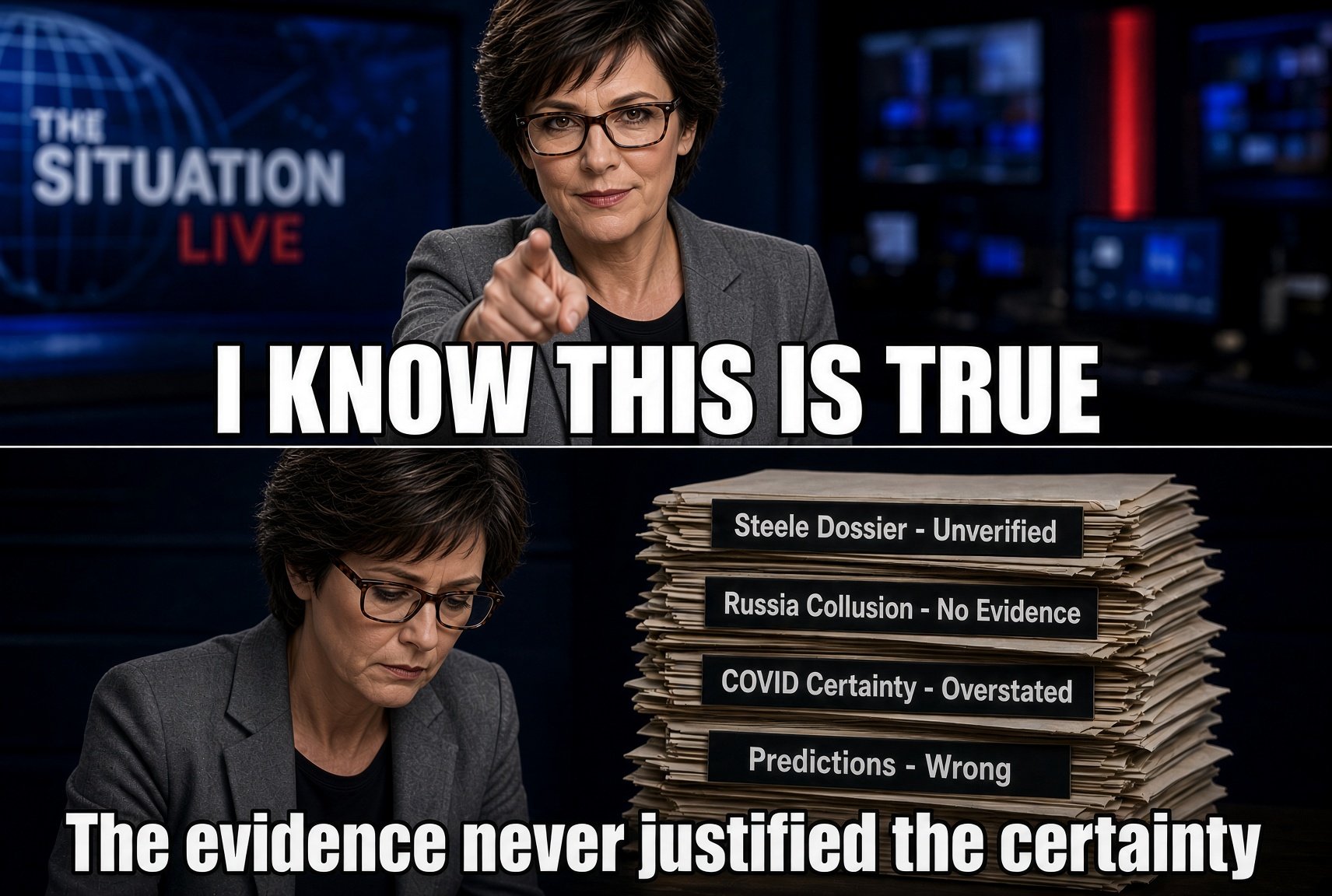
Rachel Maddow represents one of the most extraordinary compensation arrangements in American television journalism. Reportedly earning approximately $25 million annually while hosting just one regularly scheduled hour of television per week, she commands compensation that few journalists can approach.
The issue is not whether she negotiated an excellent contract. She clearly did. The more important question is whether someone receiving that level of compensation should be held to an equally extraordinary standard of factual accuracy, editorial responsibility, and professional accountability.
Given her documented errors, failed predictions, and promotion of serious allegations that were never substantiated, that question deserves serious consideration.
Scope: November 2016–November 18, 2026
Subject: Rachel Maddow, MSNBC political commentator and television host
Purpose of the report
This report examines major occasions when Rachel Maddow made statements, advanced allegations, or expressed predictions on television that were subsequently contradicted by evidence, failed to materialize, or proved substantially misleading.
The objective is to establish a documented record of what Maddow said, when she said it, what subsequently happened, and whether she corrected or acknowledged the original statement.
The investigation distinguishes between four types of failure:
Factually false: A verifiable statement contradicted by established evidence.
Failed prediction: A forecast that subsequent events disproved.
Unsubstantiated allegation: A serious claim for which the anticipated evidence never emerged.
Misleading presentation: Technically accurate information presented in a way that created an impression the underlying evidence did not justify.
An allegation that was never proven is not automatically a false statement. Similarly, an investigation that did not establish a conspiracy does not mean every suspicion prompting the investigation was fabricated.
That distinction is essential to producing a credible critique rather than another politically motivated compilation.
Completeness standard: No responsible investigation can guarantee identification of every single incorrect statement across ten years of television without reviewing the complete broadcast archive. This report will therefore distinguish documented examples from matters that require additional verification.
Chronological findings
2016–2017: The beginning of the Trump–Russia narrative
1. December 2016–January 2017 — Russian interference and the Vermont electrical grid
The early Russia-interference coverage included reports suggesting that Russian hackers had penetrated a Vermont utility's electrical infrastructure. The underlying Washington Post report was corrected after it became clear that the suspicious software had been discovered on a laptop not connected to the electrical grid.
This is an important example of inaccurate reporting during the early Russia controversy. However, Maddow's precise on-camera wording and whether she repeated the original false assertion have not been established here.
Finding: Underlying media report wrong; Maddow-specific finding pending transcript verification.
2. March 2017 — The possibility of a Russian-controlled presidency
Maddow devoted extensive coverage to possible Trump–Russia relationships, entertaining the extraordinary possibility that the presidency could be compromised by Russian interests.
The subsequent Mueller investigation established Russian interference but did not establish criminal conspiracy or coordination between the Trump campaign and the Russian government in the interference operation.
Finding: The most consequential conspiracy hypothesis was not established. This is a failure of the broader narrative's evidentiary expectations, not proof that every conditional statement Maddow made was false.
3. March 14, 2017 — Trump's supposedly explosive tax returns
Maddow announced that she had obtained Trump's tax returns and promoted the disclosure as breaking news.
The actual documents were two pages of his 2005 federal tax return, revealing approximately $153 million in income and $38 million in federal taxes. They did not establish foreign financial control or a major financial scandal.
On March 15, Maddow acknowledged that the returns contained no major damaging bombshell.
Finding: Substantial editorial overpromotion, not a false factual assertion.
PBS News+1
4. October 5, 2017 — Confidence in the Steele dossier
Maddow suggested that Christopher Steele had correctly identified a substantial portion of the Trump–Russia story.
The Justice Department inspector general's December 2019 report subsequently documented serious deficiencies in the FBI's handling and verification of Steele's reporting.
The dossier's sourcing included uncorroborated information and hearsay. Its most explosive allegations were not established.
Finding: Confidence in the dossier substantially exceeded the evidence that ultimately survived scrutiny.
The Washington Post
5. December 8, 2017 — Steele's supposed deep-cover Russian intelligence sources
Maddow presented Steele's sources as particularly important to the dossier's credibility.
The inspector general's investigation later disclosed that Steele's principal subsource described much of the information as hearsay or word of mouth.
Finding: Her presentation conveyed greater confidence in the sourcing than subsequent evidence warranted. This is a separate broadcast but part of the same dossier controversy.
The Washington Post
2018–2019: The Russia investigation and its aftermath
6. April 16, 2018 — Michael Cohen's alleged Prague meeting
Maddow discussed a McClatchy report claiming Mueller's investigators had evidence that Trump's attorney Michael Cohen visited Prague during the 2016 campaign.
The allegation mattered because the Steele dossier described a clandestine meeting involving Cohen and Russian operatives.
The Justice Department inspector general later reported that the FBI determined the Prague-travel allegation was untrue.
Finding: Maddow amplified a consequential report that failed factual verification. She did not originate the claim.
The Washington Post
7. March 2019 — The Mueller report and the absence of an established Trump–Russia conspiracy
The conclusion of the Mueller investigation represented a significant test of the narrative Maddow had developed over two years.
The report documented Russian election interference and contacts involving Trump associates, but it did not establish that Trump's campaign coordinated or conspired with the Russian government in its election-interference activities.
Finding: The most explosive potential conclusion of Maddow's sustained Russia coverage did not materialize. Her individual statements still require separate examination before they can be classified as false.
2020–2021: Vaccines and a documented false allegation
8. March 1, 2021 — Trump never encouraged vaccination
Maddow stated that Trump had never encouraged Americans to get vaccinated while president.
That was incorrect. Trump had publicly encouraged vaccination in December 2020.
PolitiFact rated Maddow's statement False. She corrected it the following day.
Finding: Verified false factual statement, subsequently corrected.
PolitiFact
9. March 18, 2021 — Devin Nunes supposedly refused to turn over Russian-linked material to the FBI
This is an especially important addition because subsequent litigation produced documentary evidence and sworn testimony.
Maddow stated that Congressman Devin Nunes had refused to turn over material associated with Russian-linked operative Andrii Derkach to the FBI.
A former House Intelligence Committee staff member testified that the package was received by committee staff, secured, and delivered to the FBI approximately two days later.
On October 15, 2026, the U.S. Court of Appeals for the Second Circuit issued a decision recounting that evidence and acknowledging that Nunes had presented evidence of the statement's falsity.
The court nevertheless upheld dismissal of Nunes's defamation claim because he had not established the required actual malice. Maddow and her producer had relied on an earlier Politico report.
Finding: A materially false on-air assertion supported by contrary sworn testimony. The lawsuit's dismissal does not establish that Maddow's statement was true, nor does the false statement establish that she knowingly lied.
Primary legal document:
Second Circuit decision, Nunes v. NBCUniversal, October 15, 2026
10. March 29, 2021 — Vaccinated individuals cannot spread COVID-19
Maddow declared that vaccination stopped the virus from infecting vaccinated people and prevented them from transmitting it.
Subsequent evidence established that vaccinated individuals could become infected and transmit COVID-19.
Although vaccines provided important protection against severe disease, the absolute assurance Maddow offered was incorrect.
Finding: A categorical scientific assertion contradicted by subsequent evidence.
2022–2023: No additional verified major failures established
Maddow moved away from her nightly hosting schedule in 2022, concentrating on a weekly program and other projects.
The research reviewed for this report has not established additional major on-camera statements from 2022 or 2023 that meet the same evidentiary standard.
That is a research gap, not a finding that her commentary during those years was consistently accurate.
2024: Biden, the Democratic nomination, and the election
11. June 18, 2024 — Biden's nomination was effectively settled
During an appearance on The View, Maddow dismissed the likelihood that Democrats would replace Joe Biden as their presidential nominee.
Biden withdrew from the presidential race on July 21, 2024.
On September 10, Maddow revisited her earlier comments and acknowledged that her forecast had been wrong.
Finding: Clear failed prediction, acknowledged publicly.
12. The 2024 election — JD Vance's effect on voters
Maddow later acknowledged that she had expected voters to be more troubled by JD Vance than they appeared to be.
Trump and Vance won the November election.
Finding: A mistaken assessment of voter reaction, although the election result alone does not quantify Vance's effect on the Republican ticket.
2025–2026: Continued commentary and subsequent legal developments
13. October 15, 2026 — Judicial confirmation of contrary evidence in the Nunes case
The Second Circuit's decision is significant because it places the March 2021 Maddow statement within a formal judicial record.
The court upheld NBCUniversal's victory on the defamation claim while describing evidence that the underlying assertion was false.
Finding: This is not a new Maddow statement, but an important 2026 evidentiary development concerning an earlier error. It should be indexed under the original 2021 broadcast, not counted twice.
At present, I cannot substantiate further distinct 2025–2026 on-camera errors sufficiently to add them as verified findings. One circulating allegation that Maddow made contradictory statements about attacking Iran in 2025 and 2026 was itself found to rely on fabricated quotations. It should not be included in an accountability report.
Media Bias/Fact Check
Consolidated accountability table
The following table counts distinct issues, rather than counting every repeated broadcast or subsequent legal development as a separate error.
Year
Issue
Assessment
2016–17
Vermont electrical-grid hacking
Maddow's specific claim unverified
2017
Russian-controlled presidency hypothesis
Not established
2017
Trump tax-return revelation
Overhyped
2017
Steele dossier accuracy
Overstated confidence
2017
Steele's intelligence sources
Overstated reliability
2018
Michael Cohen in Prague
Underlying allegation false
2019
Trump–Russia conspiracy expectations
Not established
2021
Trump never encouraged vaccination
False; corrected
2021
Devin Nunes withheld Russian-linked material
Contrary evidence established
2021
Vaccines prevent infection and transmission
Incorrect categorical claim
2024
Biden would remain the nominee
Wrong prediction
2024
Vance would trouble more voters
Acknowledged misjudgment
Findings and conclusions
12
Distinct issues examined
4
Clear false statements or failed forecasts
1
Additional false underlying report amplified
The remaining entries concern unsupported theories, overconfidence, misleading promotion, or insufficiently verified attribution. These categories overlap, so the figures should not be interpreted as a statistical error rate.
Three principal conclusions
First, Maddow's Russia coverage deserves the most extensive scrutiny. It dominated substantial portions of her programming and repeatedly elevated allegations that later investigations failed to substantiate. The distinction between Russian interference and an established Trump–Russia conspiracy is central.
Second, her errors were not confined to predictions. The vaccination statement, COVID-transmission assurance, and Nunes allegation concerned factual assertions that could be tested against evidence. The Nunes case is particularly noteworthy because the contrary evidence appears in a federal appellate decision.
Third, the available record does not justify claiming that every major Maddow prediction over ten years has now been identified. PolitiFact's speaker-specific archive, for example, contains only one False-rated Maddow statement within the requested period, but that limited archive is plainly not a comprehensive audit of her television commentary.
PolitiFact+1
Sources for a full broadcast-level investigation
The most valuable source materials are the original MSNBC recordings and transcripts, the Mueller report, the Justice Department inspector general's December 2019 report, contemporaneous reporting, independent fact checks, and court records.
The most useful starting points are:
The Rachel Maddow Show — MSNBC
Mueller Report — U.S. Department of Justice
DOJ Inspector General report — December 2019
PolitiFact's Rachel Maddow fact-check archive
Nunes v. NBCUniversal — 2026 appellate decision