
History of DOGE - Past, Present, and Future
Segment #725
The average American citizen wonders why DOGE is not a permanent federal department. Maybe it should and will be.
History of DOGE (Department of Government Efficiency)The Department of Government Efficiency (DOGE) originated as a campaign promise during Donald Trump's 2024 presidential run. Elon Musk first suggested the idea on X (formerly Twitter) in 2024, proposing a government efficiency commission. The name "DOGE" is a deliberate reference to the Dogecoin cryptocurrency (inspired by the Shiba Inu "Doge" meme), which Musk has long promoted.
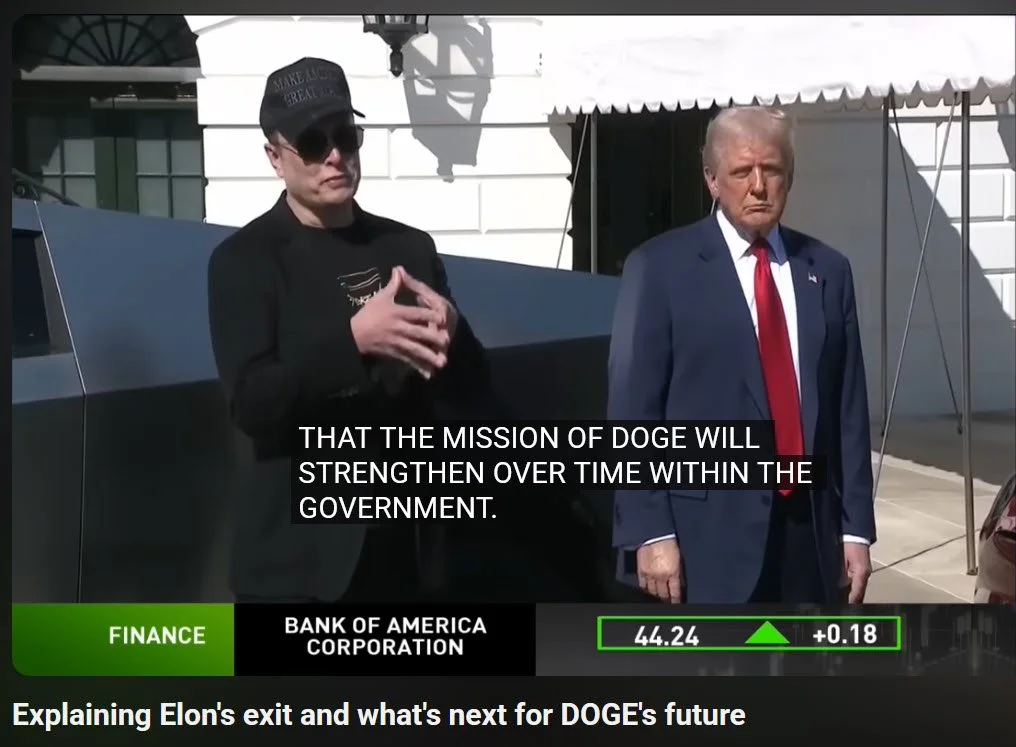
Elon Musk has officially stepped down from his role leading the Department of Government Efficiency, better known as DOGE, a federal initiative focused on streamlining spending and cutting waste. Why Musk Left DOGE Despite speculation of political friction, Musk’s departure was expected. He was appointed as a Special Government Employee (SGE), a category created under 18 U.S.C. 202 that allows federal agencies to temporarily bring in outside experts for up to 130 days in any 365-day period. According to the U.S. Department of Justice, SGEs are subject to a time limit to preserve ethical boundaries and distinguish them from full-time federal employees. Musk’s time at DOGE reached that limit, requiring him to step down.
November 12, 2024: President-elect Trump officially announced DOGE, appointing Elon Musk and Vivek Ramaswamy as co-leads. It was described as an external advisory body to "dismantle bureaucracy, slash regulations, cut wasteful spending, and restructure agencies," with a target completion date of July 4, 2026 (America's 250th anniversary).
January 20, 2025: On his first day in office, Trump signed an executive order formally establishing DOGE by renaming the existing U.S. Digital Service (a tech modernization team) to the U.S. DOGE Service (USDS). It was housed in the Executive Office of the President, focusing on IT upgrades, productivity, and cost-cutting. DOGE teams were embedded in agencies, typically including engineers, HR specialists, and attorneys.
DOGE was never a full cabinet-level department (requiring Congressional approval) but an advisory initiative with significant influence through executive actions.
Initial goals included cutting $2 trillion in federal spending (later scaled back to $1 trillion, then $150–175 billion claimed), mass layoffs, regulatory rollbacks, and agency consolidations/eliminations.StaffingDOGE's structure evolved rapidly and was controversial for lacking transparency.
Leadership:
Elon Musk: De facto leader initially, with lieutenants like Steve Davis (from The Boring Company/SpaceX).
Vivek Ramaswamy: Co-lead until early 2025 (around January), when he departed amid reported tensions with Musk to pursue a potential Ohio gubernatorial run.
Staff Composition:
Core team: Roughly 40–100+ members, many young tech engineers/coders from Musk's companies (SpaceX, Tesla, X, Palantir via Peter Thiel connections) with little government experience.
Embedded in agencies: DOGE placed staff in key roles, e.g., CIOs at OMB, OPM, DOE, SSA. Some converted offices into living quarters and worked extreme hours.
Recruitment: Public calls for "high-IQ revolutionaries" via X; many were political appointees or "special government employees."
No public full list; investigative reporting (e.g., ProPublica, NYT) revealed ties to Musk/Thiel networks and potential conflicts (staff cutting regulations in areas they previously worked).
Critics highlighted opacity, with lawsuits alleging violations of advisory committee laws (e.g., Federal Advisory Committee Act for transparency and balanced viewpoints).Where They Are Now (as of late December 2025)
DOGE as an Entity: Effectively disbanded or dissolved by November 2025, months before its July 2026 charter end. Officials (e.g., OPM Director) stated "DOGE doesn't exist" as a standalone body, though its principles (deregulation, waste reduction) were "institutionalized" across agencies via embedded staff and ongoing policies like hiring freezes (later lifted).
Elon Musk: Departed in May 2025 after a public clash with Trump (over policy/budget issues). He pivoted back to private sector focus (Tesla, SpaceX, xAI). Remained an informal advisor but no longer involved in cabinet-level meetings.
Vivek Ramaswamy: Left in January 2025; focused on potential political ambitions (e.g., Ohio governor bid).
Remaining Staff: Dozens transitioned to permanent/political roles in agencies (e.g., State Department, HHS). No "burrowing" into career civil service positions. Some projects continued decentralized (e.g., AI for regulations, tech modernization via National Design Studio).
Outcomes: Federal workforce reduced by ~317,000 (buyouts, layoffs, attrition). Claimed savings ~$175 billion (disputed; many inaccuracies/exaggerations per analyses). Overall federal spending rose ~6% in 2025 (to ~$7.56 trillion), driven by entitlements/debt interest. Criticisms included disruptions (e.g., IT crashes, foreign aid cuts linked to humanitarian impacts) and unfulfilled big promises.
What's Planned for the FutureWith DOGE formally ended:
No centralized future plans; the initiative concluded early without meeting ambitious targets.
Legacy: Efficiency efforts continue informally through Trump administration priorities (e.g., deregulation, workforce reshaping via OMB). Some ex-DOGE staff drive ongoing tech/AI initiatives in agencies.
Expiration was built-in (2026), but dissolution came sooner amid challenges, legal issues, and leadership exits.
Analysts note DOGE caused significant disruption but limited measurable savings, with mandatory spending (Social Security, debt) untouched.
DOGE remains a polarizing symbol of attempted radical reform—high-profile but ultimately short-lived and contentious.
Future of DOGE

No, the Department of Government Efficiency (DOGE) cannot be structured as a permanent federal department without congressional action, and there are no indications that this has happened or is planned as of late December 2025.Why DOGE Cannot Become a Permanent Department Unilaterally
Legal Requirements for Cabinet-Level Departments: Under the U.S. Constitution (Article II, Section 2) and historical precedent, creating a new executive department (cabinet-level or otherwise) requires an act of Congress. The president can reorganize existing entities via executive order (as Trump did with DOGE), but establishing a full, permanent department—complete with a secretary, dedicated funding, and statutory authority—needs legislation passed by both houses and signed into law. Examples include the Department of Education (1979), Department of Homeland Security (2002), and others.
DOGE's Original Structure: Established by Executive Order on January 20, 2025, DOGE was not a true department. It renamed and reorganized the existing U.S. Digital Service (USDS) into the "U.S. DOGE Service" and created a temporary organization (U.S. DOGE Service Temporary Organization) set to expire on July 4, 2026. It focused on IT modernization, efficiency, and cost-cutting but lacked cabinet status.
Current Status of DOGE
Disbanded as a Centralized Entity: By November 2025, DOGE effectively disbanded ahead of schedule. Officials (including OPM Director Scott Kupor) stated it "doesn't exist" as a standalone or centralized body. Leadership exited (Elon Musk in May 2025, Vivek Ramaswamy earlier), and functions decentralized—absorbed into agencies like OPM, OMB, and the ongoing USDS for tech modernization.
Legacy: Efficiency principles (deregulation, workforce reduction) continue informally across the administration, but DOGE itself is no longer operational as originally conceived. Some sources note lingering tech projects under USDS, but no centralized "DOGE" leadership or structure remains.
No Plans for Permanence
No legislation has been passed or seriously advanced to make DOGE (or a similar entity) a permanent cabinet department.
While some Republicans introduced related bills (e.g., workforce reforms tied to "DOGE Acts"), none elevated it to departmental status.
The Trump administration institutionalized cuts through other means (e.g., executive orders, rescissions via Congress), but did not pursue statutory creation of a permanent DOGE department.
In short, DOGE was always a temporary, executive-driven initiative—not a department—and its dissolution without congressional elevation to permanence aligns with legal constraints. Any future permanent version would require new laws from Congress.
How Could DOGE Be Structured as a Federal Department
The Department of Government Efficiency (DOGE) could only be structured as a permanent federal department (cabinet-level or otherwise) under the following specific circumstances, based on U.S. constitutional and statutory requirements:1. Congressional Legislation
Primary Requirement: Creating a new executive department requires an act of Congress. The president cannot unilaterally establish a permanent cabinet-level department; this needs statutory authority passed by both the House and Senate and signed into law (or overriding a veto). Historical examples include the Department of Homeland Security (2002) and Department of Education (1979).
Process:
A bill must be introduced in the House or Senate explicitly establishing the department, defining its structure, authority, funding, leadership (e.g., a secretary confirmed by the Senate), and mission.
It would likely originate in relevant committees (e.g., House Oversight and Accountability or Senate Homeland Security and Governmental Affairs).
Passage requires majority votes in both chambers, potentially with bipartisan support or reconciliation for budget-related aspects.
The president signs it into law.
2. Political and Practical Conditions
Unified Republican Control or Bipartisan Support: As of late December 2025, with Republican control of the presidency and likely Congress (post-2024 elections), a GOP-sponsored bill could advance more easily. However, creating a new department often faces resistance due to added bureaucracy (ironically, for DOGE's efficiency mission), costs, and turf battles with existing agencies.
Public and Political Momentum: Strong advocacy from the Trump administration, Elon Musk (former DOGE co-lead), or congressional allies (e.g., DOGE caucuses in House/Senate) could build support. Proposals would need to address criticisms of DOGE's temporary version (disruptions, limited savings, early disbandment in November 2025).
Funding and Reorganization Authority: Congress could use appropriations bills or reorganization plans (under limited presidential authority via the Reorganization Act, though expired and requiring renewal) to elevate existing structures, but full permanence needs explicit legislation.
Current Reality (as of December 27, 2025)
No such legislation has been passed or advanced significantly. Introduced bills (e.g., DOGE Codification Act, various "DOGE Acts" for workforce reforms, state-level efficiency mandates) focus on codifying temporary actions, transparency, or related reforms—not creating a permanent department.
DOGE itself was a temporary initiative (via executive order, expiring July 2026 but disbanded early) and has been decentralized/institutionalized into agencies like OPM and USDS, without centralized structure.
Absent new laws, any "permanent" DOGE would remain advisory or absorbed informally, not a statutory department.
In summary, the key circumstance is congressional enactment of specific legislation. Without it, DOGE cannot become a permanent federal department, regardless of executive intent.