
“America First” - What Is It?
Segment #723
The media is describing a war within the conservative movement. Tucker Carlson believes this is fake. Ultimately, Tucker is right as he notes the movement is defined as “America First”, the foundational concept that holds it all together. Clearly considering the Biden years there are those on both the left and right that see America First as a litmus test for politicians whether they be local or national.
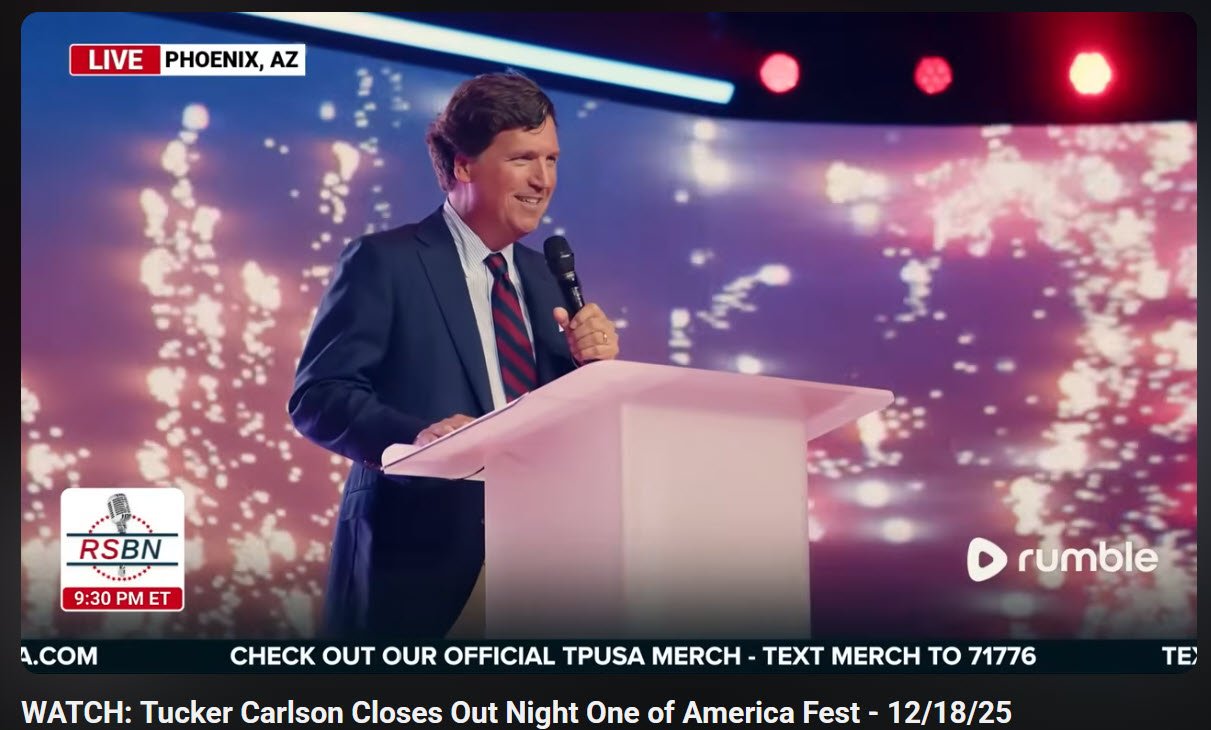
On December 18, 2025, Tucker Carlson delivered a keynote speech at Turning Point USA's AmericaFest (AmFest) in Phoenix, Arizona. This was the first AmFest following the assassination of TPUSA co-founder Charlie Kirk earlier that year, and Carlson used the platform to define "America First" as a core principle prioritizing the interests of American citizens above all else.Core Definition of "America First"Carlson described America First as a straightforward litmus test for leaders and policies:
"Can you clearly explain how your decisions put American citizens first? If not, you have no right to rule."
He argued that this principle rejects identity politics, ritual denunciations, and deplatforming tactics—things he claimed voters overwhelmingly opposed in recent elections. Instead, it demands accountability from politicians and commentators to justify actions based solely on benefits to ordinary Americans, not foreign entities, special interests, or ideological agendas.Key Themes from the Speech
Rejection of divisive tactics: Carlson criticized efforts (including from some on the right) to weaponize labels like "Nazi" or "racist" to silence debate, calling it a recycled form of left-wing identity politics that shuts down legitimate questions about policy.
Free speech and Christian foundations: He tied America's unique protection of free speech to its Christian-influenced founding documents, praising Charlie Kirk's commitment to this while pushing back against censorship.
Foreign policy implications: Without naming specific conflicts directly in summaries, he emphasized avoiding unnecessary wars and questioned decisions that don't demonstrably serve U.S. citizens first (e.g., referencing past debates on regime change).
Coalition-building: He called for a broad movement of everyday Americans united against elite moral posturing, race-based narratives, and external influences, focusing on concrete outcomes like economic security and national sovereignty.
The speech also included indirect responses to onstage criticism from Ben Shapiro earlier that evening, who had denounced Carlson for platforming controversial figures. Carlson framed such attacks as distractions from the real "America First" mandate.Reception and ContextThe full speech is available on Tucker Carlson's site and YouTube (titled variations like "Tucker on the America First Movement & New 'Deplatforming' Agenda"). It sparked significant debate within conservative circles, with supporters viewing it as a defense of populist priorities and critics seeing it as evasive on specific issues like foreign alliances or domestic threats.In essence, Carlson presented America First not as isolationism or nativism, but as pragmatic governance: leaders must prove their loyalty is to American people first, or forfeit legitimacy. This aligns with his broader commentary emphasizing citizen welfare over global entanglements or internal witch hunts.
History of America First
Historical Meaning"America First" originated as a political slogan in the early 20th century, notably used by President Woodrow Wilson in his 1916 campaign to emphasize U.S. neutrality during World War I. It gained prominence in the interwar period through the America First Committee (AFC), founded in 1940. The AFC was a large isolationist pressure group (peaking at over 800,000 members) that opposed U.S. entry into World War II, advocating non-interventionism, American nationalism, and unilateralism in foreign affairs. Prominent figures like Charles Lindbergh supported it, arguing that America should prioritize its own welfare and avoid European conflicts. The committee dissolved after the Pearl Harbor attack in 1941. Critics at the time and historians later noted associations with nativism, and in some cases, anti-Semitism or sympathy toward fascist regimes, though the core focus was anti-intervention.Modern Meaning (Trump Era and MAGA)In contemporary U.S. politics, "America First" was revived by Donald Trump during his 2016 presidential campaign and has become a central slogan of the MAGA (Make America Great Again) movement. It generally refers to a nationalist foreign and domestic policy approach that prioritizes U.S. interests above international commitments, including:
Foreign policy: Non-interventionism or restraint in overseas conflicts, skepticism toward multilateral institutions (e.g., withdrawing from treaties like the Paris Agreement or questioning NATO alliances), protectionist trade deals, and focusing on threats like China while avoiding "endless wars."
Domestic policy: Economic protectionism (e.g., tariffs to protect American jobs), strict immigration controls, and emphasizing the well-being of American citizens over global or elite interests.
Core principle: Leaders should make decisions based solely on what benefits ordinary Americans first, often described as "principled realism" or transactional diplomacy rather than ideological interventionism or isolationism.
Supporters, including the America First Policy Institute, argue it means "America is best positioned to lead when it places the safety, prosperity, and well-being of the American people first," rejecting both neoconservative nation-building and pure isolationism.Variations and DebatesThe term's exact meaning has evolved and sparked internal conservative debates, especially in Trump's second term (2025 onward):
Trump has claimed personal ownership, stating he "developed 'America First'" and decides its definition, emphasizing preventing threats like Iran acquiring nuclear weapons.
Critics within the right, such as Tucker Carlson, have argued for a stricter non-interventionist interpretation, opposing U.S. involvement in conflicts (e.g., supporting Israel against Iran) as contrary to putting American citizens first and avoiding foreign entanglements.
Some factions push "America First, America Only," prioritizing absolute restraint abroad.
Overall, "America First" today represents populist nationalism: pragmatic governance focused on American sovereignty, security, and economic strength, distinct from both globalist liberalism and rigid isolationism, though interpretations vary across the political spectrum.