Far Left Says Screw Dem Party of JFK
Segment #950
To understand how the modern progressive and democratic socialist wings of the Democratic Party have moved away from the philosophy of John F. Kennedy’s era, it helps to look directly at the policy platforms.
While JFK was considered a standard-bearer of mid-century liberalism, his platform focused heavily on private sector growth, broad-based tax cuts, a hawkish anti-communist foreign policy, and free trade. Modern progressive politicians explicitly reject these core pillars in favor of democratic socialism, market intervention, and a non-interventionist global posture.
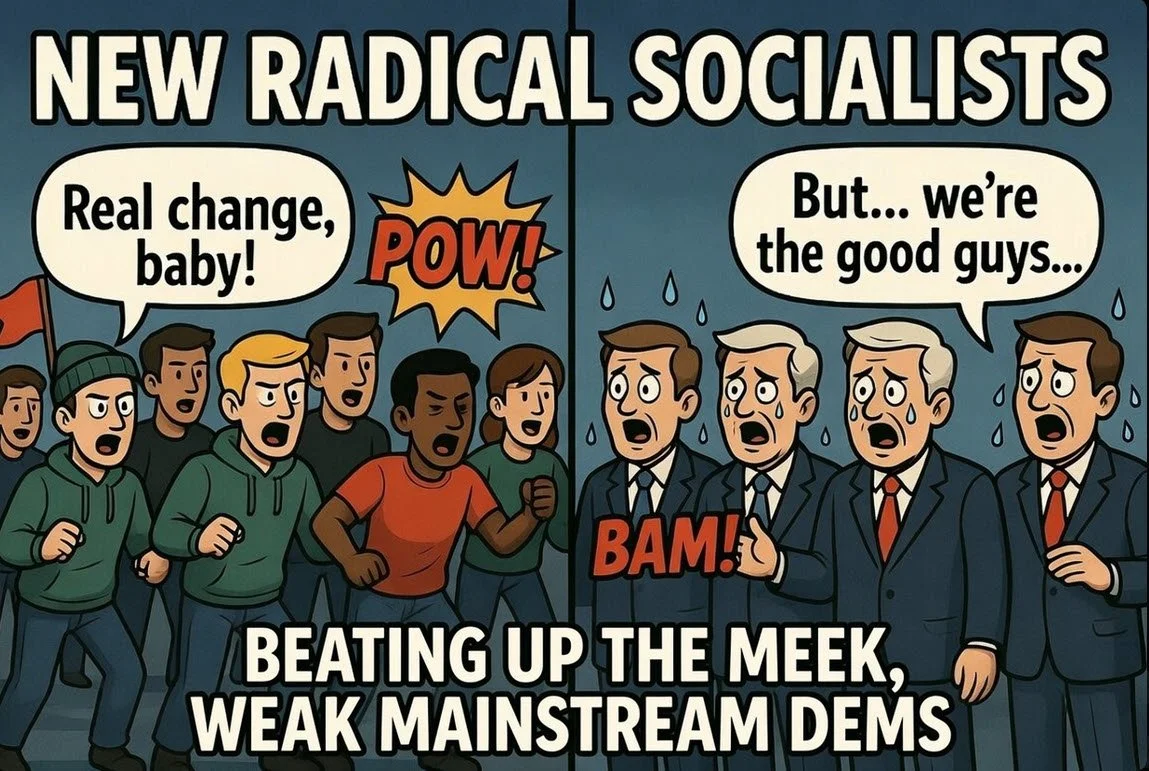
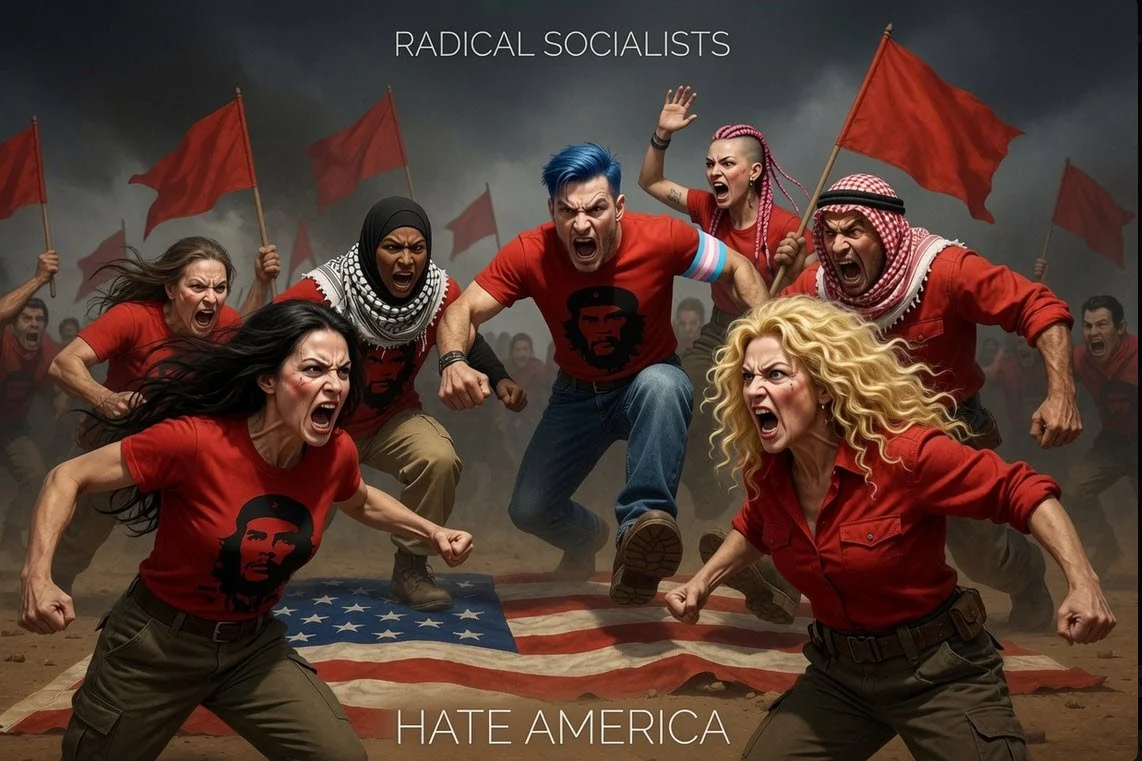
The far left politicians and candidates are seeking the destruction of the U.S. as we know it and they are speakinbg their truths for all to hear.
Electorate Impact of Far Left Socialism
Third-Party Socialist Vote: Less than 1% in general elections.
Dedicated Socialist/Far-Left Core:8% to 12% of the total national electorate.
Democratic Primary Leverage:25% to 35% of the Democratic primary vote, allowing them to successfully elect factional candidates in deeply left-wing, urban congressional districts (e.g., "The Squad").
Demographic Strength of the Far Left
Data from polling firms, academic voter studies (including the comprehensive Pew Research Center Political Typology data), and election results outline specific demographic profiles and geographic strongholds where the far-left or democratic socialist factions are strongest.
The "Progressive Left" or democratic socialist voter base is not evenly distributed across the left-wing coalition; it is highly concentrated within narrow age, educational, and geographic categories.
Age: The Core Generational Engine
Age is the single strongest demographic predictor of far-left support. The movement is overwhelmingly driven by young adults.
Pew Typology Data: According to deep-dive data, roughly 79% of the explicit "Leftward Progressive" bloc is under the age of 50.
The Under-30 Concentration: Among Democrats and Democratic-leaning independents under the age of 30, 26% fit into the hard-progressive/far-left category. By comparison, that number drops precipitously to just 6% among Democrats aged 50 and older.
Geography and Population Density
Far-left candidates rely entirely on dense, urban centers, specific inner-ring suburbs, and college towns. Because their geographic concentration is narrow, they perform exceptionally well in local municipal or congressional primary elections in specific zip codes but struggle in statewide or nationwide contests.
Major Metropolitan Cities: The strongest hubs for organizations like the Democratic Socialists of America (DSA) are deeply urban, high-density environments. This includes specific boroughs of New York City (Queens and Brooklyn, where Alexandria Ocasio-Cortez and Jamaal Bowman built their operations), Los Angeles, Chicago, Seattle, Minneapolis-St. Paul, and Washington, D.C.
College Towns: Municipalities with massive university populations—such as Burlington, Vermont; Berkeley, California; Madison, Wisconsin; and Ann Arbor, Michigan—serve as intellectual and organizing bases for socialist candidates.
The "Sociocultural" Class: Ideological support for democratic socialism is strongest among what sociologists call "sociocultural professionals." This includes individuals working in academia, media, journalism, non-profit management, and law, where a preference for state-directed social planning aligns with professional values.
Contrast with Manual Labor: Manual and industrial blue-collar workers are considerably more resistant to the socialist label, preferring capitalism by a 57% to 38% margin, often due to differing views on regulations, energy policy, and policing.
Race and Cultural IdentityThe racial makeup of the true far-left/radical wing differs significantly from the broader, more moderate working-class Democratic base.
The Racial Breakdown: Nationally, the "Leftward Progressive" core is majority White (67%), with 13% Hispanic, 7% Black, and 6% Asian representation.
Intra-Party Ideological Splits: White Democrats are heavily polarized into the ultra-liberal camps, with roughly half qualifying as staunchly progressive or far-left. Conversely, Black and Hispanic Democrats tend to be significantly more conservative on social issues, immigration restrictions, and law enforcement, concentrating heavily in the center-left or moderate factions of the party.
Religious Alignment
The far-left faction features an exceptionally low rate of religious affiliation compared to any other voter segment in the country.
Secular Dominance: Roughly 63% of this voting bloc identifies as atheist, agnostic, or "nothing in particular." Only 6% of this demographic reports attending any form of weekly religious service, contrasting sharply with the traditional, highly religious Black and church-going moderate Democratic base.
Socialist Philosophy Rejecting JFK
Taxation and Economic Theory
JFK’s economic philosophy was rooted in the idea that high marginal tax rates choked private sector expansion and that lowering them would stimulate investment and increase federal revenues. He proposed across-the-board cuts that ultimately lowered the top marginal income tax rate from 91% to 70%.
"Our true choice is not between tax reduction, on the one hand, and the avoidance of a federal deficit on the other... An economy hampered by restrictive tax rates will never produce enough revenues to balance our budget, just as it will never produce enough jobs or enough profits."
— John F. Kennedy, Address to the Economic Club of New York (1962)
The Modern Rejection: Politicians like Senator Bernie Sanders and Representative Alexandria Ocasio-Cortez (AOC) directly oppose this growth-oriented tax philosophy. AOC famously proposed a 70% top marginal tax rate on incomes over $10 million to directly fund social programs rather than spur corporate investment.
Specific Action: Progressive lawmakers frequently introduce legislation for a Wealth Tax (targeting accumulated assets rather than just income) and heavily criticize traditional Democratic tax policies from the 1960s through the 1990s as variants of "trickle-down economics."
Foreign Policy and Defense Spending
JFK ran to the right of the Eisenhower administration on defense in 1960, warning of a "missile gap" and dramatically increasing the defense budget. His foreign policy was defined by robust military readiness and a willingness to project American power globally to contain adversaries.
"Let every nation know, whether it wishes us well or ill, that we shall pay any price, bear any burden, meet any hardship, support any friend, oppose any foe to assure the survival and the success of liberty."
— John F. Kennedy, Inaugural Address (1961)
The Modern Rejection: The progressive wing, including members of "The Squad" like Representatives Ilhan Omar, Rashida Tlaib, and Jamaal Bowman, regularly advocate for sweeping cuts to the Pentagon budget. They frequently introduce or vote for amendments aimed at reducing defense spending by 10% or more.
Specific Action: Modern progressive foreign policy rejects the JFK-style internationalist intervention. Instead, these politicians focus on anti-imperialism, challenging traditional bilateral military alliances, opposing foreign arms sales, and calling for the withdrawal of U.S. troops from global deployments.
Free Trade vs. Protectionist Planning
The Kennedy administration championed international commerce as a tool of Western alliance-building and economic vitality, culminating in the Trade Expansion Act of 1962, which gave the president unprecedented authority to reduce tariffs.
The Modern Rejection: Far-left candidates completely reject standard free-trade philosophy, viewing globalized trade agreements as detrimental to American labor and corporate-driven.
Specific Action:Bernie Sanders built much of his national platform on opposing free trade agreements like NAFTA, CAFTA, and the Trans-Pacific Partnership (TPP). Rather than relying on free markets, progressives champion aggressive state-directed economic planning, such as the Green New Deal, which seeks to mandate industrial transitions through federal spending and regulation.
Universal Single-Payer Healthcare
JFK supported the creation of a health insurance program specifically for senior citizens tied to Social Security—a proposal that eventually became Medicare under Lyndon B. Johnson. However, his platform preserved the private healthcare system and employer-sponsored insurance for the vast majority of Americans.
The Modern Rejection: Progressive candidates reject the public-private compromise of the traditional Democratic platform.
Specific Action: The primary healthcare objective for the modern far-left is "Medicare for All." Sponsored heavily by Sanders, AOC, and Representative Pramila Jayapal, this policy would completely replace private health insurance with a single-payer government system, effectively outlawing private insurance duplicates—a concept far outside the scope of JFK's New Frontier.
The Radical Mantra as They Preach It
When examining the platform of modern progressive, democratic socialist, and far-left candidates, their public statements reveal a sharp break from standard mid-century liberalism.
Specific quotes from prominent left-wing figures and elected officials outline their positions on these ten issues:
ICE (Immigration and Customs Enforcement)
Progressive candidates have consistently called for the complete elimination of ICE, viewing it as fundamentally corrupt rather than an agency in need of reform.
Representative Alexandria Ocasio-Cortez (AOC):
"I believe that ICE needs to be abolished... We are looking at an agency that has repeatedly systematically violated human rights." (CNN Interview, 2018)
Representative Ilhan Omar:
"ICE is a lawless, rogue agency that has systematically violated human rights... It is time to abolish ICE and end the weaponization of immigration enforcement." (Statement on X/Twitter)
Zohran Mamdani:
"I've said time and again that I believe that ICE should be abolished... My message to ICE agents is that everyone will be held to the same standard of the law... If you want to pursue your promise to create the single largest deportation force in American history, then you will have to get through me to do that here in New York City." (Public campaign statements & Katie Couric interview
Police
The "Defund the Police" movement explicitly advocated for the redirection of funds away from traditional law enforcement agencies into community programs, with some calling for dismantling departments entirely.
Representative Cori Bush:
"With all due respect, I am not going to stop saying 'defund the police.'... It’s not a slogan, it’s a mandate. We need to defund the police and fund our communities." (Axios Interview)
Representative Rashida Tlaib:
"No more policing, incarceration, and militarization. It can't be reformed." (Statement following a police shooting, 2021)
Graham Platner:
Before scrubbing his social media history for his Senate run, Platner's unvarnished anti-law enforcement posts from the early 2020s aligned directly with far-left slogans.
He explicitly wrote that "all cops [are] bastards" and fiercely "criticized police officers" and systemic police violence. (Uncovered Reddit archive)
Zohran Mamdani:
On limiting the scope of law enforcement:
"When it comes to our police force, I've been very clear about the fact that there cannot be any work in coordination with ICE, in planning with ICE... and there cannot be any assistance in civil immigration enforcement."
Open Borders / Immigration Enforcement
While few use the phrase "open borders," prominent democratic socialists advocate for the effective decriminalization of border crossings and the shutdown of all immigrant detention facilities.
Senator Bernie Sanders:
"We will end the criminalization of immigrants... Border crossings will be handled as a civil matter, not a criminal one." (2020 Immigration Platform Policy Plan)
Representative Pramila Jayapal:
"The maximum cruelty that ICE inflicts on immigrants is horrifying... It's time to replace this inhumane system with one that treats immigrants with dignity while ending our reliance on detention." (Congressional Statement)
James Talarico:
While criticized by opponents for advocating open-border policies, Talarico reframes immigration with a high-welcome approach."Our border should be like a front porch — it should have a welcome mat out front and a lock on the door." (Texas Senate Campaign Address)
Incarceration
Far-left philosophy frames the American justice system as inherently oppressive, calling for mass de-carceration and the abolition of cash bail and private prisons.
Representative Ayanna Pressley:
"We must dramatically reduce our jail and prison populations... Our current system of mass incarceration is a multi-layered crisis rooted in structural racism and economic exploitation." (Introducing the People’s Justice Guarantee, 2019)
Zohran Mamdani:
Championing a complete halt to the transfer of individuals into federal detention systems, Mamdani committed to shielding individuals from the justice system:
He advocates for "strengthening New York City's existing sanctuary policies by further limiting local agencies' communication... and prohibiting ICE from accessing city facilities, such as jails."
Reparations
Progressives advocate for direct federal compensation to Black Americans to address the historical legacy of slavery and systemic racism.
Representative Cori Bush:
"Black people in our country cannot wait any longer for reparation... The United States must face its history of slavery, systemic racism, and white supremacy and provide direct financial redress." (Press conference introducing the Reparations Resolution)
James Talarico:
Merging progressive policy with his distinct brand of religious populism, Talarico frequently argues that economic and systemic repair is a moral obligation.
He has stated that "politics is really just another word for how we treat our neighbors," using his platform to argue that true neighborly love requires correcting the "systemic inequalities" holding back minority communities.
Wealth Tax
Breaking from traditional income-tax models, democratic socialists advocate for taxing accumulated personal wealth and net worth directly.
Senator Bernie Sanders:
"At a time of unprecedented income and wealth inequality, this legislation demands that the billionaire class in America finally pay their fair share... Billionaires cannot have it all. It is time to enact a wealth tax." (Senate Press Release)
James Talarico:
Talarico centers his entire economic message on an aggressive top-versus-bottom class framework.
"The biggest divide in this country is not left vs. right. It's top vs. bottom. Billionaires want us looking left and right at each other instead of looking up at them... They divide us by party, by race... so we don't notice they're defunding our schools, gutting our healthcare, and cutting taxes for themselves and their rich friends." (Official Campaign Platform)
Private Property Ownership
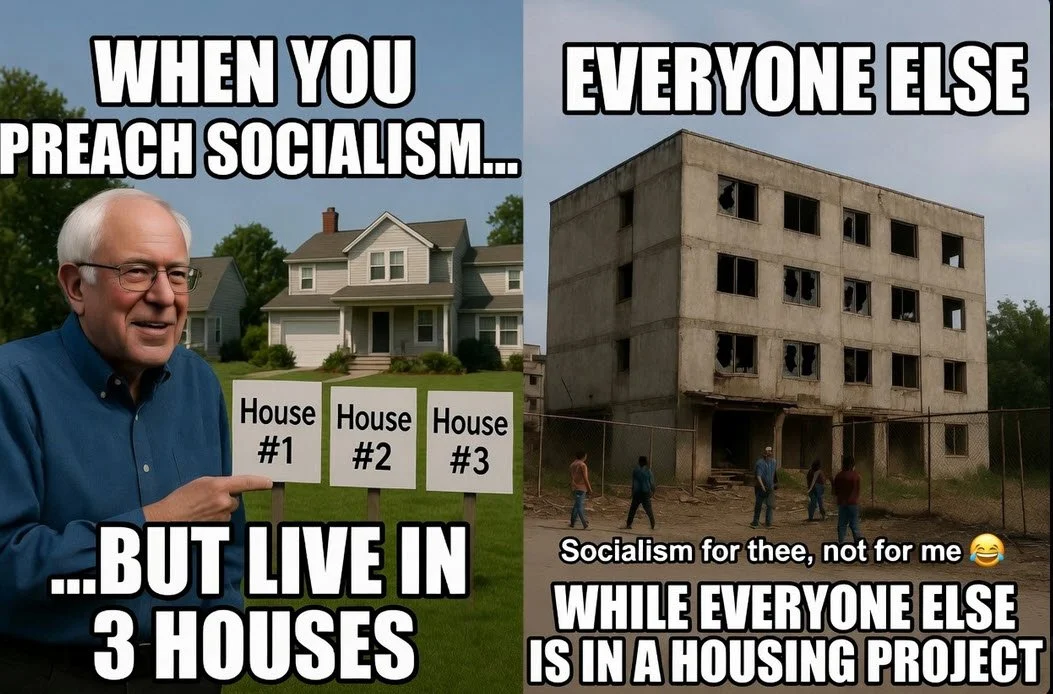
Far-left figures often target corporate landlords, real estate speculation, and the concept of housing as a commodity, advocating for intense government control over rental properties.
Representative Alexandria Ocasio-Cortez (AOC):
"Housing should be a right, not a commodity. When we treat housing like a investment vehicle for private equity and billionaires, we price working families out of their homes." (Town Hall meeting)
Graham Platner:
Prior to adjusting his public branding for a statewide run, Platner explicitly rejected capitalist real estate and property norms.
He identified himself as a "vegetable growing, psychedelics taking socialist these days" who openly stated on left-wing forums, "I got older and became a communist." (Deleted Reddit posts)
White Oppression / Systemic Racism
Modern progressive rhetoric strongly emphasizes systemic race-based oppression, viewing foundational American systems as structurally designed to favor white supremacy.
Representative Jamaal Bowman:
"We must dismantle the systems of white supremacy that continue to oppress Black and brown people in every single corner of American life—from housing and health care to policing." (Public Address)
Graham Platner:
In his unedited, past online commentary regarding the cultural dynamics of the electorate, Platner took direct aim at demographic groups.
He explicitly "castigated rural white Americans as 'racist' and 'stupid,'" a radical stance he was forced to publicly disavow upon entering the Senate race. (CNN Report
Freedom of Choice (Economic & Healthcare Context)
In the progressive view, true freedom of choice is an illusion if limited by financial means, leading them to oppose private market competition in sectors like healthcare.
Senator Bernie Sanders:
"You don't have freedom of choice if you can't afford to go to the doctor... Real freedom means guaranteeing Medicare for All as a human right, which means eliminating private insurance companies that profit off your sickness." (Primary Debate)
James Talarico: Far-left candidates argue that corporate power has stripped regular citizens of choice, calling for structural overhauls to basic economic systems.
"There's something broken in America. Our economy is broken. Our politics are broken... That's because the most powerful people in the world want it that way... It's time to start flipping tables."
Gun Ownership
Progressive candidates consistently call for sweeping restrictions on the Second Amendment, including mandatory buybacks and the outright banning of specific classes of firearms.
Former Representative Beto O'Rourke:
"Hell yes, we're going to take your AR-15, your AK-47. We're not going to allow it to be used against our fellow Americans anymore." (Democratic Presidential Debate)
James Talarico: Following major shootings in Texas, Talarico used his legislative platform to demand aggressive state intervention and gun control restrictions, taking a hard line against standard Second Amendment defenses.
"There is something profoundly cynical about asking God to solve a problem that we're not willing to solve ourselves." (Texas House Floor Speech)
Blue Sanctuary Cities the Center of Radical Socialism
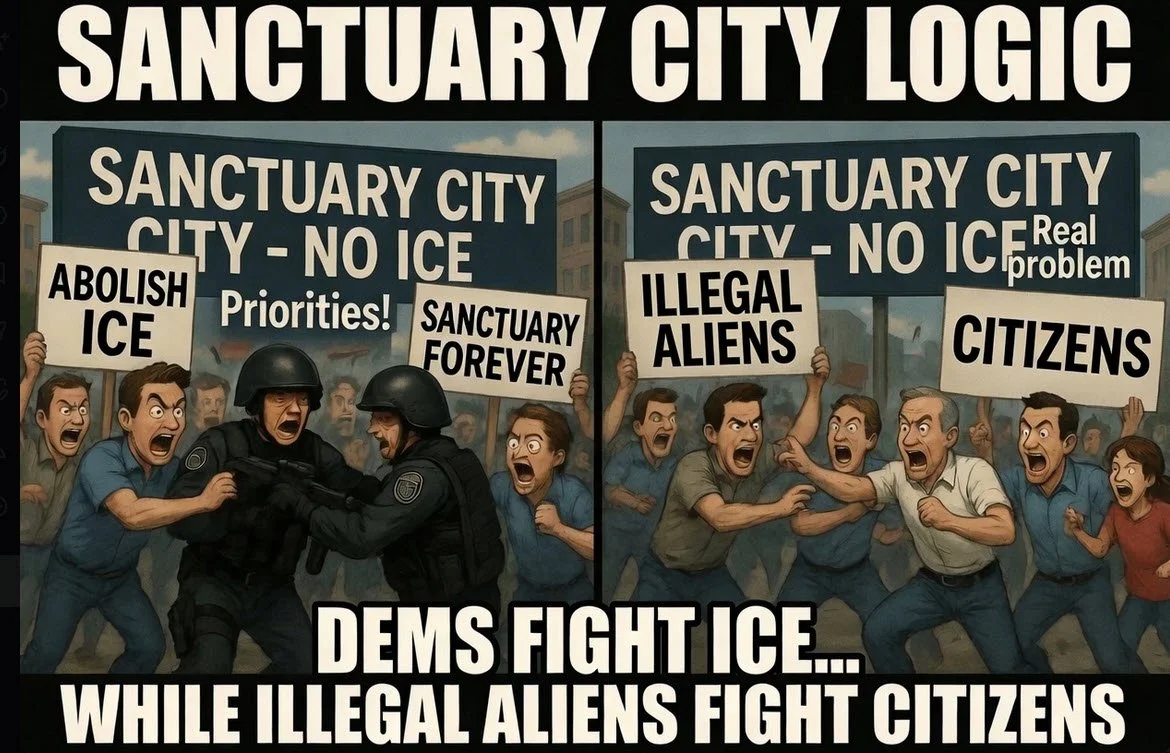
The rhetoric from newly prominent progressive and democratic socialist figures in the country’s largest blue cities highlights a continuing departure from traditional centrist policies. Across these hubs, far-left leaders and insurgent challengers frame their platforms around a complete systemic overhaul of law enforcement, immigration, and capitalism.
New York City
The democratic socialist wing continues to exert significant influence, frequently clashing with moderate Democrats over policing and city resources.
Mayor Zohran Mamdani (On curbing law enforcement cooperation):
"When it comes to our police force, I've been very clear about the fact that there cannot be any work in coordination with ICE, in planning with ICE... and there cannot be any assistance in civil immigration enforcement." On Forbidding Jails and City Facilities from cooperating with Law Enforcement:
He campaigned explicitly on "strengthening New York City's existing sanctuary policies by further limiting local agencies' communication... and prohibiting ICE from accessing city facilities, such as jails."
Melissa Avila Chevalier (Insurgent far-left Congressional challenger in NY-12, linking American municipal systems to global oppression):
"I came back, and I couldn't unsee all those things. And I started seeing them in our own systems, right? Our systems of policing, of deportation, of the controlling of our movement."
2. Chicago
In Chicago, the progressive faction actively focuses on leveraging executive and legislative power to redistribute wealth and reshape municipal structures, directly challenging the business community.
Mayor Brandon Johnson (Reflecting on the far-left's governing strategy):
"We've learned a lot in Chicago. I think about how power works. I think the Left in Chicago has opened up a new set of contradictions... we have an ability to understand what power is, and that is what is going to give us the ability to enact the kind of transformation that we want to see."
Alderman Carlos Ramirez-Rosa (On the goal of municipal socialism):
We want to tax the rich to fund our communities. We are not just here to manage austerity; we are here to fundamentally change who holds power in the city of Chicago."
Los Angeles
The progressive push in Los Angeles centers heavily on the "Housing First" doctrine, stripping funding from law enforcement, and treating housing as a non-commercial utility.
Alex Gruenenfelder (Progressive mayoral challenger, on reshaping the economy and the LAPD):
"I envision a Los Angeles where Black Angelenos don't fear interactions with the LAPD. A Los Angeles where we focus on the needs of our people, rather than the profits of a few massive corporations."
Councilmember Nithya Raman (On the elimination of criminal penalties for poverty and homelessness):
"Enforcement does not solve homelessness. Sweeping encampments and using police to manage a housing crisis is an expensive, failed policy that actively inflicts trauma on our city's most vulnerable people."
Baltimore
Radical candidates in Baltimore frequently target the city's traditional police spending and the private housing market, framing the city's historic problems as a consequence of systemic capitalism.
Councilmember Phyllis Green (On defunding traditional law enforcement budgets):
"Every dollar we pour into an inherently racist and corrupt police department is a dollar stolen from our youth, our schools, and our neighborhoods. True safety comes from dismantling these punitive systems, not funding them."
Councilmember Odette Ramos (On private housing specualtion and landlord penalties):
"Housing is a fundamental human right, not a vehicle for corporate landlords to extract wealth from Black and brown neighborhoods. We need aggressive government intervention to seize vacant properties and take them out of the speculative market."
5.Detroit
Left-wing activists and officials in Detroit focus heavily on environmental racism, water access, and explicit rejections of corporate tax incentives.
Congresswoman Rashida Tlaib (On the total abolition of the carceral system):
"No more policing, incarceration, and militarization. It can't be reformed... We must completely shift our focus from a punitive justice system to one built on community restoration."
Councilmember Angela Whitfield-Calloway (On corporate development subsidies):
"We are tired of watching millions of public tax dollars being handed over as corporate welfare to billionaire developers while the basic infrastructure of our neighborhoods crumbles. It is time to halt these handouts and mandate community wealth-sharing."
Dr. Abdul El-Sayed
Rejection of Washington Leadership and Foreign Policy.
During a 2026 campaign swing that sparked intense intra-party friction due to his events with radical internet streaming personalities, El-Sayed directly blasted the focus of Washington, D.C., and federal foreign police. "The fact that this is the controversy to me, says everything we need to know about what D.C. focuses on. I don't pay much attention to D.C. I pay attention to Michigan... Here in Michigan, people can't afford to fill up a tank because of the war that's being fought out of D.C. and have to suffer. The president is tweeting about his genocidal fantasies in Iran. He's tweeting about the drapes in a building. So at the end of the day, like, I just don't take my cues from there." (CBS News, 2026)
Confronting the Corporate and Billionaire Class
El-Sayed explicitly frames his legislative goals around an adversarial battle against billionaires and corporate entities, a core pillar of his populist campaign message: "What we need right now is somebody who's willing to take the fight directly to Trump and Musk, but then also knows how to rebuild a version of our federal government that better serves working people after the carnage that Musk and Trump are going to leave behind... Our campaign is 100% funded by people like you — not corporations and would-be oligarchs." (Campaign launch & platform statements, 2025–2026)
Attacks on Establishment Democrats and Special Interests
At the primary debate on Mackinac Island, El-Sayed broke sharply from traditional primary decorum to openly mock his more moderate, establishment-aligned opponents over corporate health care money:"I'll tell you this, the revolution is definitely not coming if we're not fighting for it... So let's play a game. If you're on this stage and you've never taken a check from Blue Cross Blue Shield, raise your hand." (Televised Democratic Primary Debate, May 2026)
Direct Support for Abolishing ICE
Allying directly with the platform of the furthest-left members of Congress, El-Sayed has repeatedly rejected the necessity of federal immigration enforcement agencies:He has explicitly advocated for "abolishing ICE," arguing formally that the agency "no longer functions as a legitimate law enforcement agency" and needs to be dismantled entirely rather than reformed. (Campaign Policy Platform / Wikipedia Registry)
Government Mandated Healthcare (Medicare for All)
As the author of Medicare for All: A Citizen's Guide, El-Sayed has consistently called for the total elimination of the private insurance market, framing capitalist health care as an active threat to human life:"I didn't set out to be a politician; I trained as a doctor, but saw how broken politics were making people sick... We need a healthcare system that guarantees high-quality, affordable healthcare for every American [by eliminating] private insurance companies that profit off your sickness." (Ballotpedia Survey / Public Forums)