Did You Know You Will Have a Digital Twin
Segment #1043
Digital Twins for Every Patient: Where Medicine May Be Heading
The concept is potentially much more consequential than simply putting a patient's medical record into an AI system. A genuine medical digital twin would be a continuously updated computational model of an individual patient that attempts to reproduce enough of that person's biology to predict what will happen under different interventions.
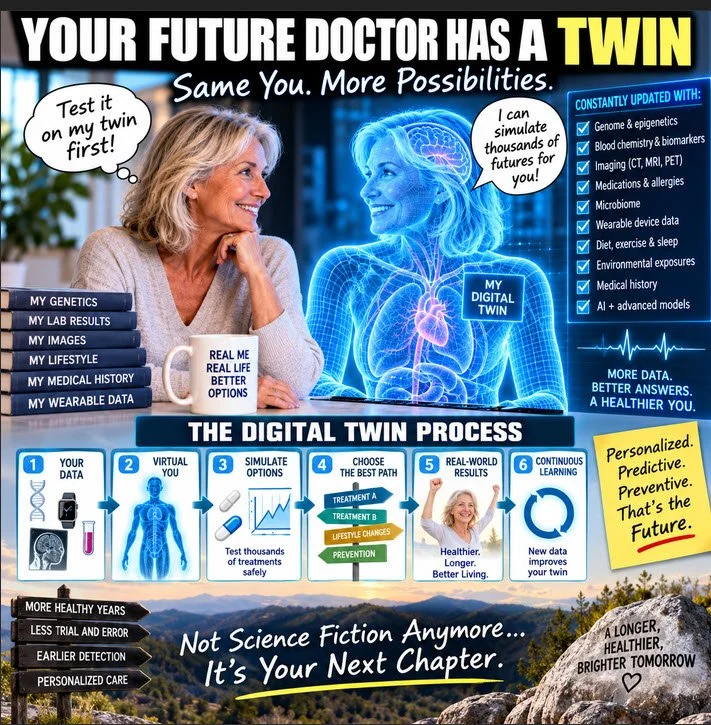
The FDA's definition is useful: a digital twin is a virtual construct that mimics the structure, context and behavior of its physical counterpart, is dynamically updated with data from that counterpart, and is used to inform decisions. The FDA explicitly recognizes potential applications in personalized treatment and in-silico clinical trials. (U.S. Food and Drug Administration)
The long-term idea is therefore:
Patient → data → digital patient → thousands of simulated futures → treatment selection → real patient outcome → new data → improved digital patient.
That could represent one of the biggest changes in medicine since randomized clinical trials—but we're nowhere near a reliable whole-body twin for every person yet.
1. What a true patient twin would contain
Imagine that at birth—or perhaps even prenatally—you acquire a medical computational identity alongside your conventional medical record.
It could progressively incorporate:
Genome + epigenetics + proteins + metabolites + microbiome + blood chemistry + medications + allergies + imaging + pathology + cardiovascular measurements + neurological measurements + medical history + environmental exposures + diet + exercise + sleep + continuous wearable data.
AI would sit above those data, while mechanistic models underneath it represent things such as cardiovascular dynamics, metabolism, drug absorption, kidney clearance, tumor biology and immune responses.
The important distinction is that this would not merely be an AI reading your chart.
A sophisticated digital twin would try to answer counterfactual questions:
What happens to this particular patient if we do A instead of B?
For example, rather than telling a physician that Drug A works in 61% of patients fitting a certain profile, a sufficiently validated twin might eventually simulate Drug A, Drug B and combinations at different doses and estimate the patient's probable responses and uncertainties.
That is why the concept goes considerably beyond today's "precision medicine."
2. The revolutionary concept: experiment on the twin first
This is where digital twins become genuinely interesting.
Medicine today largely operates:
Diagnosis → population evidence → treatment → observe result → adjust treatment.
Digital-twin medicine could increasingly operate:
Diagnosis → construct/update twin → simulate possible treatments → compare predicted outcomes → select intervention → observe patient → recalibrate twin.
That means a physician could theoretically run hundreds or thousands of virtual experiments before exposing the actual patient to one.
This isn't merely science fiction. A 2025 npj Digital Medicine review describes the objective as predicting individual health trajectories and interventions, while emphasizing that verification, validation and uncertainty quantification will be essential before such systems can be trusted clinically. (Nature)
And FDA regulation is already moving toward the broader computational framework required for this. In June 2026 the FDA finalized ICH M15 guidance establishing principles for model-informed drug development, including how computational evidence should be evaluated and documented. (U.S. Food and Drug Administration)
3. Cancer may be one of the strongest early applications
Cancer illustrates why this could matter.
Suppose a newly diagnosed cancer patient has genomic sequencing, pathology, circulating tumor DNA, PET/CT imaging, immune markers and comprehensive blood chemistry.
Instead of simply classifying the patient as:
Stage III, mutation X, biomarker Y
the system could construct a computational model of that individual's tumor.
Researchers could potentially simulate different therapeutic strategies against it:
Drug A → Drug B → combination A+B → immunotherapy → radiation → surgery → different sequencing and dosing combinations.
Then the patient's actual response feeds back into the model.
If a tumor unexpectedly stops responding, the discrepancy becomes valuable information:
The real patient has just demonstrated that something in the twin is wrong.
The model then needs recalibration.
That feedback loop is what differentiates a true twin from an ordinary predictive algorithm.
4. It could radically alter clinical trials
This may happen sooner than the universal patient twin.
Suppose 500 patients enter a clinical trial. Each patient also receives a validated digital counterpart predicting what would probably happen without the experimental treatment.
Researchers could potentially supplement portions of a conventional control group with digital or synthetic controls.
Instead of:
250 treatment + 250 placebo
future trials might, in appropriate circumstances, use a smaller physical control population supplemented by validated computational counterparts.
A 2026 npj Digital Medicine analysis sees digital twins and causal inference as potentially useful for identifying responsive patient subgroups, optimizing regimens and supplementing control arms, while emphasizing that fully synthetic controls remain under regulatory evaluation. (Nature)
Nature Medicine went sufficiently far this year to describe the "arrival of digital twins and in silico trials in drug development," while emphasizing the need for regulator and public-sector involvement before simulations become dependable evidence for drug approvals. (Nature)
That could eventually make trials faster and potentially expose fewer people to ineffective therapies.
5. Eventually we could have a "trial of one"
This is the deeper conceptual change.
Traditional medicine asks:
What happened to 10,000 patients similar to you?
Precision medicine asks:
What happened to patients sharing your biomarkers?
Digital-twin medicine ultimately wants to ask:
What is most likely to happen to you?
That moves medicine toward an N-of-1 computational experiment.
Researchers are already discussing precisely this issue. Because every twin is individualized, conventional population-level validation becomes difficult. Researchers are consequently examining N-of-1 methodologies for validating personalized twins. (Nature)
But there is a paradox here.
The more individualized the model becomes, the harder it becomes to prove that it is correct.
If there is only one John, how do we establish that John's digital twin accurately predicts John's biological future?
That validation problem may prove harder than building the AI itself.
6. The twin shouldn't be one enormous AI
I think the most plausible architecture is actually a federation of specialized twins rather than one monolithic digital human.
You might eventually have:
Cardiac twin ↔ vascular twin ↔ metabolic twin ↔ kidney twin ↔ liver twin ↔ immune twin ↔ musculoskeletal twin ↔ neurological twin ↔ pharmacological twin.
A higher-level AI system would integrate their predictions.
This is similar to engineering. Engineers don't simulate an entire aircraft at the molecular level. They combine validated models operating at appropriate scales.
Europe is explicitly pursuing this multiscale approach. Its Virtual Human Twins Initiative describes models operating from cells through tissues, organs and organ systems, eventually combining them. The European Commission says more than €100 million has been invested in the initiative and is building infrastructure intended to integrate and validate different VHT models. (Digital Strategy)
That's important because it suggests that governments are treating this as an emerging research infrastructure, not simply a futuristic medical-AI concept.
7. Continuous monitoring changes everything
The really transformative version isn't the twin constructed during a hospital visit.
It's the longitudinal twin.
Imagine twenty years of:
wearable measurements, laboratory results, imaging, prescriptions, illnesses, physical activity, sleep patterns and physiological responses to previous treatments.
Today's medical record primarily tells physicians what happened.
A digital twin would try to infer:
what is happening now, why it is happening, and what is likely to happen next.
The system could detect that your physiology is diverging from its expected trajectory before conventional diagnostic thresholds are crossed.
Medicine could consequently shift somewhat from:
symptoms → diagnosis → treatment
toward:
trajectory deviation → investigation → prevention.
That may ultimately be more important than treatment optimization.
8. But we're much earlier than the terminology suggests
This is where some enthusiasm needs correcting.
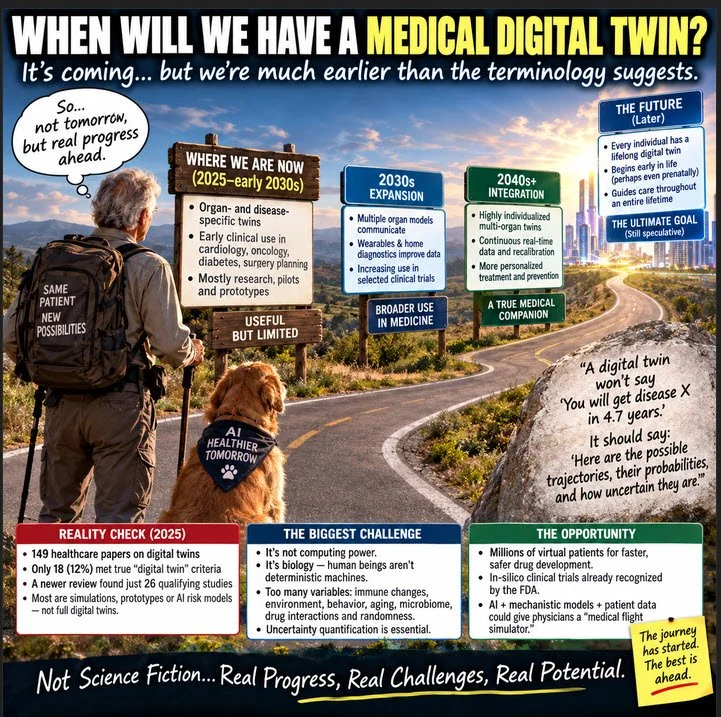
A 2025 scoping review examined 149 healthcare papers describing digital twins. Only 18—about 12%—actually satisfied the National Academies-style criteria of being personalized, dynamically updated and predictive for decision support. (Nature)
An even newer systematic review found only 26 qualifying healthcare studies through May 2025. Most were simulations or prototypes, and genuine integration into clinical practice remained rare. (PubMed)
So "digital twin" is currently being used rather loosely.
Many supposed medical twins are really:
predictive algorithms, simulations, AI risk models or sophisticated electronic records.
Those are useful, but they aren't the full concept.
9. The hardest problem isn't computing power
We can probably build extraordinary computational systems.
The harder problem is biology itself.
Human beings are not deterministic machines.
A patient's future depends upon enormous numbers of partially observed variables: immune-state changes, infections, environment, behavior, adherence, aging, random mutations, interactions between drugs, microbiome changes and biological stochasticity.
Consequently, the realistic digital twin won't say:
"You will develop disease X in 4.7 years."
It should say something more like:
"Given the information available today, these are the plausible trajectories, these are their estimated probabilities, and this is how uncertain those estimates are."
That's why uncertainty quantification is becoming central to serious digital-twin research. (Nature)
A digital twin that gives a confident wrong answer could be considerably more dangerous than a physician who openly acknowledges uncertainty.
10. The AI breakthrough could create another breakthrough: millions of virtual patients
Once researchers have sufficiently validated individual biological modules, another possibility emerges.
Researchers wouldn't necessarily need to restrict themselves to twins of actual people.
They could generate synthetic populations representing millions of biologically plausible individuals:
different ages, genomes, metabolisms, diseases, organ function, drug sensitivities and combinations of conditions.
A candidate therapy could therefore undergo enormous computational testing before a human receives it.
This would not eliminate animal experiments or human clinical trials in the foreseeable future. But it could potentially identify failures much earlier and determine which experiments actually warrant human testing.
The FDA already explicitly recognizes digital twins as potentially useful for assembling cohorts for in-silico clinical trials. (U.S. Food and Drug Administration)
11. AI and digital twins will probably converge
There are really three technologies converging:
AI understands information and discovers patterns.
Mechanistic simulation represents biological processes.
Digital twins connect those models continuously to an actual patient.
AI alone can find correlations.
Mechanistic models can explain biological relationships.
The digital twin attempts to integrate both around one continuously changing human being.
That combination could eventually give physicians something resembling a medical flight simulator.
Before making an irreversible decision on the actual patient, physicians could ask:
"Show me what happens under the alternatives."
Where I think this goes
I would divide the development into roughly four stages—not as firm dates, but as a technology progression.
Now–early 2030s: organ-specific and disease-specific twins become increasingly useful. Cardiology, oncology, diabetes/metabolism, surgery planning and drug development are likely areas of progress.
2030s: multiple organ models increasingly communicate; continuous wearable and home diagnostic information improves longitudinal modeling; digital twins become more useful in selected clinical trials.
Later: highly individualized multiorgan twins may become persistent medical companions, continually recalibrated as the person ages.
Ultimate concept: every individual possesses a lifelong computational counterpart that begins accumulating biological information early in life and accompanies the person through the healthcare system.
That last stage remains speculative. Today's evidence does not establish that we can build an accurate whole-human digital twin.
But the direction is real.
And there is a profound implication when we connect this research with the AI-risk paper you just had me analyze:
AI may simultaneously make biology easier to manipulate and make human biology dramatically easier to understand and defend.
The same extraordinarily capable "polymath" AI that raises biosecurity concerns could also operate millions of patient simulations, search enormous treatment spaces, identify previously invisible disease mechanisms and test countermeasures computationally.
The future competition therefore may not simply be AI versus disease.
It may increasingly become:
Your disease has a digital model.
Your body has a digital model.
Every prospective treatment has a digital model.
And AI runs the simulations before medicine touches the actual patient.
That is the version of the digital-twin concept that could genuinely change medicine.