Segment @793
It’s like watching your grandpa try to use 'rizz' in a sentence. It’s not just out of touch; it’s physically painful to witness. They are so desperate to be 'relevant' that they’ve forgotten how to be normal.
1. The Kente Cloth Kneel (2020)
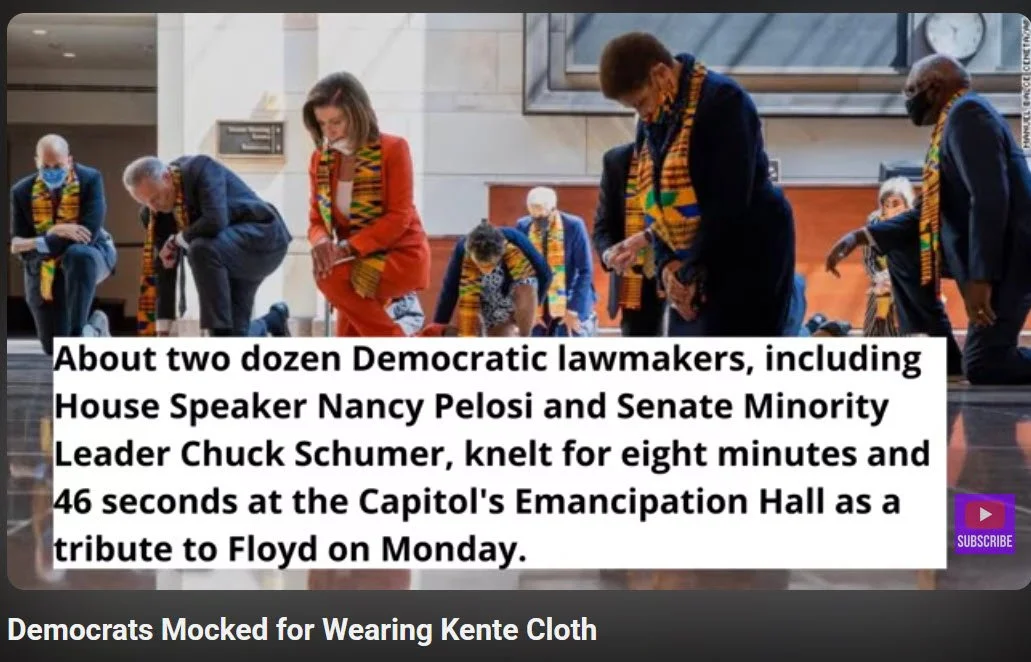
Congressional Democrats are being criticized over the stoles made of Kente cloth -- a traditional African textile -- they wore during a moment of silence for George Floyd. About two dozen Democratic lawmakers, including House Speaker Nancy Pelosi and Senate Minority Leader Chuck Schumer, knelt for eight minutes and 46 seconds at the Capitol's Emancipation Hall as a tribute to Floyd on Monday.
This remains the "gold standard" for performative critique in conservative media.
The "Prop" Argument: Outlets like The Federalist and National Review argued that using a sacred West African textile as a costume for a photo op was the height of pandering.
Legislative Substitution: A frequent talking point on Fox News was that Democrats "dressed up like a Wakandan chess set" (referencing a viral tweet at the time) instead of passing meaningful bipartisan police reform. The argument was that symbolism became a shield for a lack of legislative consensus.
The Kente Cloth "Photo-Op": Conservative pundits like Ben Shapiro and various Fox News hosts have mocked this as the ultimate "cringe" moment. The visual of elderly, wealthy politicians struggling to get back up from a kneel while wearing matching scarves was described as a scene straight out of a satirical comedy. To the right, it looked like a group of people who had never met a regular voter in their lives trying to "cosplay" solidarity.
The "Kente Cloth" Prom Disaster: The Federalist and various Fox News panels have mocked the 2020 kneeling incident as a "theatrical production" gone wrong. To them, it looked like a group of people who had never been to a "cool" party trying to dress the part and failing so hard it became a meme. The "cringe" comes from the fact that they clearly thought they looked heroic, while the rest of the world saw a low-budget costume drama.
2. Singing and "Social Media Theater"
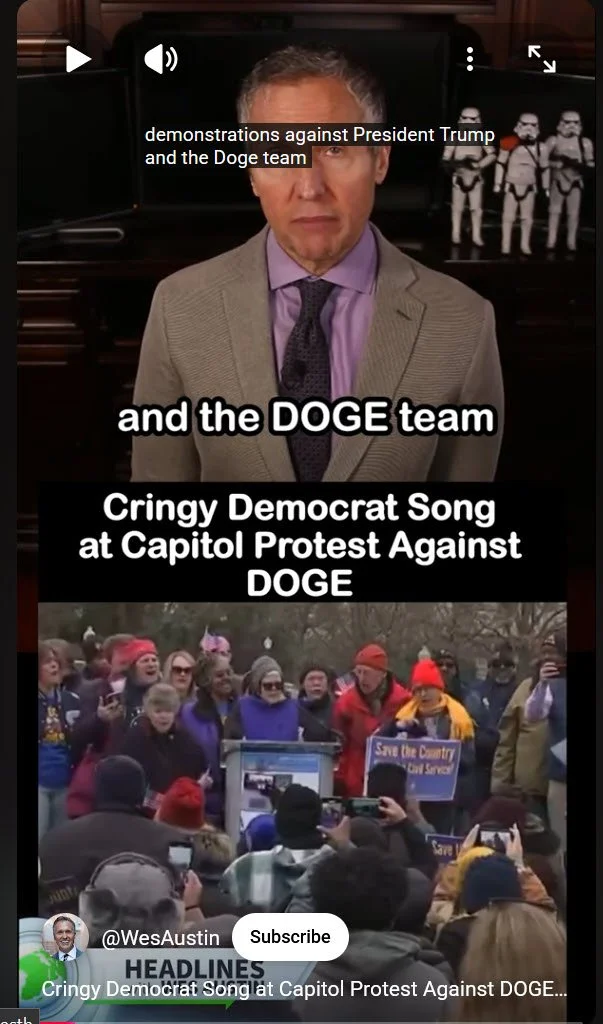
Conservative commentators often frame Democratic attempts to go viral through singing or "youth-coded" social media posts as desperate.
The "Cringe" Factor: Personalities on The Five and other opinion shows frequently highlight clips of Democratic leaders singing (e.g., about voting rights or abortion access) to paint the party as out-of-touch "coastal elites" who treat serious governance like a high school musical.
Avoidance of "Kitchen Table" Issues: The critique here is that while the country deals with inflation or border security, Democrats are "singing into their phones." It is framed as a retreat into safe, progressive echo chambers.
The "TikTok-ification" of Politics: When Democratic members of Congress post videos of themselves singing about serious policy issues (like the viral clips of singing about the overturning of Roe v. Wade), the conservative response is usually a mix of laughter and horror. The critique is that it looks silly and infantile, treating the U.S. Constitution like a high school talent show.
The "Main Character" Syndrome: Conservative pundits argue that these TikTok-style performances—singing about policy or dancing at protests—show a party that is "terminally online." They see it as a desperate plea for "likes" from the "in-crowd" (the activist base and Hollywood elites) while the "rest of the school" (the average voter) just wants to eat their lunch in peac
3. "Furries" and Animal Costumes
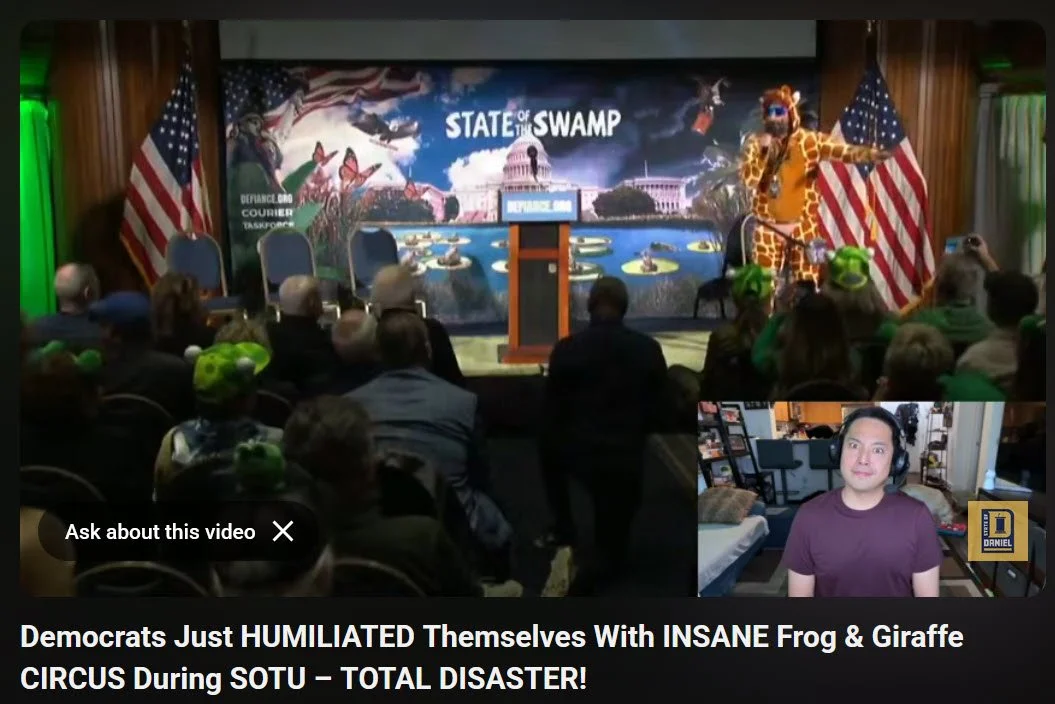
Democrats attempted to counter-program President Trump’s State of the Union with what can only be described as political theater—complete with frog costumes, giraffes, musical performances, and over 80 Democrats boycotting the SOTU. What was meant to be “resistance” quickly turned into a viral spectacle. In this breakdown, we analyze the Democrat counter-event, Joy Reid’s on-stage moment, the Portland “Frog Brigade,” and whether this strategy helps or hurts heading into the 2026 midterm elections. Beyond the optics, we examine early voting data in Texas, primary turnout trends, GOP base voter strength, and whether new Democratic voters can sustain momentum through November. CNN’s Harry Enten highlighted a major shift in Texas primary turnout—something not seen in over 20 years. Does primary voter enthusiasm predict control of the House? We look at historical election data from 2006, 2010, 2014, 2018, and 2022 to assess what this could mean for Congress, Speaker Mike Johnson, and President Trump’s second term agenda.
While less frequent at the leadership level, conservative media often amplifies fringe instances of activists in animal costumes at Democratic-aligned rallies or local events.
The "Not Normal" Narrative: This is often used to support the argument that the party has moved from being the party of "the worker" to the party of "the weird."
Cultural Estrangement: Figures like Noah Rothman have noted that the "cottage industry" of progressive symbolism makes the party look like a "foreign culture" to voters in the Midwest or the South.
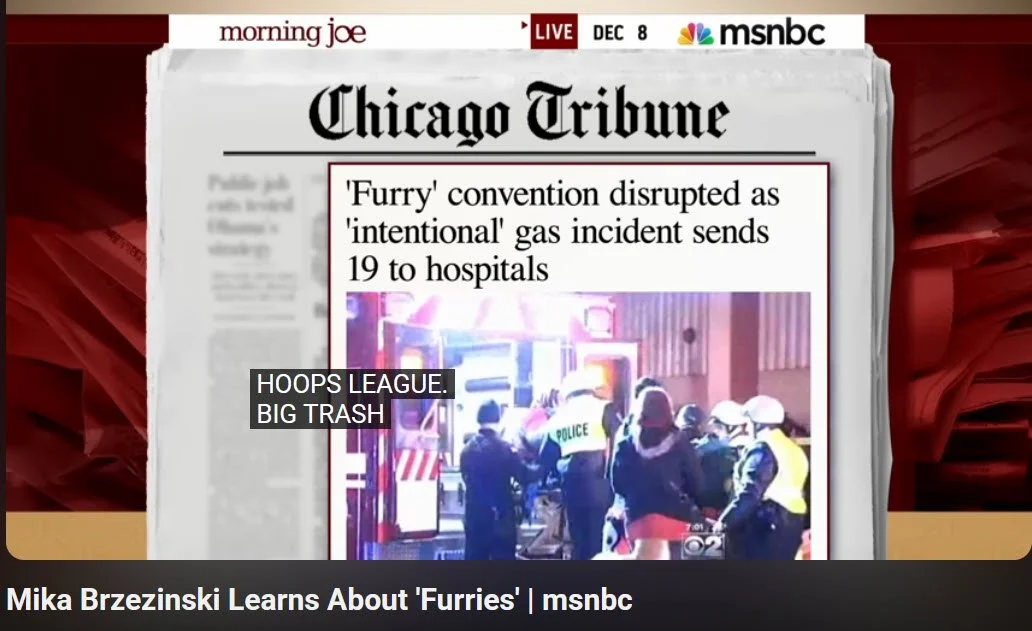
Mika Brzezinski learns what a "Furry" is and promptly runs off set.
The "Furry" and Animal Costume Tropes: Conservative influencers often hunt for the most "out-of-the-box" activists at Democratic events—people in animal ears or full fursuits—to claim the party has been hijacked by "the weirdos." The narrative is that the party has moved from the "Lunchbox Democrat" to the "Literal Cat Democrat," making them look totally out of touch with the average plumber in Ohio or a rancher in Texas.
The "Try-Hard" Energy: Critics like Ben Shapiro or Megyn Kelly often point out that when politicians start singing or adopting "youth-coded" costumes (like the "furry" or animal ear sightings at progressive rallies), they aren't actually being authentic. They look like the kid who spent all summer studying "cool slang" only to use it entirely wrong on the first day of schoo
The Resulting ArgumentActions
Seen as "performative" rather than "substantive.
Motivation
Viewed as a need to satisfy an "online mob" rather than the general public.
Vibe
Described as "unserious" or "theatrical."
Lack of Authenticity is Often Not Curable
Often, what we perceive as a lack of authenticity is actually a survival mechanism. People usually hide their true selves because:
Safety: They learned early on that being themselves resulted in rejection or conflict.
Social Friction: "Fitting in" is a low-energy path compared to the vulnerability of standing out.
The "Vague Self": Some people haven't spent enough time alone to actually know who they are, so they default to reflecting others.
State of the Union Speech 2026
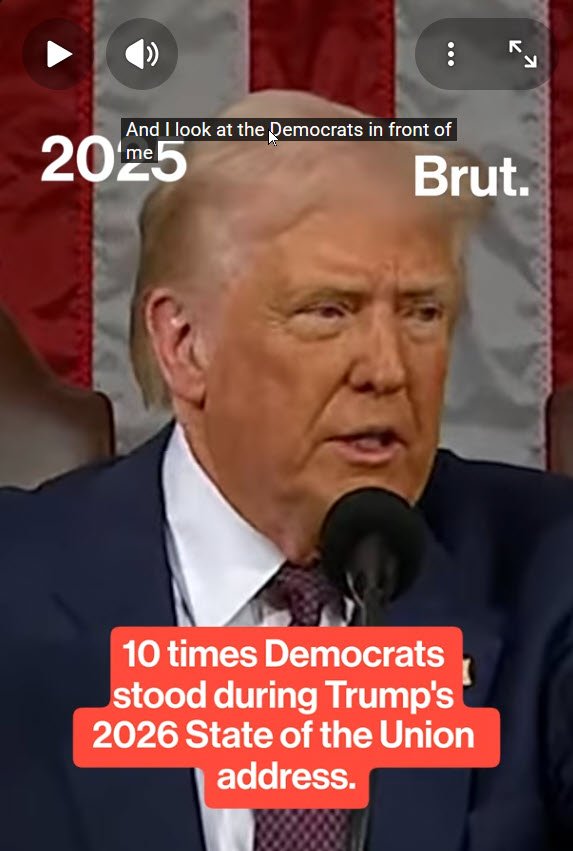
At the State of the Union address, there is no single official "conductor" with a baton, but the synchronized standing and clapping is a highly coordinated effort led by party leadership and their floor whips.
And as you watch above they still seemed confused
The goal is to present a "united front"—or a "united wall of silence"—depending on whether the President belongs to their party. Here is how that control is exercised:
1. Party Leadership and "The Whips"
The House and Senate Whips (and their assistants) are responsible for party discipline. During the speech, they often sit in prominent positions or circulate "cheat sheets" to members.
The "Cue" System: In the past, leadership has even distributed copies of the President's speech with specific applause cues marked in the margins.
Visual Cues: Often, rank-and-file members simply keep one eye on their party leaders (like the Speaker of the House or the Minority Leader). When the leader stands, the rest of the caucus follows suit instantly to avoid looking fractured on national television.
2. The Role of the "Floor Monitors"
Behind the scenes, staff members often act as "floor monitors." They watch for the "correct" moments to cheer or remain seated. If a member of the opposition party accidentally claps for a line that is secretly a "trap" (a partisan policy wrapped in bipartisan language), they may be corrected by peers or leadership afterward.
3. The "Peer Pressure" Effect
As noted by Senate historians, the chamber often behaves like a stadium crowd. Once the front rows of a party stand up, it creates a physical chain reaction. If you are a Democrat and the rest of your caucus is sitting stone-faced, standing up alone to clap for a Republican president is a major political statement (and vice versa).
4. Who Does Not Clap?
To maintain the appearance of neutrality, certain groups are strictly controlled by professional protocol rather than party politics:
Supreme Court Justices: They typically remain seated and silent to show judicial independence.
The Joint Chiefs of Staff: Members of the military do not applaud or stand for political points to signify that the military is non-partisan.
The Diplomatic Corps: Foreign ambassadors usually remain polite but neutral.
Summary Table: The Standing Dynamics
GroupTypical Behavior (President's Party)Typical Behavior (Opposition Party)Rank-and-FileFrequent standing ovations; "cheerleading."Mostly seated; "poker face" or checking phones.LeadershipLead the standing cues.Stay seated unless the topic is universally popular (e.g., veterans).The "Whips"Ensure 100% participation in cheers.Ensure no "accidental" cheering for partisan lines.
Would you like to know more about the history of the "Opposition Response" that follows the speech?