
The fundamental challenge of the modern digital age is the collapse of the traditional media gatekeeper, which forces us to act as the constant editors-in-chief of our own personal information ecosystems. Alternative commentators and podcasters often earn our initial trust by challenging institutional hypocrisies and speaking courageously. However, the financial and algorithmic incentives of independent media frequently reward a specific feedback loop that demands increasingly dramatic counter-narratives to maintain growth. Over time, the healthy skepticism that made these creators valuable watchdogs can drift into a wholesale denial of objective reality, transforming a straightforward tragedy supported by physical evidence into a conspiratorial plot.
Because credibility in the podcast world is built entirely on personal trust rather than institutional liability, we must accept that trust is a lease, not a permanent purchase. A commentator who was a reliable, insightful guide five years ago may not be a safe source of information today if they begin prioritizing audience grievance over verification. To protect our daily decisions from being hijacked by highly optimized outrage engines, we must continuously evaluate our sources based on how they handle hard correction, whether they sell clarity or paranoia, and if they encourage listeners to examine primary evidence. Vigilance is a heavy and exhausting tax to pay, but it is the only way to establish firm guidelines for who we invite into our homes as sources of truth.
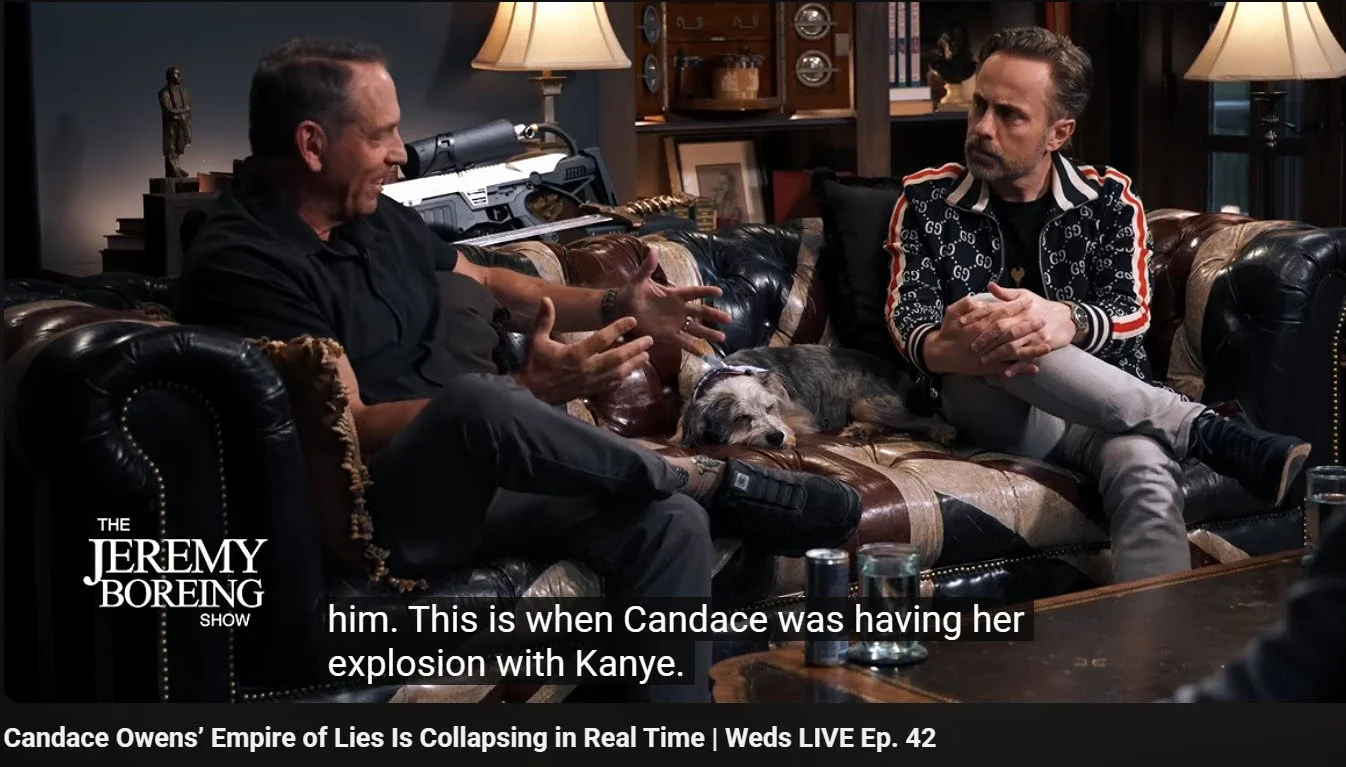
For Jeremy Boreing, watching the downward trajectory of Candace Owens isn't just a breakdown in journalistic ethics—it is a deeply sobering lesson in how the modern information ecosystem can completely hijack a person's moral compass. From his perspective, the tragedy of Candace's current state stems from an ongoing abdication of responsibility to her audience. She built her platform on courage and counter-narrative, but the highly optimized outrage engines of the internet demand a continuous escalation to keep the clicks flowing. Boreing sees this case as a devastating proof of a hard truth: trust is a lease, not a purchase. A commentator who was a brilliant, clear-eyed guide five years ago can become a dangerous source of delusion the exact moment they decide that maintaining an audience's grievances is more profitable than seeking objective reality.
When this media narrative collides with a real-world tragedy like the assassination of Charlie Kirk, Boreing argues that the monetization of conspiracy crosses a moral line into absolute malice. In his view, Candace is making a calculated bet that her followers lack basic legal literacy. By spinning a standard, preliminary probable-cause hearing into a sinister "show trial," she builds a psychological shield that allows her audience to pre-emptively reject ironclad physical facts—like DNA, surveillance video, and ballistics—before the prosecutors can even finish speaking. To Boreing, this isn't "just asking questions"; it is the deliberate weaponization of ignorance to protect a profitable storyline.
The most damning piece of this trajectory, from Boreing’s standpoint, is the real-world wreckage left in its wake. By baselessly pointing fingers at Charlie’s widow, Erika, or casting public institutions as dark, complicit forces, Candace constructs what researchers call a permission structure for targeted harassment. She doesn't have to explicitly order her followers to send death threats; she merely feeds them the righteous indignation that makes those actions feel justified, maintaining her own plausible deniability while real people suffer. Ultimately, Boreing frames this entire collapse not as a minor political disagreement, but as a stark warning to the listener. If independent media figures refuse to bind themselves to slow, unglamorous verification, it is up to us to continuously evict them from our homes before our own minds are hijacked.
Summary
The broadcast described is a case study in media accountability. It frames the situation not merely as a political disagreement, but as a moral failure where tragedy is monetized through the deliberate cultivation of grievance, speed, and conspiracy over slow, unglamorous verification.
Transactional Approach
That specific detail cuts straight to the bizarre, hyper-accelerated reality of their union. When you strip away the conventional framework of romance—the dates, the gradual courtship, the building of intimacy—the decision to marry in just over two weeks looks less like a traditional partnership and more like a sudden transaction or an impulsive leap of faith.
When Candace admitted there was no actual dating or physical intimacy before the proposal, it reframes the entire timeline. It means George’s FaceTime proposal on December 29, 2018, wasn’t the culmination of a whirlwind romance; it was the entirety of it. They jumped straight from a chance seat at a crowded London dinner table to a lifelong legal and spiritual commitment via a smartphone screen.
It completely validates why George’s friends and colleagues assumed he was "completely insane" or executing an elaborate joke. In any normal social ecosystem, committing your life, name, and future to someone you have barely spent a few hours with face-to-face is a massive gamble.
Yet, looking at how their marriage operates today, that lack of a traditional foundation explains a lot about their dynamic. By bypassing the usual emotional trial-and-error of dating, they essentially treated the engagement and early marriage as the courtship itself. They traded the slow, organic process of getting to know someone for a sudden, absolute alignment of ambition and worldview—proving that in the alternative media ecosystem, even the personal lives of its stars move at the breakneck speed of a viral trend.
The First Meeting: London
The couple met on a wintry night in December 2018 in London. Candace was in the UK filming an episode of Russell Brand's Under the Skin podcast, which ran long. Afterward, a mutual friend had arranged a large dinner gathering of about 30 people, which included political commentator Charlie Kirk.
Because the podcast ran late, Candace arrived three hours behind schedule and was seated directly next to George. According to the couple, George barely spoke to her during the initial dinner, though he was deeply struck by her mind and personality. George later shared that meeting Candace served as a profound turning point for him, describing it as a moment that brought him closer to his faith.
An 18-Day Engagement
Following their initial meeting, the relationship progressed rapidly. Despite the short timeline—and the fact that no explicitly romantic intentions had been formally declared in the days prior—George realized he wanted to marry her. On December 29, 2018, just 17 to 18 days after their first encounter, George proposed to Candace over a FaceTime call. The sudden engagement surprised their respective social circles. George noted that while his family was receptive, many of his friends and colleagues initially thought he was "completely insane" or that the announcement was an elaborate joke.
The Wedding
The couple remained engaged for eight months before officially tying the knot. They were legally married in a private capacity 48 hours prior to their formal event, before celebrating their large public wedding in August 2019 at the Trump Winery in Virginia
Their Marriage and Partnership Today
Following their marriage, George relocated from England to the United States to build a life with Candace. They currently reside in Nashville, Tennessee, and have four children together.
The couple frequently describes their marriage as a highly collaborative partnership that navigates distinct differences in personality and culture. While George leans toward a quieter, traditional British disposition, Candace describes herself as a more outspoken, bombastic American.
Professionally and domestically, Candace heavily relies on his counsel, jokingly referring to him as her household "Supreme Court" who plays an active role in vetting her travel schedules, public choices, and business operations.