Austin Mayor - Fraud and Liar
Segment #1045
Austin’s Leadership Failed the First Test After the ICE Shooting
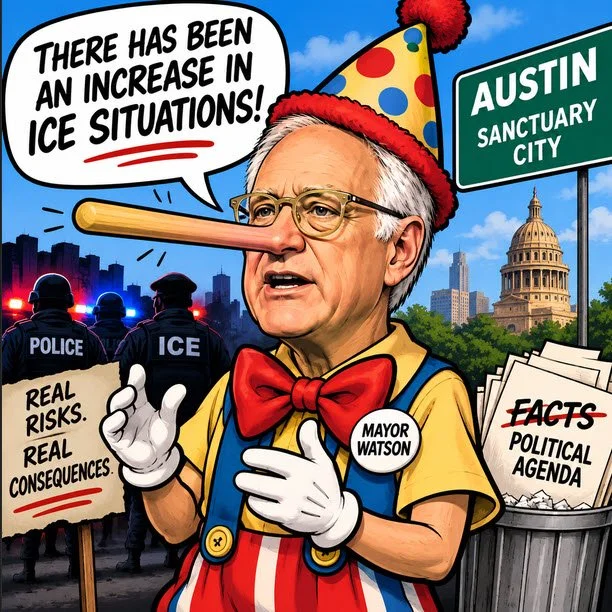
It disgusts me that Mayor Watson would rush to make inflammatory public claims before the facts were established and then use those claims to defend his sanctuary-city policies. A mayor has a responsibility to get the facts right, particularly when his words involve law enforcement and public safety. Reckless accusations can inflame tensions, undermine confidence in law enforcement, and potentially put both officers and citizens at greater risk. Mayor Watson is entitled to defend his policies and criticize federal immigration enforcement, but he is not entitled to his own facts.
Once the investigation establishes what actually happened, there should be accountability. If Watson made materially false accusations, give him 48 hours to publicly retract and correct the record. If he refuses, the appropriate state or federal authorities should examine whatever lawful remedies are available. If there is a legitimate cause of action, let him defend his statements in court, where evidence—not political rhetoric—determines the facts. And let that proceeding force the public debate much of the media seems unwilling to have: How far should an elected official be allowed to go in making accusations against law enforcement before the evidence is known?The first responsibility of political and police leadership after an officer-involved shooting is remarkably simple: establish the facts before reaching conclusions.
Austin Mayor Kirk Watson and Police Chief Lisa Davis failed that test in their handling of the September 20 ICE shooting.
The problem is not that Watson questioned ICE. Federal law-enforcement officers should be subject to investigation when they shoot someone, just as local police officers should be. The problem is that Watson began delivering a political indictment of ICE before Austin officials could even explain what had happened.
That distinction matters.
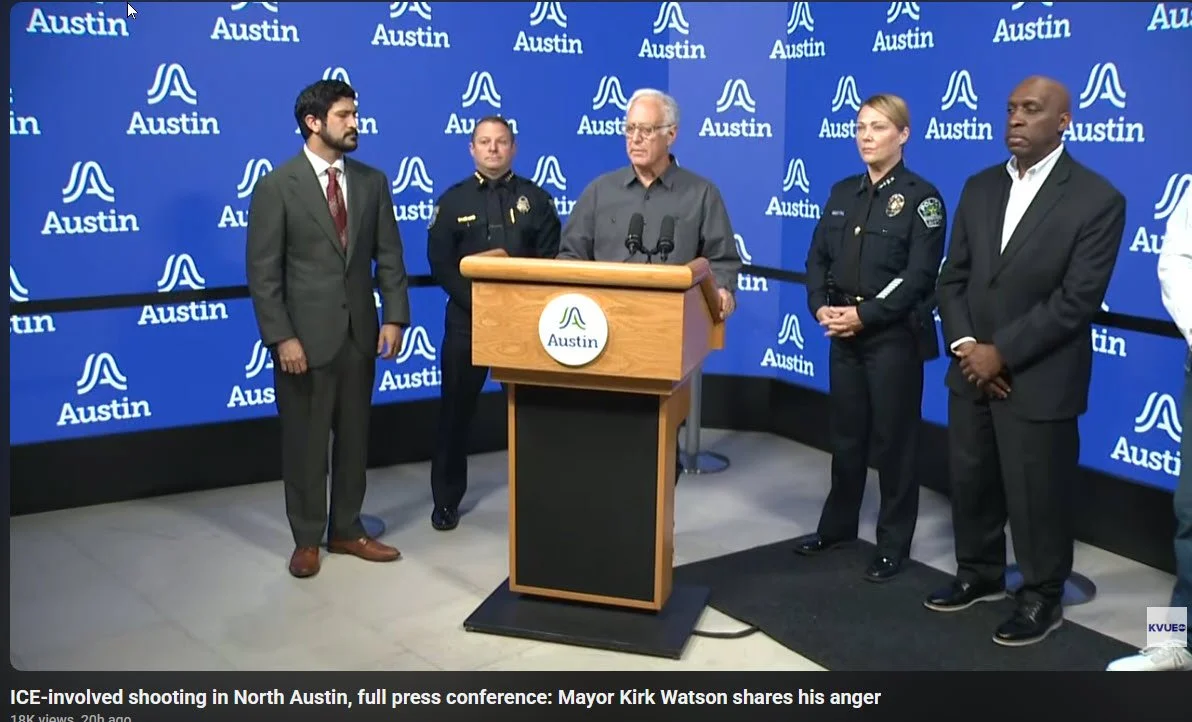
At the initial press conference, Davis acknowledged that APD had only limited information about the shooting. Public reporting at the time established that an ICE officer had shot 28-year-old Venezuelan national Wilber Rafael Garces Perez after an encounter in North Austin and that Perez was hospitalized in serious but stable condition. Critical questions about what precipitated the shooting remained unanswered. (AP News)
Yet Watson was already publicly attacking ICE and portraying the incident within his broader criticism of federal immigration enforcement.
That was premature.
Watson Put Politics Ahead of Evidence
A responsible mayor did not need to defend ICE.
He needed to defend due process and factual investigation.
Watson could have said that Austin did not yet know whether the shooting was justified, that the city expected complete federal cooperation, and that no conclusions should be reached until investigators obtained witness statements, video, forensic evidence and the officer's account.
Instead, he effectively supplied the political narrative before investigators supplied the evidence.
That is particularly troubling because Austin's own approach to police critical incidents recognizes the importance of separating preliminary information from final conclusions. APD has previously emphasized when releasing information about its own critical incidents that the facts are preliminary because the investigation remains at an early stage. (City of Austin)
Federal officers deserve the same evidentiary standard.
If an ICE agent acted unlawfully, the evidence should establish it and the officer should be held accountable. If the officer reasonably believed deadly force was necessary, the evidence should establish that as well.
The mayor should not decide which story he prefers before either has been proved.
Chief Davis Should Have Been the Adult in the Room
Chief Lisa Davis's performance deserves scrutiny for a different reason.
A police chief understands better than almost anyone why officials must be extraordinarily careful during the first hours of an officer-involved shooting.
Evidence is still being gathered. Witnesses have not necessarily been interviewed. Video may not have been reviewed. Investigators may not yet know what the officer saw, what the person who was shot did, or what happened during the seconds immediately preceding the gunfire.
Davis therefore had an obligation to draw a bright line between verified facts and political commentary.
Instead, Austin presented the public with the extraordinary spectacle of a police chief acknowledging the shortage of information while standing beside a mayor making sweeping condemnations of the federal agency involved.
Davis herself reportedly warned against getting in front of cameras too quickly without sufficient information. That principle should have governed the entire press conference.
If the facts were inadequate, say less.
If federal investigators had not provided sufficient information, say exactly that.
If Watson began moving beyond established evidence, Davis could have made equally clear that APD was not endorsing any conclusion about whether the ICE officer's use of force was justified.
That would have protected the integrity of her department.
There Is Also a Police-Safety Issue
This is where Watson's rhetoric becomes especially irresponsible.
Officer-involved shootings generate intense emotions. This one quickly attracted anti-ICE protesters. AP reported that protesters gathered near the scene soon after the shooting. (AP News)
There is no evidence presently establishing that Watson's comments caused those protests or caused violence, and it would be wrong to claim otherwise.
But political leaders should understand something very basic: words spoken by a mayor during a volatile police incident carry consequences.
Describing a law-enforcement agency in inflammatory terms before determining what its officer actually did can intensify public hostility toward officers who may still be working at the scene.
That is precisely when elected officials should lower the temperature rather than raise it.
Imagine the reverse situation.
Suppose an Austin police officer shot someone and, before APD had reviewed the body-camera footage, a federal official held a press conference accusing APD of rogue behavior and deliberately terrorizing the community.
Austin officials would quite reasonably demand that the federal government wait for the evidence.
ICE officers deserve the same presumption of an investigation before condemnation.
Davis Should Understand This Better Than Watson
Austin itself maintains procedures governing police critical incidents and public release of evidence. Its policies contemplate releasing relevant video and other information precisely because evidence—not political rhetoric—is ultimately what allows the public to evaluate police conduct. (City of Austin)
That makes Davis's position particularly difficult to defend.
She knows how carefully an officer-involved shooting must be investigated.
She knows how dangerous incomplete information can be.
And she knows that police officers should not have their conduct adjudicated at a podium before investigators have reconstructed what happened.
A police chief cannot demand evidentiary restraint when her own officers are involved and tolerate political prejudgment when federal officers are involved.
The standard has to be the same.
The Evidence May Ultimately Vindicate Either Side
None of this proves that the ICE shooting was justified.
It may not have been.
The investigation could eventually produce evidence severely damaging to the ICE officer. Conversely, video, witness statements or forensic evidence could demonstrate that the officer reasonably perceived an imminent threat.
That uncertainty is precisely the point.
Watson didn't know. Davis didn't know. The public didn't know.
And yet Austin's mayor was prepared to move from uncertainty to condemnation.
That isn't transparency. It isn't careful leadership. And it isn't how government should handle an unresolved police shooting.
The proper response required only a few sentences:
We don't yet know what happened. We will obtain the evidence. We expect complete cooperation from federal authorities. We will protect the public, protect the integrity of the investigation, and follow the evidence wherever it leads.
Instead, Austin allowed an unresolved shooting to become a political argument almost immediately.
Watson bears primary responsibility for making that choice.
Davis bears responsibility for participating in a presentation in which the city's political rhetoric ran substantially ahead of the known evidence.
For both officials, the lesson should be straightforward:
Investigate first. Establish the facts. Then speak.
Anything else risks undermining the investigation, damaging public confidence and making an already volatile encounter between police and the public even more dangerous.
I deliberately made the strongest argument around professional standards, premature judgment, equal treatment of ICE and APD officers, and officer safety. That makes the criticism harder to dismiss as simply pro-ICE or anti-Watson rhetoric.
The facts as of September 24, 2026 - What Watson should have known before speaking
Immigration status: Federal officials say Garcés Pérez is subject to a final deportation/removal order. His attorneys say he originally entered the United States legally in 2024 through the Biden-era CBP One/parole process and applied for asylum, but subsequently missed an immigration hearing because notice allegedly went to the wrong address. Thus, describing his original entry as simply an illegal border crossing appears inaccurate; describing him as currently subject to removal is supported by the available record.
What happened: According to DHS officials cited in subsequent reporting, Garcés Pérez initially drove away and nearly struck an ICE officer. Officers pursued him. During another attempt to detain him, he allegedly attempted to drive away again, and an ICE officer fired, striking him. Those details remain part of an active investigation rather than adjudicated facts.
The shooting: Garcés Pérez was hit once in the upper torso/back. He was hospitalized in serious but stable condition, discharged after roughly four hours and transferred to the South Texas ICE Processing Center in Pearsal
Investigation: DHS's Homeland Security Investigations is investigating with FBI assistance. Local authorities have also sought involvement in investigating the shooting. Reuters
Deportation temporarily blocked: A federal judge ordered Garcés Pérez to appear at a September 30 hearing, which effectively prevents the government from deporting him before that hearing.