Are You Better Off - A Comparison
Segment #1036
Presidential candidates often ask, “Are you better off than you were four years ago?” But that is not the only question voters should be asking. The more consequential question is: Will you be better off four years from now than you are today?
The evidence matters. Compared with four years ago, wages have recovered relative to inflation, violent crime has declined substantially, murder is down sharply, and the country’s overall economic and public-safety position has improved. Not every family feels equally secure, and serious problems remain, but the measurable direction has been positive.
The midterm elections and the 2028 presidential election will determine whether that progress continues. If voters return control to the same political forces whose policies contributed to inflation, declining purchasing power, disorder and weakened public confidence, they should not expect a different result. The danger may be greater now because the political left has moved further left, increasing the potential economic and social consequences of those policies.
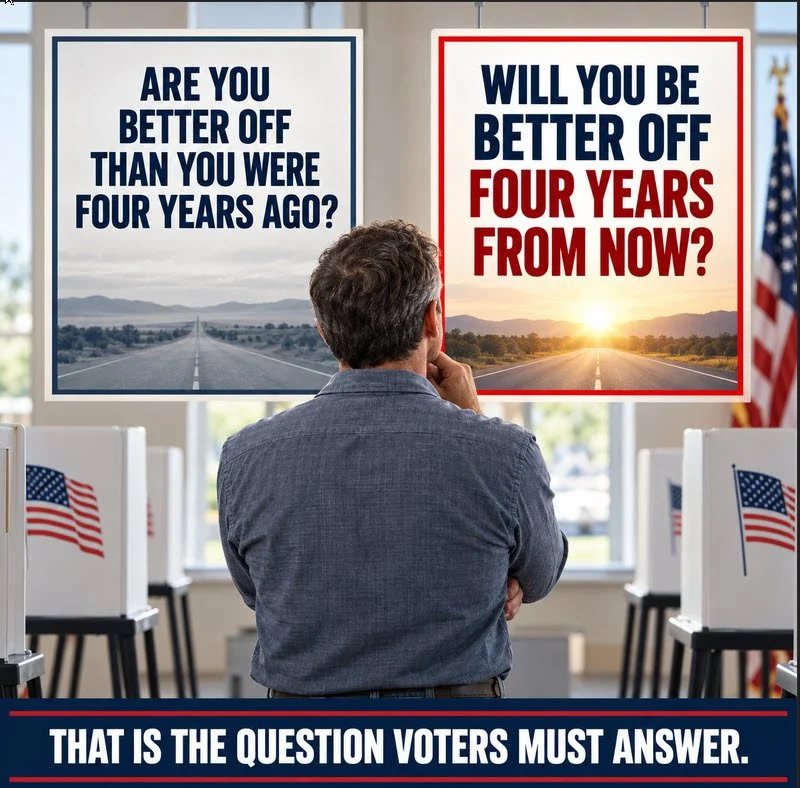
The choice is therefore not merely between the present and the past. It is a choice between two possible futures. Voters should ask themselves: Which policies made life better, which made it worse—and who can be trusted to protect that progress over the next four years?
The economic record of 2022 was the direct consequence of reckless progressive governance: uncontrolled spending that triggered a 40-year inflation crisis, an erased southern border that overwhelmed domestic resources, soft-on-crime policies that gutted metro business districts, and welfare expansion that paid working-age adults to stay home.
By contrast, 2026 demonstrates the results of enforcing the rule of law, restoring fiscal sanity, and protecting domestic industry.
Economic Indicator
2022 (Biden-Era High-Water Mark)
2026 (Trump / Conservative Policy Stance)
Headline CPI Inflation
Biden - 8.0% (surging to a crippling 9.1% peak)
Trumo - 3.4%
Biden’s multi-trillion-dollar spending sprees vaporized family budgets. Freezing runaway federal programs and prioritizing domestic energy curbed the 2022 hyper-inflationary spike.
Gasoline & Energy
Biden - Gas hit an all-time record $5.02/gal
Trump - Normalized; regulatory shackles cut
The war on domestic drilling and pipeline cancellations in 2022 drove energy costs to record highs, functioning as a direct tax on working-class commuters.
Federal Funds Rate
Biden - Rapidly spiked from ~0% to 4.50%
Trump - 3.75% – 4.00%
The Federal Reserve was forced into the most brutal rate-hike campaign in modern history to clean up the administration’s inflationary stimulus mess.
Unemployment Rate
Biden - 3.6% (artificially suppressed labor pool and expanding government by hiring)
Trump - 4.1% (native wage growth prioritized)
2022 "low" unemployment masked millions dropping out of the labor pool due to welfare handouts. 2026 enforces work requirements and protects American paychecks.
Net Illegal Border Crossings
Biden - 2.4+ Million encounters (Record High) 10 - 15 million unvetted illegal aliens crossed over the border
Trump - Plummeted via strict border enforcement
Millions of unvetted migrants in 2022 strained municipal budgets, overcrowded public schools, and depressed entry-level wages for legal American workers.
Retail Theft & Shrink Losses
Biden - Over $112 Billion nationally
Trump - Cracked down via zero-tolerance policing
Radical "bail reform" and decriminalization of retail theft turned major metros into lawless zones, forcing nationwide store closures and raising prices for law-abiding shoppers.
Personal Saving Rate
Biden - Collapsed to ~3.3%
Trump - Rebuilding household capital
Working families depleted their savings and maxed out credit cards in 2022 just to pay for eggs, fuel, and rent.
Crime Statistics
Violent crime Trump 2026 Compared to Biden 2022
All violent crime - Down 10.6%
Murder/nonnegligent manslaughter - Down 23.0%
Rape - Down 18.6%
Robbery - Down 19.6%
Aggravated assault - Down 7.2%
Property crime
All property crime - Down 22.1%
Burglary - Down 29.0%
Larceny-theft Down 19.1%
Motor-vehicle theft Down 30.6%
FBI - Arrests
2020 - 2022- Top10 Most Wanted - 4; All Arrests - Not released
20NO 24 - 2026 - Top 1o Most Wanted -10: All Arrests - 67,000
Wages and Cost of Living
The cost-of-living problem was considerably worse during 2020–2022:
Prices rose almost 14%.
Wages rose approximately 10%.
The average worker’s purchasing power declined materially.
From late 2024 through August 2026:
Prices rose approximately 6.1%.
Wages rose approximately 5.8%.
Purchasing power was essentially flat, though slightly lower.
The Policy Breakdown: Destruction vs. Restoration
Border Security vs. The Open Border
The Progressive Result (2022): Open-door asylum abuse and parole flooded cities with millions of low-skill entrants. This created an immediate fiscal crisis for taxpayers—who footed the bill for emergency shelters, free healthcare, and legal aid in cities like New York and Chicago—while flooding the lower end of the labor market and suppressing blue-collar wage growth.
The America First Policy (2026): Restoring Title 42-style enforcement, ending catch-and-release, and executing deportations ends the taxpayer subsidy of foreign nationals, removes the strain on state budgets, and ensures wage gains flow directly to American citizens.
Law and Order vs. Soft-on-Crime Experiments
The Progressive Result (2022): De-policing, elimination of cash bail, and progressive prosecutors refusing to charge property crimes led to rampant retail shrink, carjackings, and commercial blight. Major retailers were forced to shutter profitable locations across San Francisco, Chicago, and Philadelphia, gutting city property tax bases and driving away capital.
The America First Policy (2026): Unapologetic backing of local police, targeting organized retail crime rings, and deploying federal resources to restore urban safety creates the baseline security required for small businesses to invest and operate without paying extortionate private security and insurance costs.
Work Incentives vs. The Expanding Welfare State
The Progressive Result (2022): No-strings-attached stimulus checks, expanded food stamps, and indefinite student loan payment pauses created a dependency trap that kept millions on the sidelines during acute labor shortages, fueling the "Great Resignation" and driving up service costs.
The America First Policy (2026): Enforcing strict work requirements for able-bodied adults on SNAP and Medicaid, alongside ending unconstitutional loan forgiveness schemes, restores the principle that work builds wealth while curtailing ballooning mandatory entitlement deficits.
School Choice vs. The Federal Education Monopoly
The Progressive Result (2022): Billions poured into failing public school bureaucracies beholden to teachers' unions, accompanied by executive attempts to transfer hundreds of billions in student loan debt onto blue-collar workers who never attended college.
The America First Policy (2026): Expanding Universal Education Savings Accounts (ESAs) empowers parents to direct tax dollars to the best private, charter, or trade schools, introducing free-market competition into a broken system and aligning education with marketable workforce skills rather than administrative overhead.