Who Wants to Talk About Karmelo Anthony
Correction of the Record: Final Jury Composition
The assertion that the final panel was an "all-white jury" is factually incorrect. The final jury panel selected to try the case actually consisted of:
7 White Jurors
3 Hispanic Jurors
2 Asian Jurors
While the panel did not include any Black members—which prompted the defense's Batson challenge—it was a multi-racial jury. The distinction is critical because the final panel reflected the wider demographics of Collin County, rather than a homogenous exclusion of all minority groups.
Strategic Vetting and Statutory Disqualifications During Voir Dire
The final composition of the jury was determined by standard, race-neutral procedural mechanisms under the Texas Code of Criminal Procedure (CCP), driven by explicit statements from the prospective jurors themselves rather than systemic exclusion.
Striking for Direct Bias (Texas CCP Art. 35.16)
The exclusion of certain prospective candidates came down to mandatory disqualifications for cause based on admitted bias:
The Admission of Racial Bias: A prospective African American juror was struck after explicitly stating on the record that he would "have a hard time putting a brother in jail." Under Texas law, any juror who openly admits they cannot evaluate the evidence objectively due to the defendant's demographic identity is legally disqualified. The prosecution is procedurally required to challenge such candidates to preserve the integrity of the state’s right to a fair trial.
The Fifth Amendment Conflict: Other prospective candidates directly disqualified themselves by stating that a defendant’s decision not to testify—which Anthony chose to do—would heavily influence their deliberations ("silence is deafening").
Peremptory Strikes and the "Educator" Strategy
The defense's Batson challenge focused on the state using three peremptory strikes to eliminate Black candidates who had not expressed explicit bias.
The State's Rationale: Assistant District Attorney Dewey Mitchell established a race-neutral justification: the state systematically struck individuals employed by school districts or educational institutions. Because the crime took place under a team tent during a high school track meet involving minors, the state’s strategy was to avoid jurors with an innate professional bias regarding student behavior, safety protocols, or campus administration.
Judicial Review: Judge John Roach Jr. reviewed the state’s strikes under established legal parameters and ruled them fully compliant, noting that the selection criteria were applied based on occupation rather than race.
Evidentiary Realities vs. Statutory Self-Defense
The jury's eventual consensus on a murder conviction and a 35-year sentence was anchored entirely in the state’s meticulous breakdown of Texas Penal Code requirements across 21 witnesses.
[Unlawful Entry into Tent] ➔ [Verbal Provocation/Taunts] ➔ [Escalation to Knife] ➔ [Fatal High-Force Strike]
      (Trespass)                 (Statutory Exclusion)         (Disproportionate)        (Proves Murder Intent)
The Breakdown of Self-Defense
Under Texas Penal Code § 9.31 and § 9.32, a self-defense claim collapses if the state proves either provocation or a lack of proportionality:\
The Aggressor Exclusion (§ 9.31(b)(4)): Anthony entered a tent reserved exclusively for Memorial High School—a school he did not attend. When asked to leave, eyewitness testimony from student-athletes proved he escalated the situation verbally ("I'm not leaving, f you all") and issued a physical challenge ("Touch me and see what happens"*). Under Texas law, an individual who provokes an encounter cannot claim self-defense unless they explicitly attempt to withdraw; Anthony did not.
Disproportionate Deadly Force (§ 9.32): Deadly force is only permissible to deter an imminent threat of death or serious bodily injury. The physical altercation between Metcalf and Anthony consisted entirely of pushing and shoving. Introducing a lethal weapon (a knife) into a minor fistfight or shoving match completely invalidates the statutory "reasonable belief" required to justify deadly force.
Forensic Proof of Intent
The forensic testimony delivered by the medical examiner sealed the state's case for murder over manslaughter. The autopsy proved that the blade was driven with severe, high-velocity force directly through Austin Metcalf’s heart. The mechanics of the wound structure contradicted any claim of an accidental or purely defensive flail, establishing a deliberate, lethal act.
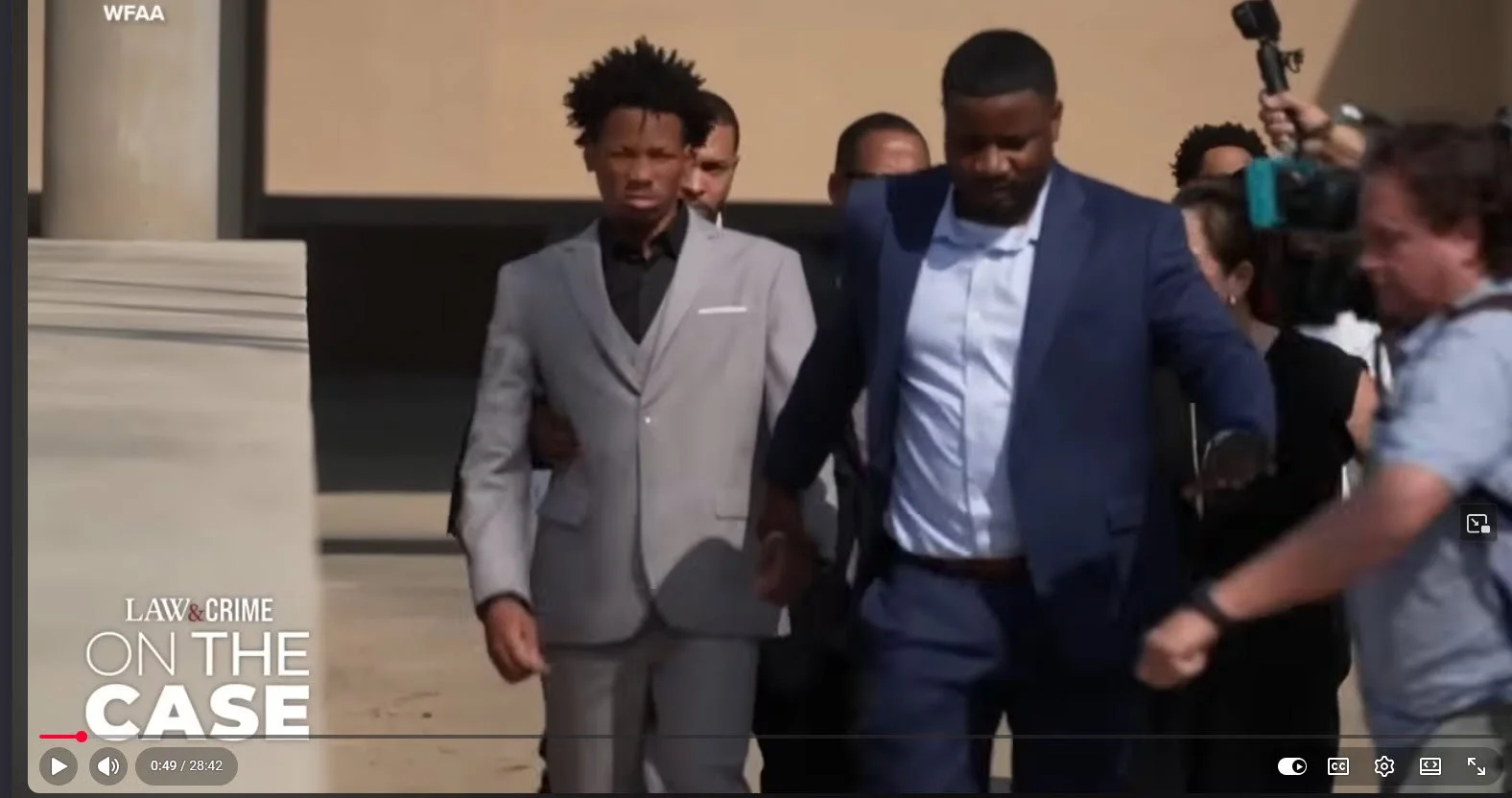
Karmelo Anthony made bail and was released from jail earlier this week. The teen is accused of stabbing star athlete Austin Metcalf to death at a track meet. When police caught up with Anthony, police say he was crying and confessed to the crime. A judge reduced Anthony’s bond from $1M to $250,000 and he posted bond. Law&Crime’s Chris Stewart breaks down alleged reports of Anthony using crowdfunding money to move into a mansion and threats the case’s judge is now receiving on this episode of On the Case.
Public Polarization and Outside Backlash
The public backlash following the 35-year murder conviction of Karmelo Anthony has manifested in targeted harassment, explicit death threats, and digital weaponization aimed at the Metcalf family—specifically targeting Austin Metcalf's twin brother, Hunter. Despite repeated public pleas from both families to keep race out of the narrative, outside actors have systematically used the digital sphere to inflict additional psychological trauma on the survivors.
Chilling Digital Harassment & Memes Targeting Hunter Metcalf
Hunter Metcalf—who witnessed his twin brother’s murder, frantically attempted to perform CPR under the team tent, and later delivered an emotional victim impact statement in court—has become a central focus of online vitriol from Anthony's supporters and internet agitators.
Weaponization of Court Footage and Audio
The digital harassment against Hunter escalated dramatically after the state introduced bodycam footage and audio into evidence.
The Splicing of Tragic Moments: Audio of Hunter screaming, "Oh, God, oh, God. My brother, my twin," as coaches and trainers desperately performed CPR on Austin, was captured on police bodycams. Rather than treating this as sensitive evidence, online trolls ripped the audio, creating highly disturbing memes, remixes, and viral short-form videos designed to mock Hunter's grief.
Vile Public Commentary: Hunter's direct words to Anthony during the sentencing phase—expressing that his twin brother was supposed to be the uncle to his future children—were met with widespread mockery across X (formerly Twitter) and TikTok. Trolls flooded public threads with comments taunting Hunter, claiming that his brother "f***ed around and found out" or got what he deserved in the track meet altercation.
Direct Threatening Correspondence
According to security and media reports, explicit digital messages have been directed toward the family’s personal accounts and phone numbers, stating:
"Should've stabbed Hunter too."
These communications directly imply that Hunter should have met the same fatal end as his twin brother under the Kuykendall Stadium tent, escalating the harassment from general online trolling to targeted, actionable domestic terror.
Symmetrical Death Threats and the Reality of Both Families
The severe drop in public decency has extended beyond Hunter to include the broader families of both the victim and the defendant. Leaders on both sides have detailed a lifestyle of ongoing fear, even after the legal system reached a definitive conclusion.
Ongoing Threats to Jeff Metcalf and the Victim’s Family
Austin and Hunter's father, Jeff Metcalf, confirmed to local and national media that the conclusion of the trial did not stop the deluge of hatred.
Post-Verdict Vitriol: Following the 35-year sentence handed down by the multi-racial jury, Jeff Metcalf reported receiving a massive spike in explicit death threats. "Yesterday, I had a death threat; this morning, I had multiple emails, texts threatening me, calling me all sorts of names," Metcalf stated to reporters.
Grave Desecration Taunts: Beyond standard death threats, the family has received explicit digital messages threatening to physically vandalize and soil Austin Metcalf’s grave in Frisco, forcing local law enforcement to keep a heightened watch on the cemetery area.
The Continuation of Swatting: The family remains on high alert following multiple instances where swatting teams arrived at their residences with weapons drawn due to fraudulent emergency calls made by anonymous bad-faith actors.
Symmetrical Harassment of the Anthony Family
The toxic external environment has not been one-sided. Karmelo Anthony's parents, Kala Hayes and Andrew Anthony, have also spoken out about the constant state of fear they live in, demonstrating that the external radicalization has targeted both households regardless of the outcome.
"They Want Our Family Dead": Andrew Anthony candidly detailed the ongoing terror his family faces from the opposing side's extremists. "People want us dead," he stated. "After they still got what they wanted [the 35-year conviction], they still want us dead. I go look at my phone, people want us dead. They want our family dead."
Community Pressures: Minister Dominique Alexander, speaking on behalf of the Anthony family via the Next Generation Action Network (NGAN), emphasized that the family has been subjected to continuous, vile racism and localized safety threats that have completely upended their ability to live safely in the North Texas area
The Crowdfunding Totals & Intended Purpose
The Amount Raised: The family's official campaign on GiveSendGo ("Help Karmelo Official Fund"), organized by his mother, Kala Hayes, raised just under $634,000 before being shut down by the platform following the guilty verdict.
The Stated Terms: While initially perceived by critics as strictly a legal defense fund, the campaign's written disclosure explicitly stated that the money would also be used for "safe relocation of the Anthony family due to escalating threats to their safety and well-being, as well as basic living costs, transportation, counseling, and other security measures.
Current Status: GiveSendGo confirmed that the funds were dispersed over the last year for those stated pre-trial and relocation needs. Because the trial has concluded, the original campaign is officially closed, though separate activist-led fundraising efforts have since emerged.
Fact-Checking the Luxury Purchases (The Escalade & Gated Home)
The specific claim that the family immediately went out and bought a Cadillac Escalade or a luxury home with the donation money is false.
The Timeline Gap: The rumor that the family purchased an Escalade and a $900,000 home first went viral on social media (and was amplified by various public figures) in mid-April 2025.
No Funds Withdrawn: Both the Anthony family and GiveSendGo co-founder Jacob Wells confirmed at that time that the family had not withdrawn a single penny from the campaign when the rumors began circulating. The platform's processing period meant the money was completely inaccessible to them when the vehicle and housing claims were being pushed online.
The Gated Community Reality: Investigative reporting (including an initial story by the Daily Mail) noted that the family had moved into a rental home in a gated community during the pre-trial period, which was approved by the courts due to severe, documented safety threats and doxing. There was no evidence of a luxury vehicle purchase or property ownership connected to the fund.
Current Financial Status & Appeal
Despite the $634,000 raised and dispersed over the past year for legal fees, security, and living expenses, the family maintains that they are now exhausted of resources for the next phase of the legal battle.
Following the verdict, Karmelo Anthony filed a notice of appeal. In the court documents filed by WFAA, he requested a court-appointed public defender, officially declaring himself a "penniless, destitute, and indigent person, too poor to employ counsel to represent me on the appeal."
Where the $634,000 Went
Following Karmelo’s conviction and 35-year sentence, GiveSendGo officially shut down the "Help Karmelo" campaign and issued a public statement clarifying where the money went.
According to the platform, the funds have already been entirely spent and dispersed over the course of the 14-month pre-trial period. They were not sitting in a bank account at the end of the trial. Per GiveSendGo’s compliance review, the money was drained by:
High-end criminal defense attorney fees for a complex, two-week murder trial.
The cost of breaking their lease and completely relocating the family due to documented death threats and doxing.
Security measures and basic living expenses over the last year.
Their Current Financial Status
The family is currently broke. The evidence of this is a matter of official court record:
Immediately after the 35-year verdict, Karmelo Anthony filed his intent to appeal. To do so, he had to submit financial disclosure documents to the court to request a public defender. In those WFAA-obtained documents, he is officially designated as indigent, with the filing stating he is a "penniless, destitute, and indigent person, too poor to employ counsel to represent me on the appeal." If any substantial portion of that $634,000 remained accessible to the family, the court would have denied the request for a state-funded public defender.
Because the original funds are completely exhausted, local activists in Dallas have recently attempted to launch a brand-new, separate fundraising effort to help the family try to scrape together resources for the upcoming appellate process.
Final Conclusion
The treatment of Hunter Metcalf and the surrounding families reveals the dangerous nexus between modern internet culture and high-profile criminal cases. Because outside commentators completely stripped the trial of its statutory legal boundaries, the real-world survivors have been denied the ability to grieve in peace. Hunter Metcalf, in particular, remains the target of deeply malicious digital campaigns that transform a teenager's worst nightmare into viral content, backed by explicit, real-world promises of violence.
The conviction of Karmelo Anthony was determined by a multi-racial jury (7 White, 3 Hispanic, 2 Asian) that evaluated the case strictly on black-letter Texas law. The state’s 21 witnesses successfully proved that Anthony acted as the provocateur and deployed lethal force that was wholly disproportionate to a schoolyard shoving match. The absence of Black jurors was the result of standard, lawful voir dire disqualifications for explicit bias and race-neutral peremptory strikes. The outside racial polarization was driven exclusively by commentators who substituted ideological narratives for the actual trial transcripts.