
Segment #836
The March 2, 2026, Triggernometry episode titled "The Best Iran War Breakdown You'll See on the Internet" featuring Aimen Dean and Richard Miniter provides a comprehensive look at what they describe as a "total recalibration" of global power.
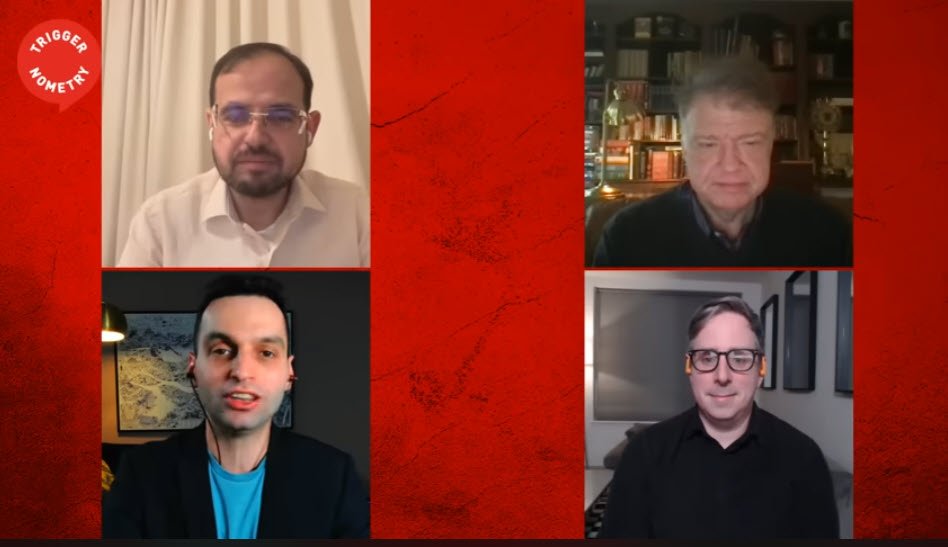
The average American voter, often focused on immediate "kitchen table" economic concerns, may struggle to appreciate the complex trade-offs required for long-term national security. This perspective frequently overlooks the necessity of enduring short-term hardship to ensure future stability and success.
Media commentators often mirror this narrow focus, delivering superficial analysis that caters to the audience's immediate emotional responses rather than challenging them with nuance. This creates a self-perpetuating cycle of reactive, "knee-jerk" public opinion. A greater sense of humility from these "talking heads"—including a willingness to acknowledge the limitations of their own insights or the possibility that their predictions could be wrong—would go a long way in elevating the national discourse. This is why the Triggernometry podcast is so important now.
Below is an expanded breakdown of the specific insights they shared during the 80-minute discussion.
1. The "Dead Hand" Strategy: Standing Orders
Aimen Dean provided chilling details on the IRGC’s "headless" operational capability. He explained that the Iranian regime anticipated a decapitation strike on its leadership.
Decentralized Command: Dean noted that the IRGC has shifted to a "cell-based" command structure where local commanders have pre-authorized "standing orders" to launch strikes against specific targets (U.S. bases in Iraq/Syria and oil infrastructure) if communication with Tehran is severed for more than 48 hours.
The Esotericism of the Regime: Dean emphasized that the regime’s eschatological beliefs (the return of the Mahdi) mean they view a period of "total chaos" not as a failure, but as a religious necessity. This makes conventional deterrence almost impossible.
2. Strategic "Long Play" Against Russia and China
Richard Miniter argued that the 2026 strikes were the culmination of a strategy to isolate the other two members of the "New Axis."
Russia’s Drone Supply: Miniter highlighted that by destroying the production facilities in Isfahan and Shiraz, the U.S. has effectively cut off Russia’s primary source of Shahed drones, significantly impacting the war in Ukraine.
China’s "Energy Blackmail": The guests discussed how China has been using Iran as a "proxy spoiler" to keep the U.S. bogged down in the Middle East. By engaging Iran directly and securing the Gulf, the U.S. is signaling to Beijing that its energy supply is now under Western "oversight," reducing China's leverage in the South China Sea.
3. The 1979 Context: The "End of the Road"
The podcast framed the current conflict as the inevitable conclusion of a 47-year cycle.
Failure of Engagement: Miniter argued that every U.S. administration since 1979—regardless of party—tried to find a "moderate" faction within the Iranian government to deal with. He stated that this latest engagement is an admission that no such faction exists.
Generational Shift: Dean pointed out that the current Iranian population (the Gen Z of Iran) has zero affinity for the 1979 Revolution. He suggested the "long play" also includes betting on an internal collapse once the IRGC’s funding is cut off by the destruction of their shadow banking networks.
4. Technical Insights on the Air Campaign
Miniter, drawing on his national security sources, shared that the scale of the initial 24-hour air campaign was "unprecedented in the 21st century."
Cyber-Physical Integration: He mentioned that before the first bombs fell, a massive cyberattack disabled the Iranian air defense grid (the "Bavar-373" system), making it appear as though the radars were functioning normally while they were actually being fed "looping" data.
Targeting Precision: The strikes specifically avoided civilian infrastructure, focusing instead on "IRGC Economic Hubs"—the businesses and ports that fund the regime's external terror operations.
American Voter Impatience
In the March 2, 2026, Triggernometry episode, Aimen Dean and Richard Miniter addressed the "elephant in the room": the growing fatigue and impatience of the American voter. They framed this not just as a domestic political hurdle, but as a strategic variable that the Iranian regime is actively trying to exploit.
1. The "Vietnam Clock" vs. the "Blitz"
Richard Miniter argued that the current administration is acutely aware that the American public has a very short "patience clock" for Middle Eastern interventions.
The Speed Mandate: Miniter suggested that the intensity of the recent air strikes was a direct response to voter impatience. The strategy is to achieve "maximum degradation" of Iranian capabilities in weeks, rather than years, to avoid the appearance of another "forever war."
Avoidance of Boots on the Ground: Both guests emphasized that any move toward a large-scale ground invasion would be a "political suicide note." They noted that the current strategy relies almost entirely on stand-off munitions (missiles and drones) and cyber warfare to keep American casualties near zero—the primary metric for voter tolerance.
2. The "Gas Pump" Factor
Dean and Miniter discussed how the American voter’s impatience is often tied directly to their wallets.
Energy Blackmail: Dean pointed out that Iran’s "standing orders" to harass shipping in the Strait of Hormuz are designed to spike global oil prices. The goal is to make the war so expensive for the average American commuter that the public demands a withdrawal.
The Counter-Strategy: Miniter noted that the U.S. has been leaning heavily on domestic production and strategic reserves to dampen this effect, attempting to "de-link" the war from the price of gas to buy the military more time.
3. Misreading the American "Long Play"
Aimen Dean offered a unique perspective on how Tehran perceives American impatience:
Regime Miscalculation: Dean argued that the Iranian leadership believes the U.S. is internally fractured and "weak." However, he suggested they might be miscalculating; while Americans are "impatient," there is a significant portion of the electorate that—after decades of tension since 1979—now views a "final resolution" with Iran as preferable to another 40 years of proxy conflict.
The "Pearl Harbor" Effect: They noted that if Iran’s decentralized cells successfully carry out a major strike on U.S. soil or a high-casualty attack on a Navy vessel, American "impatience" could instantly flip into "total resolve," much like the shift seen in historical conflicts.
4. The Influence of Alternative Media
The hosts (Konstantin and Francis) and the guests discussed how the "Triggernometry-style" audience—often skeptical of mainstream narratives—is processing this.
Skepticism of Intelligence: Miniter acknowledged that after Iraq and Afghanistan, the "burden of proof" required by the American voter is much higher. He argued that the administration is being forced to be more transparent with declassified evidence (like the "looping" radar data) to maintain public trust.
The "Zero-Choice" Narrative: The guests concluded that the most effective way to manage voter impatience has been the framing of the war as a necessity. By arguing that "there was no choice" because Iran was on the verge of nuclear breakout, the administration has managed to keep a fragile majority of the public on board—for now.
Key Takeaways on Voter Sentiment
Richard MiniterPublic patience is the "ultimate limit" on military operations; the war must be fast and high-tech.
Aimen DeanIran is counting on American "softness" and inflation to force a U.S. retreat.The HostsThe "anti-war" sentiment is high, but "anti-Iran-regime" sentiment is often higher among the core electorate.