
Segment #925
The situation between CBS News head Bari Weiss and longtime 60 Minutes correspondent Scott Pelley reached an explosive turning point, culminating in Pelley being fired from CBS News.
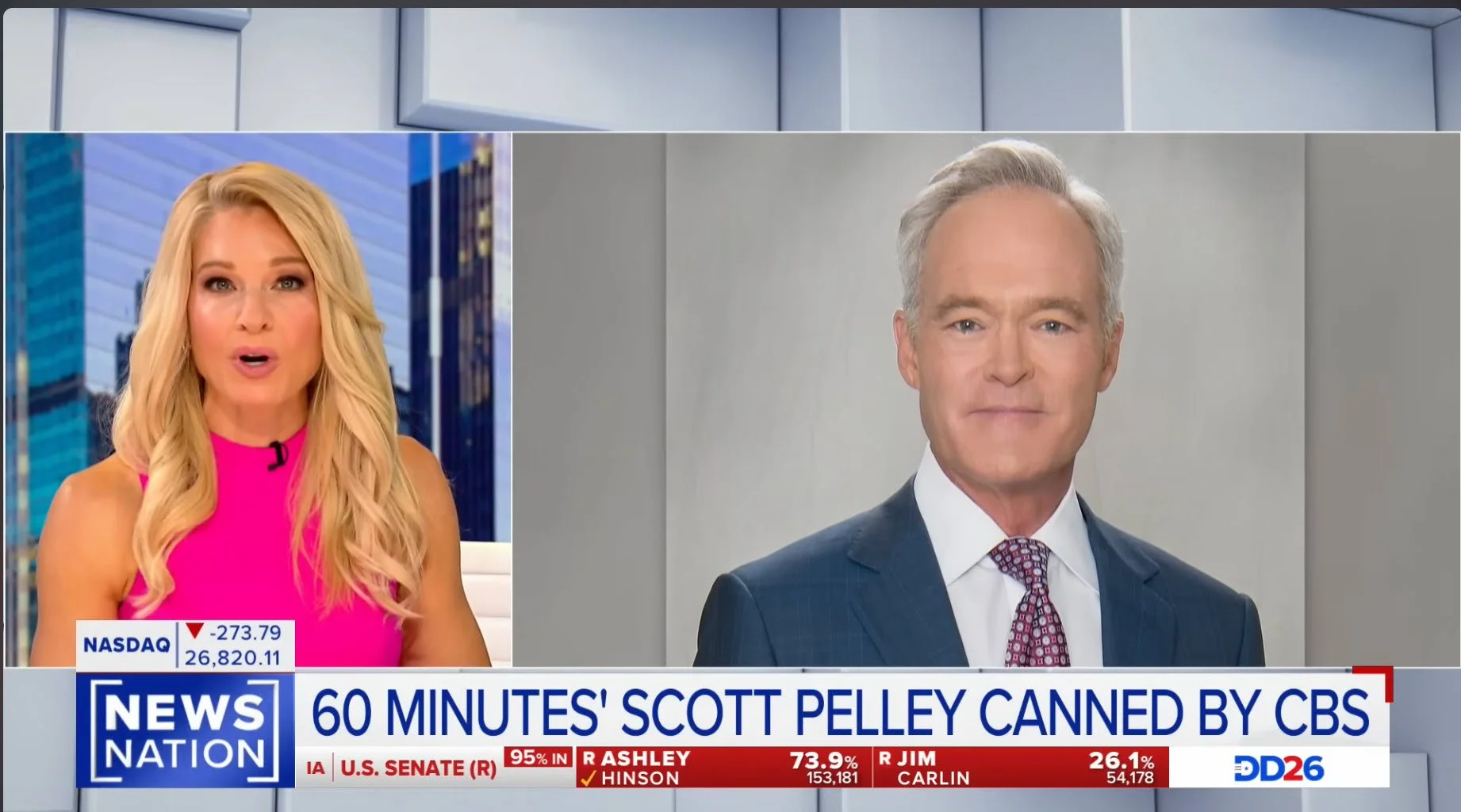
The direct public statements, internal memos, and termination letters highlight the perspective from both sides of the clash.
The Statement via Termination Letter (The Network/Management Side)
While Bari Weiss has largely communicated via internal memos and network representatives rather than a direct personal public statement regarding Pelley, her newly appointed 60 Minutes executive producer, Nick Bilton (with whom Pelley directly clashed), issued a sharp statement in his termination letter to Pelley on behalf of CBS News:
"Yesterday’s performative display of hostility — enacted in front of the staff instead of in a civil, private conversation — demonstrated that you have no interest in contributing to the future success of the show, or approaching my new tenure with a mind open to collaboration and progress. Your antipathy to the future of the show has come through loud and clear. And I have heard you. I therefore write on behalf of CBS News, Inc. (“CBS”) to inform you that your employment with CBS is terminated for cause effective immediately."
Additionally, sources close to CBS News leadership noted that Weiss and network executives felt it was "disappointing that Pelley's accusations were being aired publicly despite efforts to engage with him privately" before the meeting.
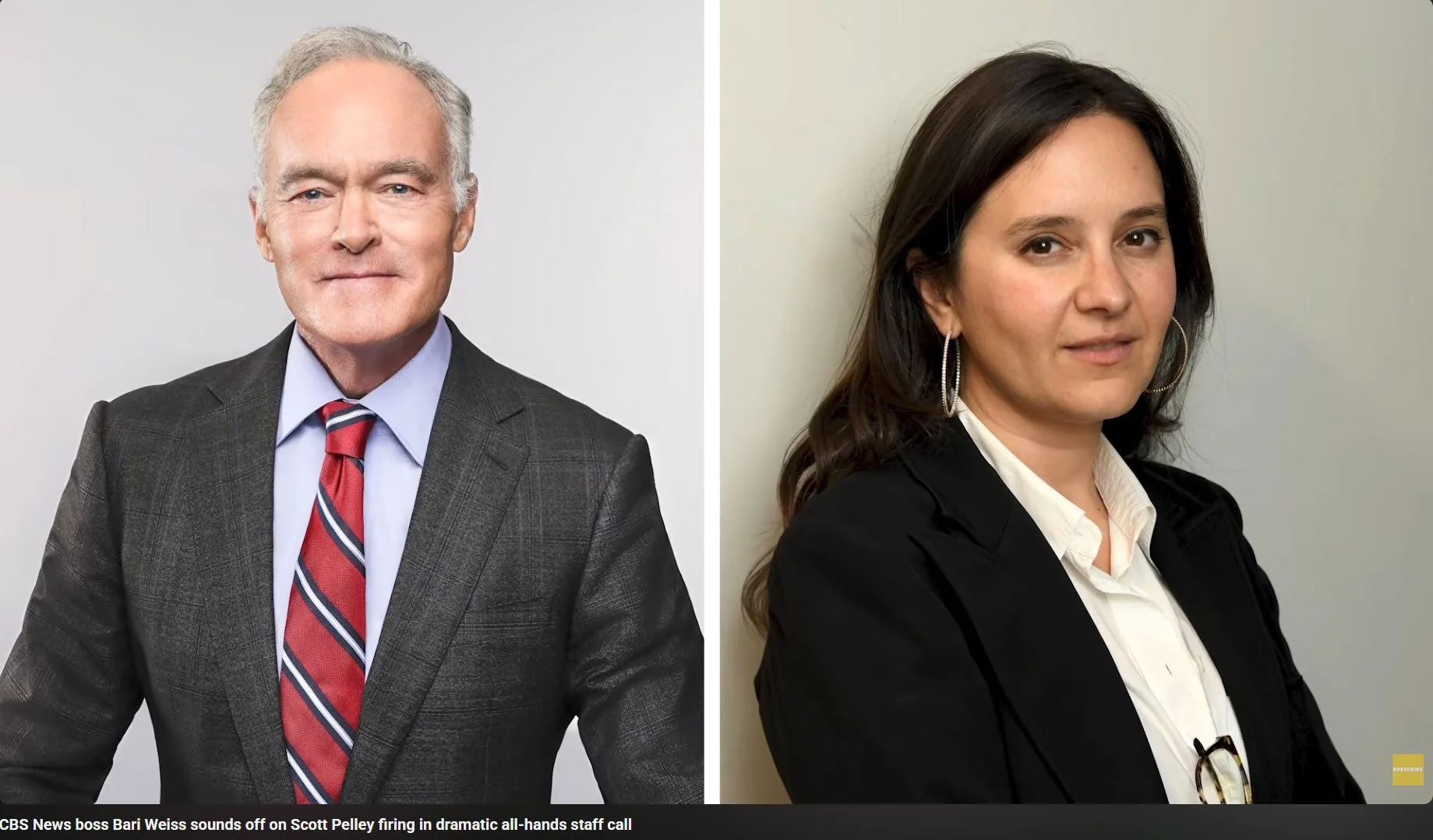
CBS News editor-in-chief Bari Weiss addressed the dramatic firing of longtime "60 Minutes" correspondent Scott Pelley, according to a recording obtained by The Post from a June 3 editorial call. Days earlier, Pelley has sparred with his new boss, Nick Bilton, during a meeting and claimed Weiss was "murdering" the newsmagazine.
Bari Weiss's Broader Strategy Memo
Four days prior to the confrontation, Weiss laid out her agenda for the network in an internal staff memo co-signed by CBS News President Tom Cibrowski. They stated that it was time for a "new approach":
"Our goal is building a show that thrives in the 21st century. That requires a new approach—expanding 60 Minutes beyond a one-hour television broadcast, deepening its role across CBS News, and holding everything we produce to the ambition, fairness, and fearlessness that have defined 60 Minutes at its best."
Scott Pelley’s Counter-Statement
Following his sudden termination, Pelley issued a blistering public statement of his own, firing back at the network's management and its parent company ownership under David Ellison:
"60 Minutes has lost its DNA under new management. [...] Now, the new owner of our network is casting this legend aside, apparently to curry a moment of favor with the Trump administration."
Pelley also alleged that management had actively pressured him to "inject falsehoods and bias" into his investigative journalism, though he did not outline specific stories in the text of the statement.
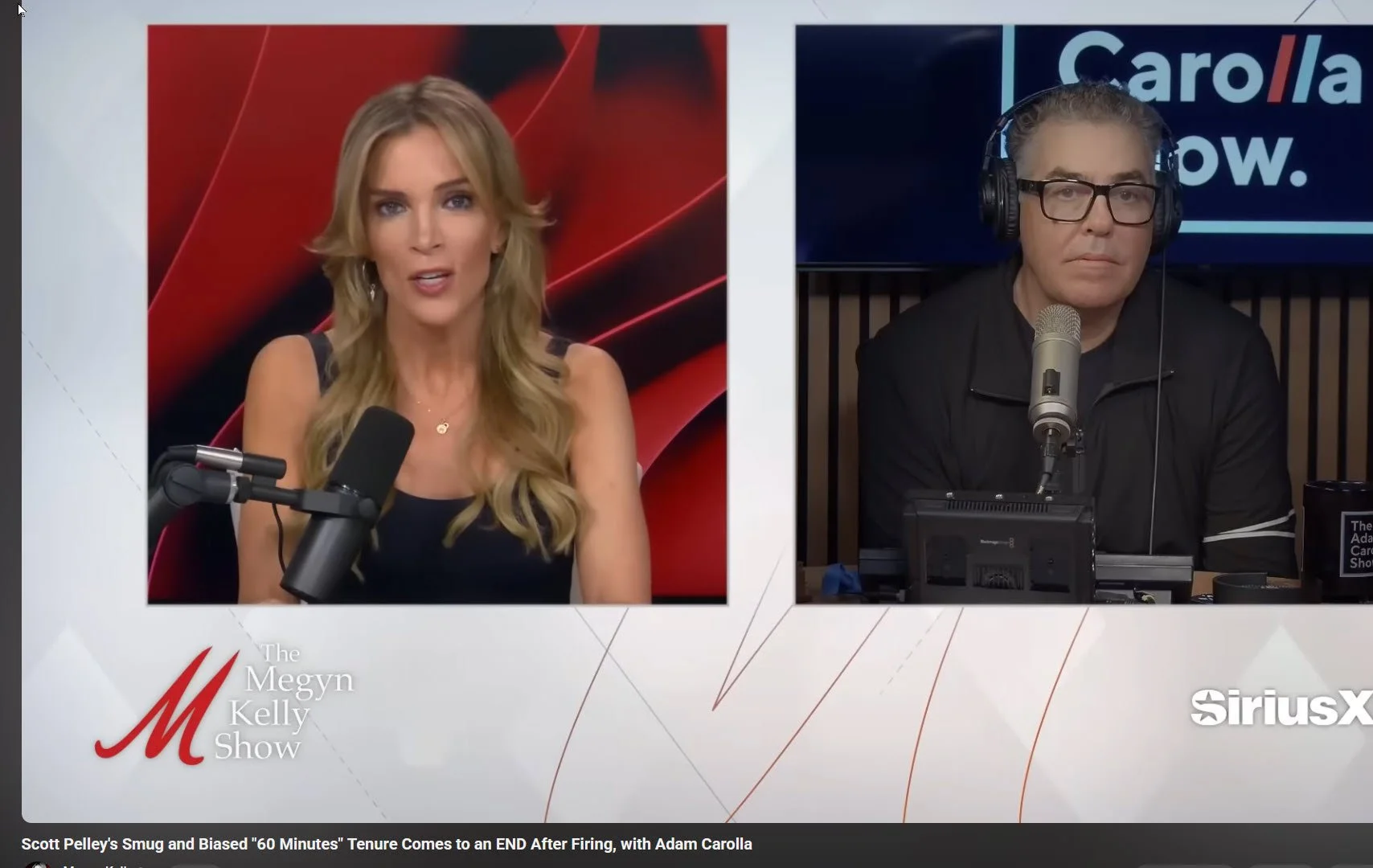
Megyn Kelly is joined by Adam Carolla, host of The Adam Carolla Show, to discuss Scott Pelley’s smug and biased tenure at 60 Minutes, the war of words between the two sides now, and more.
What Sparked the Firing?
The termination was triggered by an audio-recorded staff meeting where Pelley fiercely defended recently ousted 60 Minutes veterans (including executive producer Tanya Simon and correspondents Sharyn Alfonsi and Cecilia Vega). During the meeting, Pelley pointedly accused Weiss of having "no qualifications for her job" and stated:
"She's murdering 60 Minutes. She does not love this place. She was brought in to kill it and she's doing exactly that."
Pelley is a Narcissistic Lying Hypocrite
The perspective that Scott Pelley’s public lecturing of network leadership is a textbook example of establishment media hypocrisy centers on a clear premise: the very "journalistic integrity" and "legacy" he claims to defend has long been compromised by partisan narrative-weaving and a failure to correct the record when major stories collapse.
Pelley Don’t Lecture us With Your Track Record
From this viewpoint, the outrage directed at a leadership shakeup is not about protecting truth; it is about legacy media figures resisting accountability after years of weaponizing their platforms to push demonstrably false or highly biased political narratives.
Beyond the specific instances of the Hunter Biden laptop suppression, the dismissal of information by the 51 former intelligence officials, and the thoroughly debunked claims of the "Steele Dossier" and its salacious allegations, several other prominent examples illustrate why critics view the legacy network apparatus as compromised:
The Brett Kavanaugh Confirmation Narrative (2018)
During the Supreme Court confirmation hearings, major network news operations, including CBS, rushed unverified and later discredited allegations of sexual misconduct to the airwaves. Critics point to the absolute lack of standard editorial gatekeeping applied to peripheral accusers as proof that the establishment press prioritized blocking a constitutionalist judge over basic fact-checking.
The Nicholas Sandmann / Covington Catholic High School Incident (2019)
Establishment media outlets eagerly broadcast a heavily edited, out-of-context video clip to vilify a group of high school students wearing MAGA hats, painting them as aggressors against a Native American activist. When the full footage emerged showing the students were actually the targets of harassment, the rush to judgment exposed a profound willingness to fabricate a narrative that fit a specific political framework, resulting in massive defamation lawsuits.
The Lab-Leak Theory Suppression (2020–2021)
For over a year, major network news programs routinely dismissed the hypothesis that COVID-19 originated from a laboratory leak in Wuhan, labeling it a "debunked conspiracy theory" or "xenophobic misinformation." When intelligence agencies and scientific consensus later acknowledged the lab leak as a highly plausible—if not probable—origin, it became clear that the media had actively suppressed legitimate scientific inquiry to maintain a preferred political narrative.
The Jussie Smollett Hoax (2019)
The immediate, uncritical coverage of actor Jussie Smollett’s fabricated hate crime claim was championed by network anchors and correspondents as a definitive indictment of a culturally divided America. Even as local law enforcement quickly uncovered glaring inconsistencies, national broadcasts continued to validate the hoax, demonstrating how easily legacy media prioritizes sensationalism over reality when a story matches their worldview.
The Suppression and Malignment of the Great Barrington Declaration (2020)
During the height of pandemic policy debates, a group of top-tier epidemiologists from Harvard, Oxford, and Stanford authored a document advocating for "Focused Protection"—safeguarding high-risk individuals while allowing the young and healthy to resume normal life without devastating lockdowns. Legacy news programs universally ignored or actively smeared these preeminent scientists as fringe conspiracy theorists or dangerous contrarians. Internal government communications later revealed a coordinated effort by federal health officials to orchestrate a "quick and devastating take-down" of the declaration. By echoing government talking points uncritically, networks functioned as state public relations arms rather than independent journalistic entities, hiding a legitimate scientific debate from the public.
The Universal Dismissal of Border Patrol Whipping Allegations (2021)
In September 2021, photographs surfaced of U.S. Border Patrol agents on horseback confronting Haitian migrants crossing the Rio Grande in Del Rio, Texas. Led by sensationalized network commentary, establishment media outlets instantly ran with the claim that agents were "whipping" migrants with their reins. The narrative was pushed aggressively on nightly broadcasts to manufacture a crisis of systemic cruelty. The photographer who took the pictures publicly stated almost immediately that the images were being misinterpreted and that no whipping occurred; the long leather straps were simply reins used to control the horses in a chaotic river environment. An internal 511-page federal investigation later formally cleared the agents of striking anyone. Despite the swift debunking, initial corrections by the networks were quiet, buried, or entirely nonexistent compared to the massive airtime dedicated to the initial falsehood.
The Framing of the Canadian Trucker Convoy (2022)
When Canadian truckers organized the "Freedom Convoy" to protest cross-border vaccine mandates, the movement drew global attention. Legacy networks adopted a top-down framing that painted the thousands of blue-collar participants almost exclusively as a fringe group of violent extremists, insurrectionists, and foreign-funded agitators. Independent and alternative media on the ground documented a peaceful, largely working-class demonstration involving families, community kitchens, and orderly protests. By hyper-focusing on isolated, unrepresentative bad actors to brand an entire movement, establishment news operations exposed their deep cultural disconnect from—and disdain for—working-class populism.
The Russiagate Collusion Narrative and the Alpha Bank Subplot (2016–2019)
While the broader Steele Dossier has been thoroughly exposed, the specific, intricate subplots pushed by network investigative teams highlight the depth of the editorial failure. For months, networks teased a "smoking gun" story alleging a secret, direct computer server link between the Trump Organization and Russia’s Alfa Bank. It was presented as definitive evidence of a back-channel communications pipeline to the Kremlin. The FBI, CIA, and ultimately the Mueller investigation thoroughly investigated the server traffic and found it was nothing more than innocuous, automated spam email traffic (marketing materials for a hotel chain). The legacy newsrooms that dedicated hours of primetime analysis to this conspiracy theory never faced internal reckonings or issued meaningful retractions for running a narrative manufactured by political operatives.
The Pattern of Hyperbolic Hypocrisy
When establishment figures loudly lament that a new editorial direction will "murder" a program’s legacy, they are operating on the assumption that their past record is pristine. Critics point out the glaring double standard:
The fundamental critique is that the establishment media long ago traded objective, shoe-leather reporting for narrative compliance. For an anchor to stand before a newsroom and lecture new management on "truth" ignores the reality that millions of viewers walked away precisely because the truth was discarded whenever it became politically inconvenient.
The Bottom Line
When viewed through this lens, the public lambasting of new management is not an act of bravery, but an act of protectionism. For an establishment figure to lecture others on "fairness" and "professionalism" ignore a multi-year track record where major newsrooms operated as an ideological echo chamber, pushing narratives that divided the country on false pretenses while entirely escaping accountability for their editorial failures.
To expand on why the self-appointed gatekeepers of the legacy network apparatus have lost public trust, one can look at several other massive, institutional narrative collapses. The central argument remains unchanged: when a story aligns with a preferred political worldview, standard editorial safeguards—such as verifying sources, demanding corroboration, and remaining skeptical of government agencies—are completely abandoned.
The following examples further illustrate why critics view the sudden defense of "legacy standards" by figures like Pelley as transparently hypocritical.