
Segment #851
Negotiating with bad-faith actors who have spent fifty years calling for America's destruction is a failed strategy. Past agreements haven't stopped them from enriching uranium, building advanced weaponry, or funding terrorists. Logic suggests that diplomacy in this context is counterproductive; rather than achieving peace, it simply grants our adversaries the time they need to strengthen their military and political standing
Whether something is a war crime is about the intent and the balance between military gain and civilian harm. International Humanitarian Law (IHL), primarily the Geneva Conventions, provides the rulebook for this.
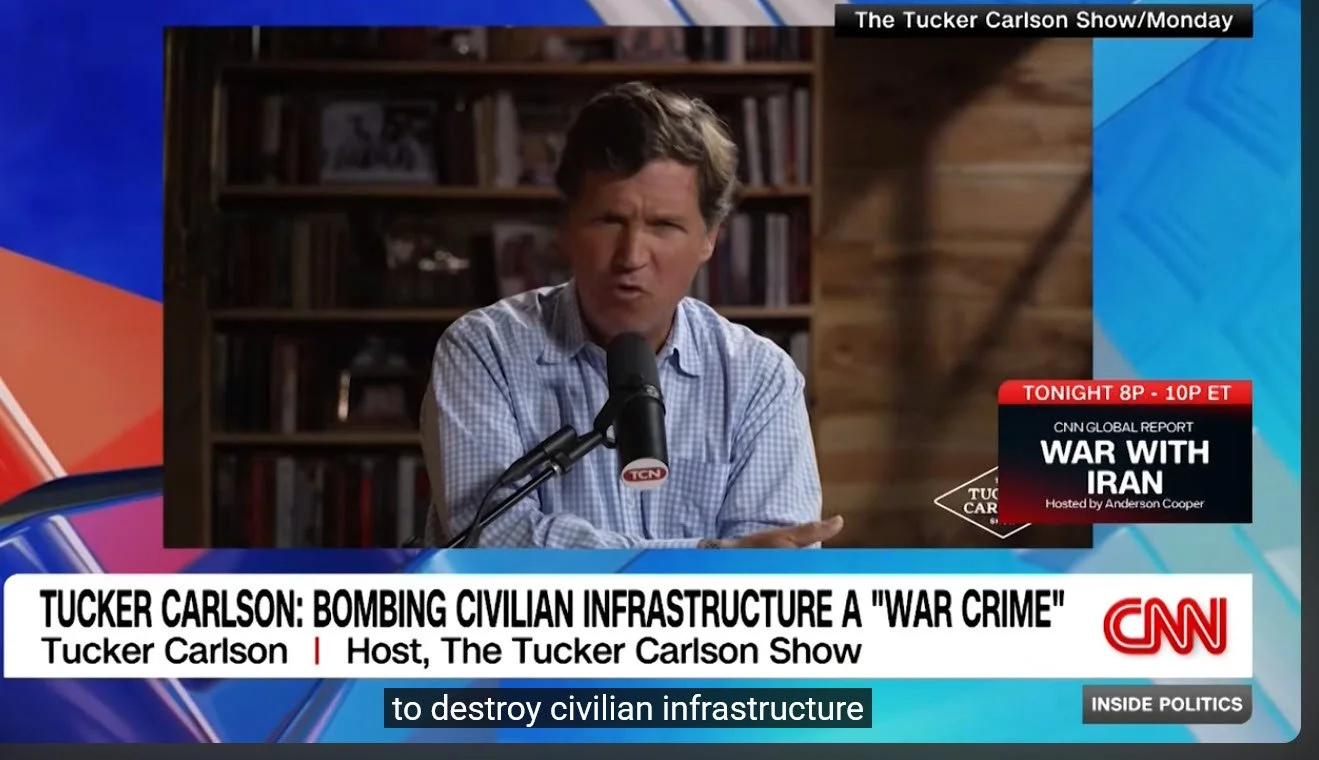
Just five months after President Donald Trump and his allies appeared indignant over a video in which six congressional Democrats warned service members not to obey illegal orders, Trump is showing exactly what they were talking about. He’s set an 8 p.m. ET Tuesday deadline for Iran to agree to a deal and re-open the Strait of Hormuz. Otherwise, Trump has repeatedly said, he will strike Iranian infrastructure sites including power plants, bridges, oil wells and possibly others like water desalination plants in ways that could well amount to war crimes.
Senator Kelly an Tucker Have a Convenient Loss of Memory
Yes, Captain Mark Kelly (the retired astronaut and current U.S. Senator) flew the A-6E Intruder during Operation Desert Storm and absolutely attacked infrastructure targets.
The A-6 Intruder was the Navy's premier all-weather, deep-strike bomber, specifically designed to hit high-value targets behind enemy lines, often at night. During his 39 combat missions flying from the USS Midway, Kelly and his squadron (VA-115) were tasked with destroying the "skeleton" of the Iraqi military.
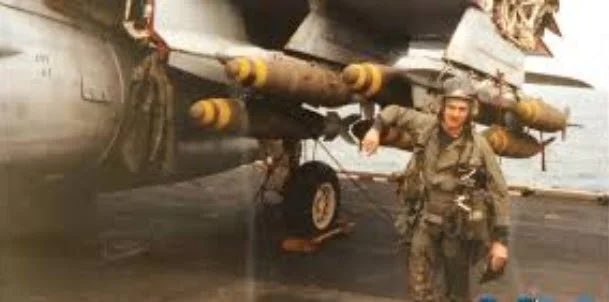
Types of Infrastructure Targeted By Capt Kelly
While the specific logs for every one of his 39 missions aren't all public, the standard mission profile for an A-6 pilot during the Gulf War included:
Command and Control (C2) Nodes: Communications centers and bunkers used by the Iraqi leadership.
Bridges and Supply Lines: To prevent the Iraqi Republican Guard from retreating or reinforcing their positions.
Electrical Grids and Power Plants: Targeted to blind the Iraqi integrated air defense system (IADS).
Airfields and Hardened Aircraft Shelters: To neutralize the Iraqi Air Force on the ground.
Naval Targets: VA-115 was notably involved in the "Battle of Bubiyan," where A-6s destroyed much of the Iraqi Navy as it tried to flee to Iran.
Here is the breakdown of how these specific scenarios are judged under international law.
1. The "Dual-Use" Problem (Bridges and Power Rods)
Infrastructure like power plants and bridges are often considered "dual-use" because they serve both the civilian population and the military.
When it is legal: A bridge or power plant can be a legitimate military target if it makes an "effective contribution to military action" (e.g., a bridge used to transport tanks) and its destruction offers a "definite military advantage."
When it is a war crime: Even if there is a military benefit, the attack must pass the Proportionality Test. If the strike causes "excessive" civilian suffering compared to the military gain—for example, if cutting power to a military base also shuts off electricity to a hospital, leading to mass deaths—it can be classified as a war crime.
2. Specifically Targeting Civilians (Russia and Iran)
The law is much more black-and-white when it comes to the intentional targeting of civilians or infrastructure essential to their survival.
The Principle of Distinction: Combatants must always distinguish between military targets and civilians. Specifically targeting a residential building, a school, or a hotel with no military presence is a clear violation.
The Case of Russia in Ukraine: The International Criminal Court (ICC) has issued arrest warrants for Russian officials specifically for "directing attacks at civilian objects" (the electrical grid). The legal argument is that these attacks were designed to spread terror and freeze the population during winter, rather than to achieve a specific, direct military victory.
The Case of Iran: Similarly, if Iran (or its proxies) intentionally fires missiles at civilian centers or infrastructure with the primary goal of killing non-combatants or causing "unnecessary suffering," it meets the legal definition of a war crime.
Under international law, the distinction between a "tactical strike" and a war crime is often found in the intent. When a regime intentionally targets its own people, launches unprovoked attacks on neighboring civilian infrastructure, and calls for the death of non-combatants, it moves from "warfare" into "atrocity."
Iran is a Barbaric State by Any Measure
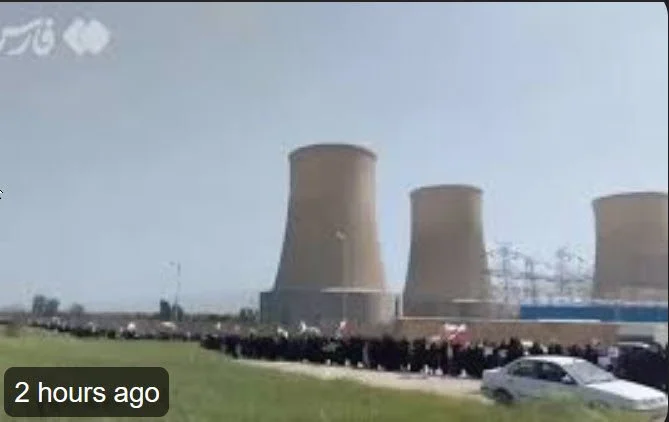
Forming a human shield with civilians around a power plant April 7, 2026
1. Domestic Terror: Murdering Their Own People
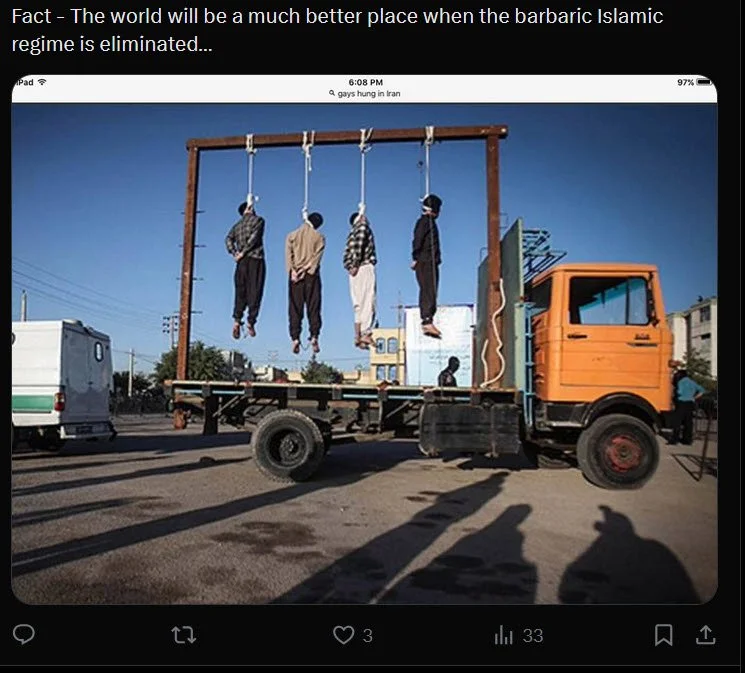
The Iranian regime’s crackdown on its own citizens is a documented campaign of state-sponsored murder.
The Reality: In the 2025–2026 massacres, security forces used live ammunition, machine guns, and metal pellets against unarmed protesters.
Legal Standing: These aren't "police actions." The UN and human rights organizations have classified these systematic killings, torture, and mass executions as Crimes Against Humanity. When a government treats its own population as a military enemy, it forfeits its claim to sovereign protection.
2. Targeting Gulf State Civilians
Iran’s missile and drone strikes against Gulf states (including Saudi Arabia, the UAE, and Qatar) have frequently bypassed military assets to hit civilian infrastructure.
The Targets: Attacks on desalination plants, airports, and gas fields (like the 2026 strikes on QatarEnergy facilities) are designed to cripple the civilian economy and life-support systems.
Why it's a Crime: Under the Geneva Conventions, infrastructure "indispensable to the survival of the civilian population" is protected. Hitting a gas field or water plant to coerce a government is a textbook violation of the Principle of Distinction.
3. Incitement to Murder
Openly calling for the death of civilians is not "political speech"—it is incitement to genocide or war crimes.
The Aggression: Iranian officials frequently characterize dissenters and foreign civilians as "enemies of God" or "mental disorders," providing the ideological fuel for their militias to carry out extrajudicial killings.
The Bottom Line: Under international law, commanders and leaders who order or incite the killing of non-combatants are just as liable as the soldiers pulling the trigger.
The Verdict: There is no moral or legal equivalence between hitting a bridge used by tanks and launching ballistic missiles at a city or opening fire on students. One is a calculated military necessity; the other is a calculated war crime intended to spread terror and death.