
Segment #1082
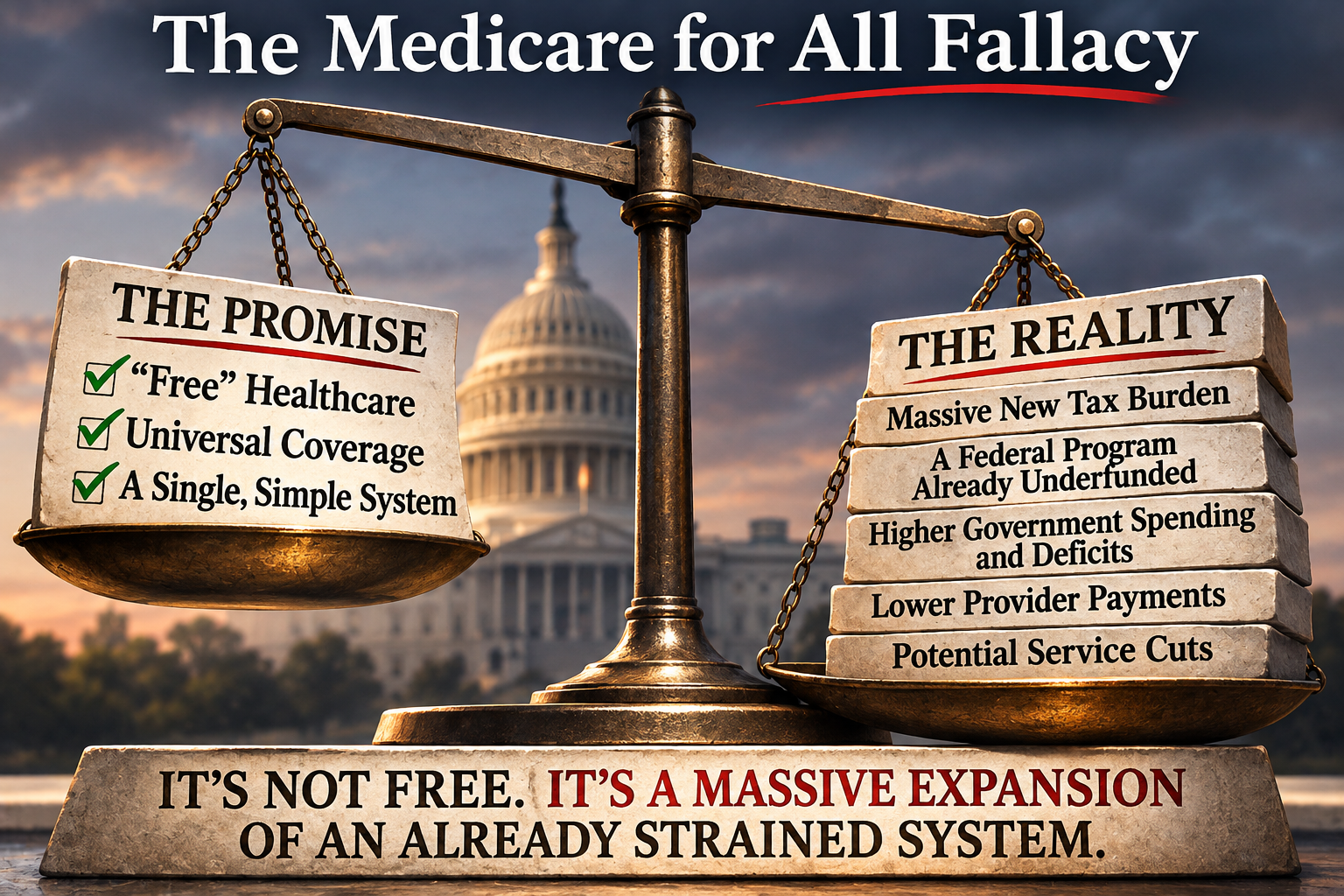
Medicare for All: Can America Provide Free Healthcare and Remain Financially Sustainable?
Medicare for All would not make healthcare free. It would change who pays for it, how providers are compensated, and who controls the financing.
There are two fundamental questions:
Can the federal government finance healthcare for approximately 340 million Americans without creating unsustainable tax obligations, deficits, or reductions in medical services?
Would Medicare for All eliminate private health insurance and replace it with a government-run system?
The answer to the second question depends on the legislation. Under the comprehensive single-payer proposals introduced in Congress, most private insurance covering the same medical benefits would be prohibited. Private hospitals and physicians, however, would not automatically become government employees.
The financial question is more complicated. Universal coverage can be financed through taxes, but whether a particular system is sustainable depends on total spending, tax revenue, provider reimbursement, medical demand, and long-term economic growth.
Medicare already faces a substantial financing problem
Medicare spending, 2026
$1.30T
Estimated annual expenditures
Beneficiaries, 2026
70.7M
Approximately
Hospital trust fund
2033
Projected reserve depletion
Projected funding available
89%
Of scheduled Part A costs at depletion
Sources: Congressional Research Service and 2026 Medicare Trustees Report.
Every CRS Report+1
This does not mean all Medicare benefits stop in 2033. It means the Part A hospital insurance trust fund is projected to exhaust its reserves under current law. Other Medicare components have different financing arrangements.
Expanding Medicare to everyone would require an entirely new financing structure, not simply enrolling another 270 million people in today's program.
Would private health insurance disappear?
Under the 2025 Medicare for All Senate bill, S.1506, the answer for most comprehensive private coverage is yes. The legislation specifically prohibits private insurers from selling coverage duplicating the benefits provided by Medicare for All. Employers would also be prohibited from providing duplicative coverage. Private insurance could remain for benefits the government program does not cover.
That would have major consequences for employer-sponsored health insurance, private insurance companies, Medicare Advantage arrangements, and consumer choice. Importantly, a public option or a Medicare buy-in is a different model: either could preserve competing private insurance plans.
Could the system be financially sustainable?
There are potential savings from centralized administration, negotiated drug prices and lower provider payment rates. But there are also substantial costs from expanding eligibility, eliminating patient charges and increasing utilization.
Eliminate premiums and deductibles - Costs shift toward taxes and government financing
Cover everyone - More people gain access to paid medical services
Pay hospitals and doctors less - Government spending may fall, but provider finances could be strained
Reduce insurance administration - Potential savings, offset partly by transition costs
Expand benefits - Higher demand and expenditures unless offset elsewhere
Control government spending - Requires financing adjustments, payment limits or other cost controls
The critical distinction is between total national healthcare spending and federal government spending. A single-payer system could reduce the first while substantially increasing the second, because expenditures currently financed by employers, households and insurers would move onto federal accounts.
Would government control lead to rationing?
Every healthcare system allocates limited resources. The methods differ.
Private insurance uses networks, deductibles, prior authorization and coverage restrictions. A government-financed system can use reimbursement schedules, budgets, coverage decisions and capacity limits.
If government reimbursement is insufficient to maintain hospital capacity or physician participation, access could deteriorate even when insurance coverage is universal. Conversely, eliminating financial barriers could improve access for people who currently postpone care because of cost.
The question is whether funding and medical capacity would be sufficient to meet demand.
Access Problems
Canada
The Canadian Medical Association reported in September 2026 that more than one-third of patients who saw a specialist in 2024 waited at least three months for the initial appointment. Its cited 2025 estimate placed the median referral-to-treatment wait at 28.6 weeks.
significant delays in specialist treatment
United Kingdom
Patients waiting 10 days on trolleys in hospital corridors, figures reveal
United Kingdom — millions awaiting treatment
England had almost 7.4 million elective treatment pathways awaiting care in August 2026. September emergency department demand reached a record for that month, and more than 10% of A&E attendees waited over 12 hours for admission, transfer or discharge.
Australia
WA hospital emergency departments under fresh strain; GPs examine overcrowding - ABC News
Australia — prolonged public hospital waiting times
In 2024–25, the median wait for public hospital elective surgery was 45 days, 10% waited at least 329 days, and 6% waited longer than a year. These statistics exclude much of the surgery performed privately.