
Segment #700
When I hear of a young female fighter pummeled by a trans (male) fighter, female swimmers at the University of Penn. having to undress in front of a 6’4” trans (male) swimmer, or a female vollleyball player suffering brain damage after getting spiked by a trans (male) opponent, I see a very screwed up system that is not serving the public interests. How in the world did we get here? Summed up like much of our world today is lack of definitions creating blurred lines for interest groups to interpret. There is no one in the women’s movement of the 1970’s that remotely considered that they needed to define legally the words man, woman, or sex. But that’s where we are and we live in a time when even a sitting Supreme Court Justice is unable to tell us what a woman is. That should stun all of us, for it informs us to some degree what is ahead for future generations.

Title IX is a federal civil rights law that protects students from sex‑based discrimination in schools and colleges that receive federal funds, and that includes athletics and use of facilities like locker rooms.ed+1
What Title IX Covers
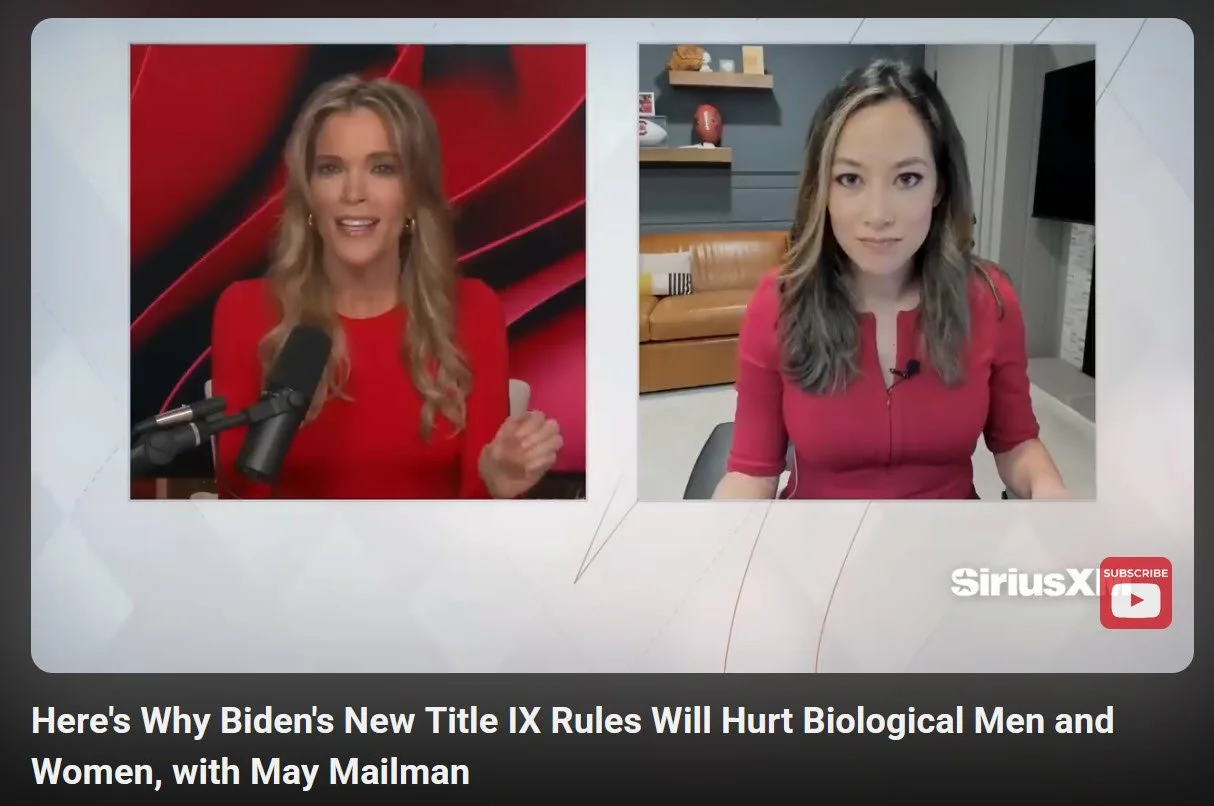
Megyn Kelly is joined by May Mailman, director of Independent Women's Law Center, to discuss why Biden’s new Title IX rules will hurt biological men and women, the infringement on parents' rights with these changes, why misgendering can now be punished as sex discrimination, and more.
Schools must provide equal athletic opportunities, benefits, and treatment for male and female students, including access to teams, coaching, equipment, and locker rooms.womenssportsfoundation+1
Title IX also protects students from sex‑based harassment or hostile environments in sports and locker rooms, which can include sexual harassment, assault, or harassment because a student does not conform to sex stereotypes.nfhs+1
Locker rooms and privacy
When a school provides “intimate facilities” such as locker rooms, it must make them available on a nondiscriminatory basis and provide comparable facilities for each sex; denying girls comparable locker room access or forcing them into clearly inferior spaces can violate Title IX.sadker+1
Schools are responsible for addressing reports that students are being harassed, groped, or intimidated in locker rooms or showers because of their sex (including being female, or being perceived as not acting the “right” way for their sex).uscenterforsafesport+1
Current policy tensions
Recent federal regulations and executive actions have focused heavily on how Title IX applies to participation in girls’ and women’s sports and access to single‑sex locker rooms, with some policies emphasizing protecting all‑female teams and facilities and others emphasizing protection for transgender and nonbinary students from sex‑based discrimination.whitehouse+3
Because these rules are actively changing and being challenged, how Title IX is applied in areas like transgender participation and locker room access can depend on the current administration, ongoing litigation, and sometimes state law.icslawyer+2
What this means for a young woman
A young woman who is denied a fair chance to play, given worse facilities, or harassed in sports or locker rooms because she is female (or does not fit sex stereotypes) may have rights under Title IX and can often report to the school’s Title IX coordinator or the U.S. Department of Education’s Office for Civil Rights.ed+2
For a specific situation (for example, being forced to undress in front of males, or being threatened if she objects), speaking with a local attorney or a legal aid group familiar with Title IX and Texas education law would give more tailored guidance.
Does Title IX define male and female
No. The text of Title IX itself does not define “male” or “female”; it simply prohibits discrimination “on the basis of sex” in federally funded education programs.
What Title IX Actually Says
Title IX’s operative language is that no person shall, “on the basis of sex,” be excluded from participation in, denied benefits of, or subjected to discrimination under any education program or activity receiving federal financial assistance. The statute does not include a separate definitions section that spells out what “male,” “female,” or even “sex” mean.ed+1
Where Definitions Come From
Because Congress did not define “male” and “female” in the statute, the meaning of “sex” under Title IX has been filled in by:
Federal regulations and agency guidance (mainly the Department of Education and Department of Justice). These have addressed whether “sex” includes gender identity and sexual orientation, and those positions have shifted by administration and are currently contested in court.congress+2
Court decisions interpreting Title IX and related civil‑rights laws, which increasingly look to Title VII reasoning to decide whether discrimination against transgender or gender‑nonconforming students is discrimination “on the basis of sex.”wikipedia+2
Ongoing conflicts and limits
Not all courts agree on a broad reading of “sex,” and some decisions and state‑level litigation resist or narrow the extension of Title IX to gender identity, especially in athletics. The result is that the meaning of “sex” under Title IX now depends heavily on the federal circuit, current federal regulations, and ongoing challenges, so schools in different parts of the country may face different legal obligations on issues like bathrooms, locker rooms, and sports eligibility.
Definitions are the Core of the Problem
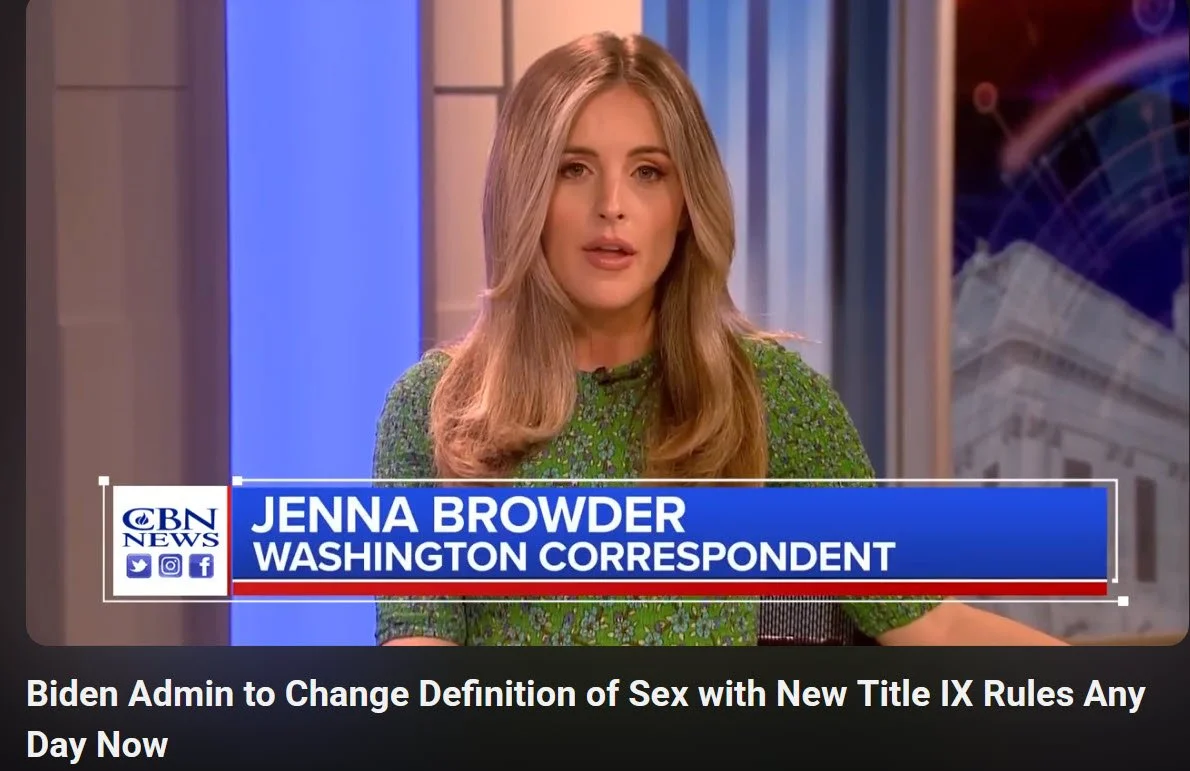
WASHINGTON – This year marks 50 years since Title IX became federal law and now under the Biden administration, it's facing major changes. Supporters say it's about expanding rights for students, but critics believe it will destroy women's sports, privacy, and more. Title IX became law in 1972 and it was meant to protect girls' and women's rights in education. Among other things, the Biden administration wants to change the way schools respond to sexual misconduct on campuses and codify protections for LGBTQ students by changing the definition of "sex."
There is no single, universal “legally accepted” definition of sex that applies across all federal and state laws; the meaning depends on the statute, the context, and current case law or regulations.politifact+1
Narrow biological definition
Historically, courts and lawmakers treated “sex” in civil-rights statutes as referring to being male or female based on reproductive biology, i.e., whether a person’s body is organized to produce sperm or ova. Many recent state laws that define “sex” in code still use this purely biological framework, tying male and female to reproductive anatomy or the capacity to produce one type of gamete.thepublicdiscourse+3
Expanded civil-rights interpretation
In federal anti-discrimination law, the U.S. Supreme Court in Bostock v. Clayton County held that under Title VII, discrimination against someone for being gay or transgender is discrimination “because of sex,” even though “sex” itself was understood in 1964 as biological male or female. That decision means that, in employment discrimination law, sex now functions as an umbrella concept that covers not only male/female status but also sexual orientation and gender identity when used as the basis for adverse treatment.cohenmilstein+2
References:
Does Title IX define Sex
In practice, schools must follow whatever interpretation of “sex” is currently binding in their jurisdiction (based on federal regulations and court rulings), but there is no simple statutory line in Title IX that says “male means X and female means Y.” If you are evaluating a specific policy (for example, sports eligibility or locker room access), the controlling law will be this mix of statute, regulations, and up‑to‑date case law rather than a neat definition embedded in Title IX’s text.justice+2
http://www.ed.gov/laws-and-policy/civil-rights-laws/title-ix-and-sex-discrimination
https://en.wikipedia.org/wiki/Gender_identity_under_Title_IX
https://sexualmisconduct.uic.edu/policy/definitions/title-ix/
Does Title IX offer any federal protection for a young women participating in sports or dressing in a locker room
http://www.ed.gov/laws-and-policy/civil-rights-laws/protecting-students/athletics
https://www.ncaa.org/sports/2014/1/27/title-ix-frequently-asked-questions.aspx
https://texaslawhelp.org/article/title-ix-and-gender-equality-in-texas-public-school-athletics
https://www.womenssportsfoundation.org/advocacy/what-is-title-ix/
https://wagnerathletics.com/news/2025/8/18/federal-title-ix-athletics-compliance-agreement.aspx
https://edworkforce.house.gov/news/documentsingle.aspx?DocumentID=411780
https://nfhs.org/stories/nine-ways-title-ix-protects-high-school-students
https://www.whitehouse.gov/presidential-actions/2025/02/keeping-men-out-of-womens-sports/
https://uscenterforsafesport.org/wp-content/uploads/2020/08/FAQ-Title-IX-Regulations-final.pdf
https://williamsinstitute.law.ucla.edu/press/eo-trans-athlete-press-release/
https://www.womenssportsfoundation.org/advocacy_category/title-ix/
https://www.congress.gov/crs_external_products/IF/PDF/IF12325/IF12325.2.pdf
https://concernedwomen.org/womens-rights-protected-from-biden-harris-title-ix-rewrite/
Current practical landscape - Definitions
Different federal statutes may have their own specialized definitions; for example, some criminal code provisions define “sex” or related terms only for that chapter and in terms of sexual acts or contact, not male/female status.law.cornell+1
In education (Title IX), health care, and other areas, agencies and courts are still actively disputing whether “sex” should be read in a strictly biological sense, in the broader Bostock sense, or something in between, so the working legal meaning can vary by jurisdiction and by the specific law at issue.lgbtmap+2
https://www.politifact.com/article/2024/mar/22/what-is-sex-what-is-gender-how-these-terms-changed/
https://www.lgbtmap.org/equality-maps/nondiscrimination/defining_sex
https://www.cohenmilstein.com/title-vii-at-60-the-evolution-of-based-on-sex/
http://www.ed.gov/laws-and-policy/civil-rights-laws/title-ix-and-sex-discrimination
https://www.justice.gov/archives/jm/criminal-resource-manual-1987-definitions-18-usc-2241-2245
https://digitalcommons.law.byu.edu/cgi/viewcontent.cgi?article=3352&context=lawreview
https://scholarworks.sjsu.edu/cgi/viewcontent.cgi?article=1098&context=themis
https://journals.law.harvard.edu/jlpp/wp-content/uploads/sites/90/2020/03/Anderson-FINAL.pdf