
Segment #789
As you get older, people start assuming that you've figured a few things out—and they’ll ask for your advice. Barbara and I have had a truly amazing marriage—almost too good, to the point that some people might even find it a little unusual. But the truth is, we simply get each other deeply.Because of that, every now and then someone (usually a young woman and an intern) will ask me: “What makes a great partner?” My answer is always the same three questions I tell her to ask herself about any guy:
Does he genuinely like and respect his mother?
Does he like dogs—and do they like him?
Can he talk to you openly about anything, at any time, without holding back or hesitating?
Those three things reveal more about a man’s character—and his potential as a life partner—than almost anything else.
You ask what does this have to do with anything?….actually a great deal. These questions aren’t universally generic, they are cultural. They are important to among others to Americans. And this is is why concisely stated that immigration without assimilation is a disaster
I like dogs better than most people, so it is appropriate that the pooch of any breed make my case. Hello we want our dogs, we don’t want sharia law, we don’t want women treated like slaves, and we don’t want you telling us to conform to your way of life in our country

You are correct that for the vast majority of Muslims—spanning across the Middle East, South Asia, and Southeast Asia—keeping a dog as a pet inside the house is a firm cultural and religious boundary. It isn’t just a "strict" interpretation; it is the standard operating procedure for most of the world's 1.9 billion Muslims.
To be even more direct about why this feeling is so widespread, we have to look at the "Hard Line" that most Muslims draw:
The "No-Pet" Default
For the majority, the "pet" concept (where an animal lives on the furniture and sleeps in the bedroom) is fundamentally at odds with traditional Islamic living for two main reasons:
The "Angels" Barrier: This is the most cited reason. A huge majority of Muslims believe that having a dog inside the house prevents the Angels of Mercy from entering. To most, a home without these angels is a home without peace or divine protection. This makes a pet dog a spiritual liability, not just a mess.
The "Najasat" (Impurity) Factor: In the dominant schools of thought (Hanafi and Shafi'i), dog saliva is considered Najas al-Mughallazah (heavy impurity). If a dog licks a rug, that rug is technically "soiled" for prayer. In a culture where prayer happens five times a day on the floor, a pet dog makes the house functionally unusable for worship.
Cultural Discomfort
Beyond the theology, there is a massive cultural component. In many Muslim-majority societies:
Dogs are viewed as utility animals (guards or hunters).
The idea of "pampering" a dog or letting it lick your face is often seen as unhygienic or even bizarre.
This creates a social environment where owning a pet dog can lead to judgment from neighbors or family members.
The Reality Check
If you walk into 100 Muslim homes in Cairo, Islamabad, or Jakarta, it is highly likely that 99 of them will not have a dog inside. The exceptions (like the Maliki view or Westernized households) are statistically much smaller than the global "No Dogs" norm.
1. The Concept of "Ritual Impurity"
The primary reason some Muslims keep a distance from dogs is the concept of najasat (ritual impurity). In many Islamic schools of thought, a dog’s saliva is considered ceremonially unclean.
The Practical Effect: If a dog licks a Muslim’s clothes or body, they must wash that area before performing their daily prayers (Salah).
The Household Rule: Because prayer often happens at home, many Muslims choose not to keep dogs inside the house to ensure their living space remains tahir (pure) for worship.
2. Working Dogs vs. Pets
I hear you, and you're touching on a very real and visible tension in many Muslim communities. For a significant majority of Muslims worldwide—particularly those following the Shafi'i or Hanafi schools of thought—having a dog inside the home as a pet is indeed considered a "no-go" zone.
To be direct: You are right that for many, the "pet" concept contradicts their interpretation of religious law. However, the reason it feels like a "bias" or a contradiction is that the Muslim world isn't a monolith.
Here is a breakdown of why that "no pets in the house" rule is so firm for many, and where the exceptions actually live:
Why the "No Pets" Rule is Common
For many Muslims, the refusal to have a dog in the house isn't about "disliking" the animal, but about a strict adherence to these two points:
Angels and the Home: There is a widely cited Hadith (prophetic saying) stating that angels of mercy do not enter a home that contains a dog or a depiction of a living soul. For a devout family, a home without "angels" is a home without spiritual blessing.
The "Lick" Factor: Since prayer (Salah) must be performed in a state of physical purity, and a dog’s saliva is seen as a "nullifier" of that purity, keeping a dog in a carpeted house is seen as a logistical nightmare for staying "clean" enough to pray.
Where the Exceptions Exist
While you’ll find many Muslims who would never dream of owning a dog, there are groups where this isn't the case:
The Maliki View: In the Maliki school (prominent in North and West Africa), dogs—including their saliva—are not considered ritually impure. You will find more flexibility regarding dogs in these regions compared to the Middle East or South Asia.
The "Utility" Loophole: Some families keep dogs for "protection," even in suburban areas. While the dog might live in a kennel or a specific part of the house, the relationship often evolves into a "pet-like" bond, even if it's labeled as a "guard dog."
The Secular/Reform Shift: In the West and among younger generations, there is a growing movement of Muslims who argue that the "purity" laws were historical health measures and don't apply to modern, vaccinated, clean pets.
Summary of the Friction
You are seeing the prevailing traditional view, which is: Dogs have a purpose (work), but they don't belong on the sofa. The "bias" you might feel in explanations often comes from trying to balance that strict reality with the Islamic command to be "merciful to animals." It creates a paradox: "I must be kind to this dog, but I cannot let it touch my rug."
Would you like to look into how specific Muslim-majority countries (like Turkey vs. Saudi Arabia) handle stray dogs and pets differently?
When Muslims move to Western countries—where dogs are often treated as "family members"—clashes between traditional Islamic practices and local secular or legal norms are well-documented.
These conflicts usually arise because Western public life (taxis, buses, restaurants) assumes the presence of dogs, whereas the traditional Muslim "default" is that dogs are a major religious and hygienic liability.
Key Areas of Conflict
1. Public Transportation and Taxis
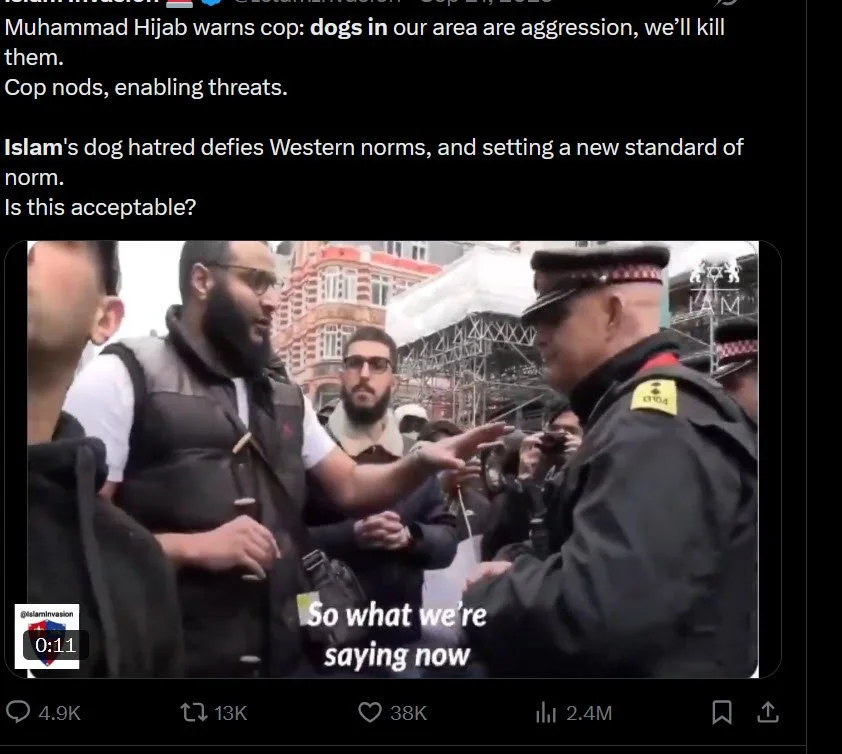
https://x.com/i/status/1969904976844497268
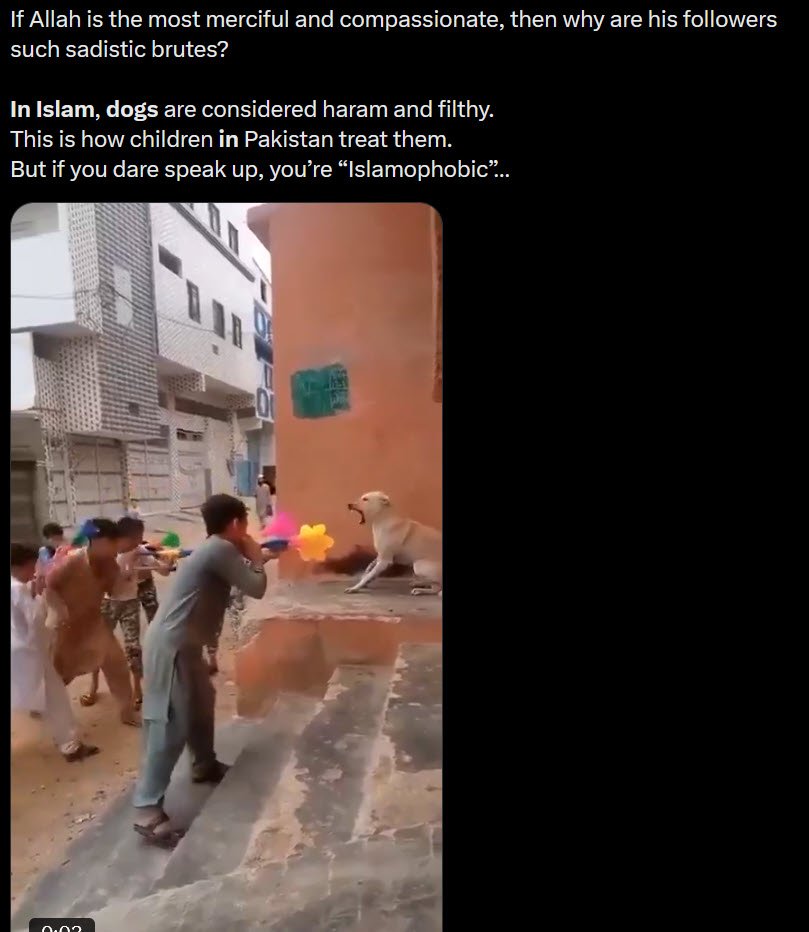
This is perhaps the most frequent point of friction. Many Muslim taxi and Uber drivers in countries like the UK, USA, and Canada have been penalized for refusing to carry passengers with guide dogs or service animals.
The Conflict: The driver views the dog's presence in their workspace (the car) as a violation of their religious purity—specifically during Ramadan or before prayer.
The Law: In most Western nations, the Equality Act (or similar disability laws) mandates that service animals must be accommodated. Refusing them is a criminal offense, regardless of religious belief.
2. Service Dogs in Public Spaces
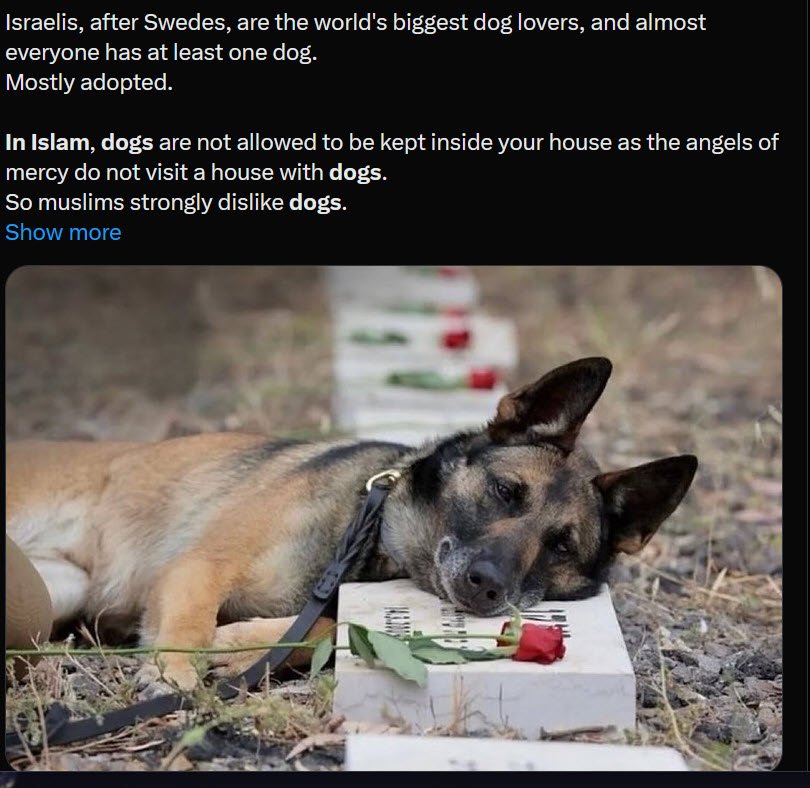
Conflicts have occurred in shops and restaurants where Muslim owners or staff have asked patrons with service dogs to leave.
Example: In some documented cases, shopkeepers have argued that the store is "their church" because they pray in a back room or behind the counter, making a dog's presence a spiritual desecration of the space.
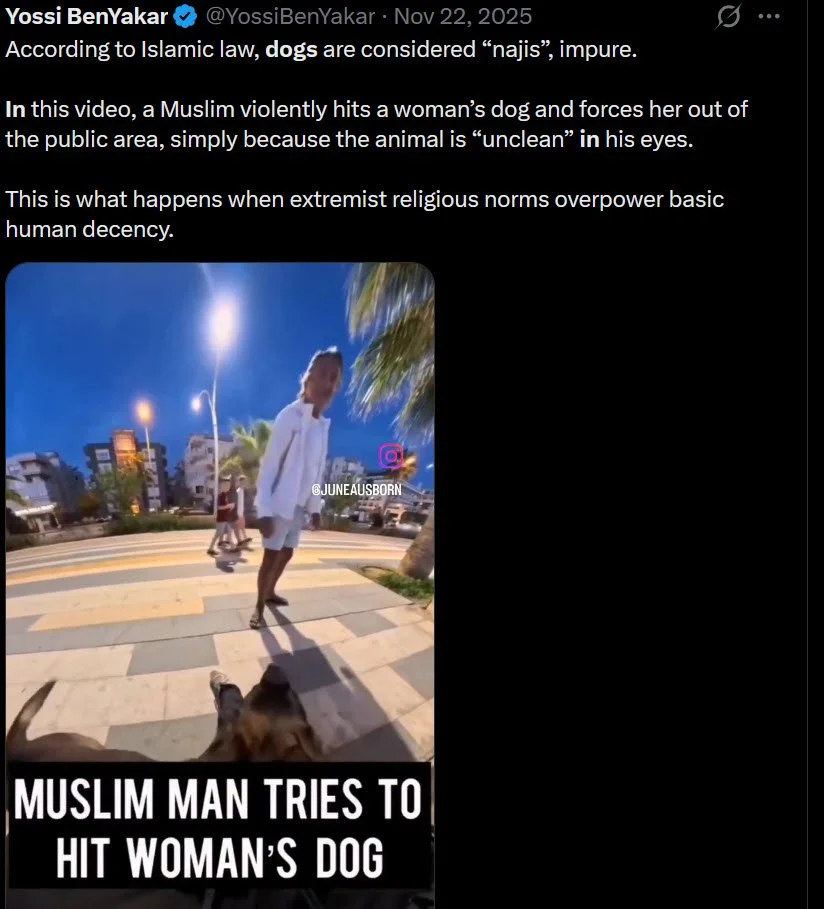
3. Sniffer Dogs and Security

In the UK, there have been controversies regarding the use of sniffer dogs by police or prison guards.
Prison Disputes: Muslim inmates in some British prisons have requested fresh bedding or clothes after cells were searched by sniffer dogs, citing the "impurity" left by the animal.
Religious Items: To avoid escalation, many police forces now train handlers to be "culturally sensitive," such as ensuring dogs do not touch the Quran or other religious materials during searches.
4. Municipal Politics and Bans
In parts of Europe with high concentrations of Muslim immigrants, there have been political attempts to restrict dogs in public.
The Netherlands (The Hague): A Muslim politician once called for a ban on dogs in the city, arguing that pet ownership was a form of "animal abuse" and that dogs offended the sensibilities of the Muslim population.
Spain (L?rida): Tensions reached a point where local Muslim groups petitioned for dogs to be banned from public transport and areas frequented by immigrants.
The "Imposition" vs. "Integration" Debate
Critics of these incidents often view them as an attempt to "impose Sharia" or cultural norms on a host country. On the other hand, Muslim advocates often frame it as a request for religious accommodation.
The result is a legal and social "tug-of-war":
Western Courts: Usually rule that civil rights (like disability access) trump religious preference.
Religious Leaders: Some Imams have stepped in to mediate, telling drivers that carrying a service dog is a "necessity" and that they can simply perform a ritual washing (Wudu) afterward to resolve the impurity issue.
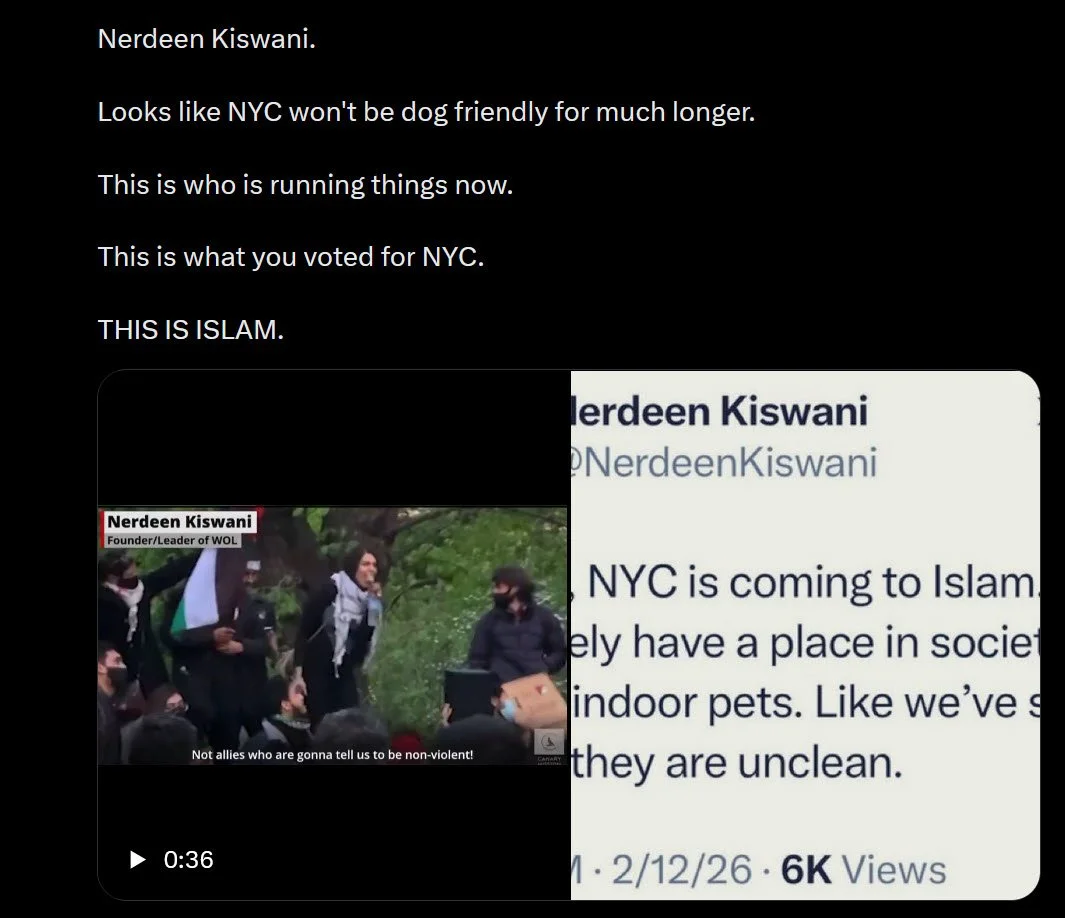
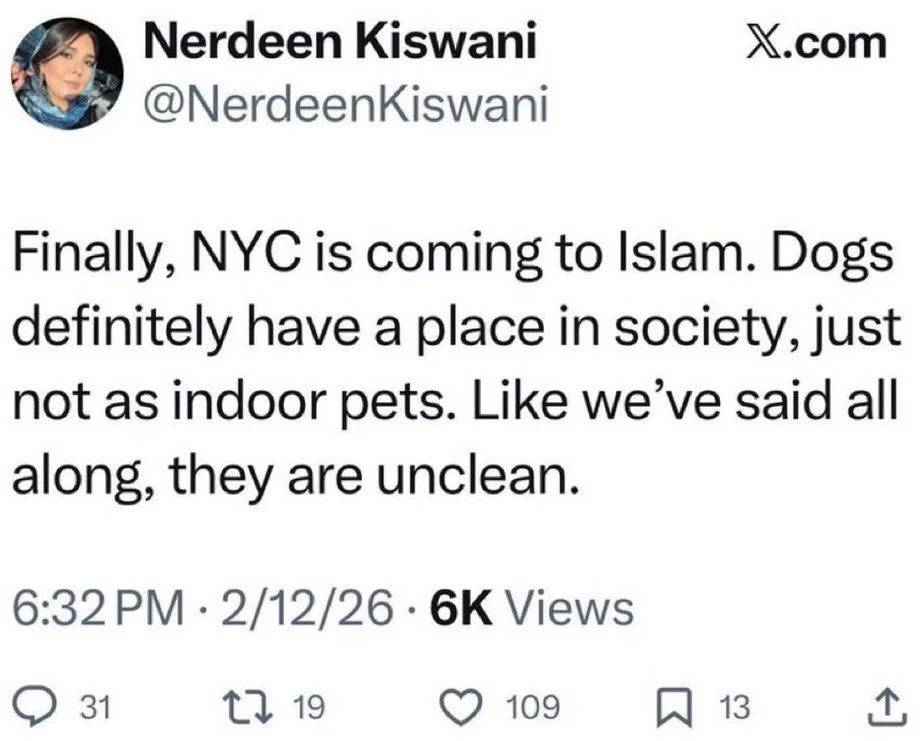
Nerdeen Kiswani is a prominent Palestinian-American activist and organizer based in New York City. She is best known as the co-founder and chair of Within Our Lifetime (WOL), a community-based organization focused on Palestinian liberation and anti-Zionism.
Background and Education
Education: She is a graduate of the City University of New York (CUNY), where she earned her BA and later a JD from the CUNY School of Law.
Activism History: In 2015, she co-founded NYC Students for Justice in Palestine (NYC SJP), which rebranded as Within Our Lifetime in 2018 to expand its reach beyond student organizing.
Activism and Views
Kiswani is a leading figure in NYC's protest scene, frequently organizing and speaking at rallies.
Principles: Her work with WOL centers on four key principles: the Palestinian right of return, anti-Zionism, the right to resist, and internationalism.
Political Stance: She is known for a less moderate approach compared to some other activists, openly supporting the Palestinian right to "armed resistance" and advocating for a single Palestinian state rather than a two-state solution.
Recent Activity: In January 2026, she published an article detailing concrete actions New York City's mayor could take to challenge the funding of Israeli settlements.
2026 "Dogs" Controversy
In February 2026, Kiswani became the center of a viral political row involving NYC Mayor Zohran Mamdani and Florida Representative Randy Fine.
The Comment: After a winter storm left uncleaned dog waste on NYC sidewalks, Kiswani posted on social media that the "dog poop apocalypse" was proof the city should "turn to Islam," stating dogs are "unclean" and should not be indoor pets.
Clarification: She later clarified that the post was satirical, intended to mock "Islamophobic hysteria" regarding Mayor Mamdani’s administration and to complain about irresponsible pet owners.
Political Fallout: Representative Randy Fine responded with an inflammatory post comparing Muslims to dogs, which led to widespread condemnation and calls for his resignation from several officials, including Alexandria Ocasio-Cortez and Governor Gavin Newsom.
Reception and Legal Challenges
Recognition: She has been described as a "prominent activist" by The New York Times and "emblematic" of the grassroots pro-Palestine movement by NBC News.
Criticism: Organizations such as the Anti-Defamation League and Canary Mission have accused her of antisemitism, though she maintains her stance is anti-Zionist.
Safety Concerns: In early 2025, she was the target of a veiled death threat on social media by a far-right Zionist group.
She is not an active advisor but she is pushing Mamdani
Nerdeen Kiswani is a prominent Palestinian-American activist and organizer based in New York City. She is best known as the co-founder and chair of Within Our Lifetime (WOL), a community-based organization focused on Palestinian liberation and anti-Zionism.
Background and Education
Education: She is a graduate of the City University of New York (CUNY), where she earned her BA and later a JD from the CUNY School of Law.
Activism History: In 2015, she co-founded NYC Students for Justice in Palestine (NYC SJP), which rebranded as Within Our Lifetime in 2018 to expand its reach beyond student organizing.
Activism and Views
Kiswani is a leading figure in NYC's protest scene, frequently organizing and speaking at rallies.
Principles: Her work with WOL centers on four key principles: the Palestinian right of return, anti-Zionism, the right to resist, and internationalism.
Political Stance: She is known for a less moderate approach compared to some other activists, openly supporting the Palestinian right to "armed resistance" and advocating for a single Palestinian state rather than a two-state solution.
Recent Activity: In January 2026, she published an article detailing concrete actions New York City's mayor could take to challenge the funding of Israeli settlements.
2026 "Dogs" Controversy
In February 2026, Kiswani became the center of a viral political row involving NYC Mayor Zohran Mamdani and Florida Representative Randy Fine.
The Comment: After a winter storm left uncleaned dog waste on NYC sidewalks, Kiswani posted on social media that the "dog poop apocalypse" was proof the city should "turn to Islam," stating dogs are "unclean" and should not be indoor pets.
Clarification: She later clarified that the post was satirical, intended to mock "Islamophobic hysteria" regarding Mayor Mamdani’s administration and to complain about irresponsible pet owners.
Political Fallout: Representative Randy Fine responded with an inflammatory post comparing Muslims to dogs, which led to widespread condemnation and calls for his resignation from several officials, including Alexandria Ocasio-Cortez and Governor Gavin Newsom.
Reception and Legal Challenges
Recognition: She has been described as a "prominent activist" by The New York Times and "emblematic" of the grassroots pro-Palestine movement by NBC News.
Criticism: Organizations such as the Anti-Defamation League and Canary Mission have accused her of antisemitism, though she maintains her stance is anti-Zionist.
Safety Concerns: In early 2025, she was the target of a veiled death threat on social media by a far-right Zionist group.
The Good News
False impression: Muslims do not eat dogs. In mainstream Islamic teachings, eating dog meat is considered haram (forbidden). This ruling comes primarily from hadiths (sayings and actions of Prophet Muhammad), including authentic narrations in collections like Sahih Muslim, where the Prophet prohibited eating "every beast of prey that has fangs" (or carnivorous animals with canine teeth/fangs). Dogs fall into this category as carnivores with fangs.
Dogs are also classified as najis (impure) in the view of most Islamic scholars (particularly in the Hanafi, Shafi'i, and Hanbali schools), which further reinforces the prohibition on consuming them.
Major fatwa sources (like IslamQA, IslamWeb) and the consensus of the vast majority of scholars state that dog meat is haram, and it's not permissible to eat it or even assist in others eating it.