
Segment #1067
The Coming Sovereign Debt Crisis: France, Europe, and the United States
Analysis of OBF Politics News video | October 23, 2026
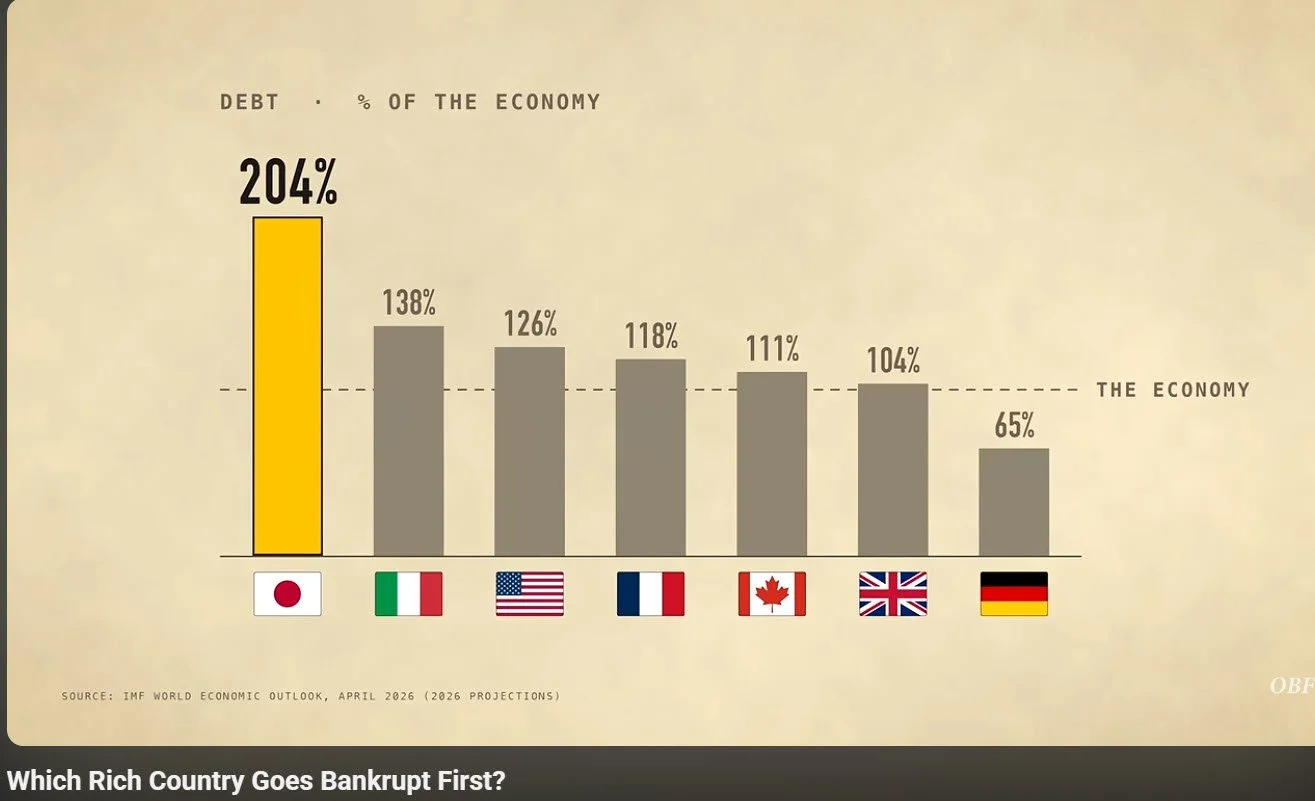
Executive summary
The video presents a disturbing proposition: the next major financial crisis may begin not with an insolvent bank or a developing economy, but with the sovereign debt of a major industrialized nation.
Its central argument is that France faces a dangerous combination of rising borrowing costs, persistent government deficits, political paralysis, and dependence on the European Central Bank (ECB). The video further argues that a French debt crisis could spread through European banks, destabilize Italy and Germany, and ultimately expose vulnerabilities in American government debt.
The argument deserves serious examination, but an important distinction must be made: a sovereign debt crisis, an ECB intervention, and a government default are three different events. The video sometimes treats them as successive stages of an almost inevitable process.
The transcript identifies three tests for sovereign financial vulnerability:
Who owns the debt? Governments dependent on foreign investors may be more exposed to sudden capital withdrawals.
Who controls the currency? Eurozone governments cannot independently create the currency in which they borrow.
Can the government change course? Political fragmentation can prevent spending reductions, tax increases, or other fiscal adjustments.
These are useful analytical questions, but they are not a complete sovereign credit-risk model. Debt maturity, economic growth, interest costs, central-bank policy, domestic savings, and financial-system resilience also matter.
The video's most consequential warning is not necessarily that France will declare bankruptcy. It is that a government can lose meaningful control over its fiscal decisions long before missing a debt payment.
1. What the financial evidence actually shows
Several of the video's central figures are supported by current French government documents and financial reporting.
French public debt, 2026 forecast
119.3%
Of GDP
2026 budget deficit forecast
5.4%
Of GDP
2027 bond issuance planned
€340B
Medium- and long-term, net of buybacks
10-year bond yield, Oct. 21
~5.0%
Highest since 2002
Sources: French Treasury, Agence France Trésor, and Financial Times.
Direction générale du Trésor
+2
The French Treasury's October 6 report forecasts public debt rising further to 121.7% of GDP in 2027. Its projections show government interest costs increasing from 2.2% of GDP in 2025 to 3.7% by 2030.
Direction générale du Trésor
France's rising public-debt burden
Public debt as a percentage of GDP; 2026–27 are official forecasts.
The key distinction concerns the €340 billion borrowing figure. It is not €340 billion of entirely new debt. Much of that issuance replaces maturing obligations. The official financing plan limits the increase in the nominal stock of medium- and long-term negotiable state debt to €160.5 billion.
Agence France Trésor
That does not eliminate the problem, but it changes its interpretation.
2. The danger of refinancing old debt
The video makes an important point about replacing older, low-interest government bonds with new, higher-interest obligations.
France cannot immediately reprice its entire debt stock. But as bonds mature, refinancing at higher rates progressively increases its interest bill.
Illustrative annual interest on €100 billion of debt
At 1.9%
€1.9B
At 4.9%
€4.9B
Additional annual interest: €3 billion
Illustrative fixed-rate refinancing calculation, not a forecast of actual French borrowing costs.
The arithmetic demonstrates the pressure. But the video's comparison of the average rate on outstanding debt with the current 10-year market yield exaggerates how quickly the higher rate affects the budget.
According to Agence France Trésor, the weighted average yield on French medium- and long-term issuance during 2026 was 3.55% through September, rather than the approximately 4.9% quoted for the October 10-year benchmark.
Agence France Trésor
3. France's political and fiscal constraints
The video's argument about political gridlock has substantial support.
France has experienced repeated government instability and difficulty passing budgets. Its government has proposed measures to bring the deficit down from 5.4% of GDP in 2026 to 5.0% in 2027, including spending restraint and revenue measures.
But the official fiscal council and Treasury acknowledge that even this planned improvement would not immediately stabilize the debt-to-GDP ratio.
Direction générale du Trésor
+1
The underlying problem is straightforward: when a country continually spends more than it collects, debt accumulates. When the cost of servicing that debt increases faster than revenues, fiscal adjustments become progressively more difficult.
France's official forecasts also anticipate only 0.5% economic growth in 2026 and 1.0% in 2027. Weak growth makes reducing the debt ratio harder.
Direction générale du Trésor
The video, however, gives insufficient attention to the fact that France retains a large, diversified economy, substantial tax-raising capacity, and access to deep European capital markets.
These are meaningful protections against a disorderly default, even though they cannot indefinitely compensate for fiscal imbalances.
4. Could the European rescue system handle a French crisis?
This is one of the video's strongest structural arguments.
The European Stability Mechanism (ESM) has a maximum lending capacity of €500 billion, with approximately €433 billion currently available. That is small relative to France's roughly €3.6 trillion public debt.
European Stability Mechanism
+1
However, a rescue fund does not necessarily need to repay a country's entire outstanding debt. It needs to provide sufficient financing, alongside other interventions, to restore confidence and market access.
The ECB also has its Transmission Protection Instrument, established in 2022, which permits potentially large bond purchases under specified conditions. Those conditions include fiscal sustainability and compliance with relevant European fiscal rules.
European Central Bank
The video's claim that ECB support automatically means foreign officials will write France's budget goes too far. An ESM adjustment program can impose detailed policy conditions, whereas the ECB's Transmission Protection Instrument operates under a different framework.
Nevertheless, France's dependence on institutions it does not independently control is a genuine vulnerability.
5. How a French crisis could spread internationally
Illustrative financial contagion pathways
French sovereign bonds sell off
Higher yields, falling bond prices, refinancing pressure
European banks
Bond losses and tighter funding
Italy
Higher sovereign risk premiums
Germany
Financial exposure and rescue commitments
Global markets
Currency, credit and liquidity shocks
Potential transmission channels, not a forecast that all outcomes will occur.
The video correctly emphasizes that sovereign debt cannot be analyzed in isolation. Banks hold government bonds, use them as collateral, and lend across national borders.
But its statement that Italy would probably follow France into crisis within days is not established by the evidence presented. Financial contagion can be rapid, but its severity depends on bank capital, liquidity, central-bank responses, and investor behavior.
Likewise, Canada cannot be described as financially safe simply because its banks have relatively limited direct lending exposure to France. Indirect exposures through markets, currencies, and economic activity still matter.
6. The American connection
The video's discussion of the United States is especially important.
It argues that during earlier international financial crises, investors rushed into U.S. Treasury bonds, lowering American borrowing costs. During the current European turmoil, however, U.S. Treasury yields have risen alongside European yields.
Recent reporting supports the observation that American 10-year Treasury yields have exceeded 5%, with the Financial Times reporting approximately 5.37% during the recent global bond sell-off.
Financial Times
But this does not prove that investors have abandoned U.S. government debt as a safe haven.
Bond yields can rise because of inflation expectations, Federal Reserve policy, increased Treasury supply, fiscal concerns, or changes in global interest rates. Identifying a structural loss of confidence requires more evidence than a few episodes of rising yields.
The video's discussion of a 2027 U.S. debt-ceiling deadline also needs qualification. A debt-ceiling crisis depends on legislation, Treasury cash management, extraordinary measures, and the timing of available funds. The transcript does not establish an unavoidable 2027 default date.
The United States also differs fundamentally from France because it borrows in a currency issued by its own central bank. That does not make default impossible, particularly in a debt-ceiling confrontation, but it changes the nature of the risk.
7. Claims that need correction or qualification
Video claim
Assessment
France's debt burden is approaching 120% of GDP
Supported by official forecasts
France plans €340 billion in 2027 borrowing
Supported, but much is refinancing
France's 10-year yield is near 5%
Supported by October market reporting
France's borrowing costs now exceed Italy's
Supported by recent market data
The ECB can intervene under conditions
Supported
France faces a 20% chance of default in five years
Not established; requires a defensible CDS calculation
France is about to go bankrupt
Not demonstrated
Italy would follow a French collapse within days
Speculative
The U.S. has permanently lost safe-haven status
Not demonstrated
A U.S. debt-ceiling default will occur in 2027
Not established
One particularly important issue is the claimed one-in-five probability of French default. Five-year credit-default-swap prices around 80–90 basis points, using a conventional 40% recovery assumption, imply a substantially smaller five-year risk-neutral default probability, roughly 6–7%. Even that is not an objective forecast of default, because CDS prices include risk premiums and market effects.
+1
That materially weakens one of the video's more alarming numerical claims.
8. What I would watch over the next 12 months
The most useful indicators are:
French–German 10-year yield spread: Measures the additional return investors demand to hold French rather than German government debt.
French bond auction demand: Repeated weak auctions would be more troubling than high yields alone.
France's primary budget balance: Shows whether revenues cover spending before interest.
Debt-service costs: Reveals how refinancing at higher rates affects the budget.
ECB intervention signals: Particularly changes in language about market fragmentation and monetary transmission.
European bank funding conditions: Important for identifying contagion beyond sovereign bond markets.
These indicators would provide stronger evidence of an approaching funding crisis than an arbitrary default countdown.
Final assessment
The video identifies a real and increasingly serious financial problem. France is carrying a large and rising debt burden, running persistent deficits, experiencing political difficulties in passing fiscal reforms, and paying substantially more to borrow. These concerns are supported by official French Treasury data and independent reporting.
Yet France is not currently shut out of capital markets. Reuters reported on October 21 that the country was not yet in a debt crisis, while the Financial Times noted on October 23 that European bond-market conditions remained far from the extreme dislocation experienced during the previous eurozone crisis.
Reuters
+1
The most credible warning is that financial markets may eventually force France into fiscal adjustments that its political institutions have struggled to deliver voluntarily. That could produce a serious European economic and political confrontation without necessarily resulting in sovereign default.
The broader issue extends beyond France: governments with persistent deficits and rising interest costs have less flexibility to respond to future shocks. If financial markets begin demanding significantly higher returns from multiple major governments simultaneously, the consequences could extend well beyond Europe.
The distinction between an approaching fiscal reckoning and an imminent bankruptcy is essential. The first is supported by substantial evidence. The second remains unproven.
Principal sources: Agence France Trésor — 2027 financing plan, French Treasury — Public debt sustainability report, ECB — Transmission Protection Instrument, and European Stability Mechanism.
I can monitor French bond yields, sovereign credit risk, and ECB intervention announcements and alert you when significant developments occur. Want that set up?