
Segment #1034
Gayle King gave us one of those wonderful television moments when a few unscripted words reveal far more than several minutes of carefully prepared commentary. She was interviewing Paula Devlin, one of the eleven jurors who ultimately wanted to find Lindsay Clancy not criminally responsible for killing her three children. One juror refused to go along.
King learned that there had been only one person of color on the jury. A man. Then came the revelation: the lone holdout was that Black man.
King's reaction? “Whoa. I have to sit with that for just a second.”
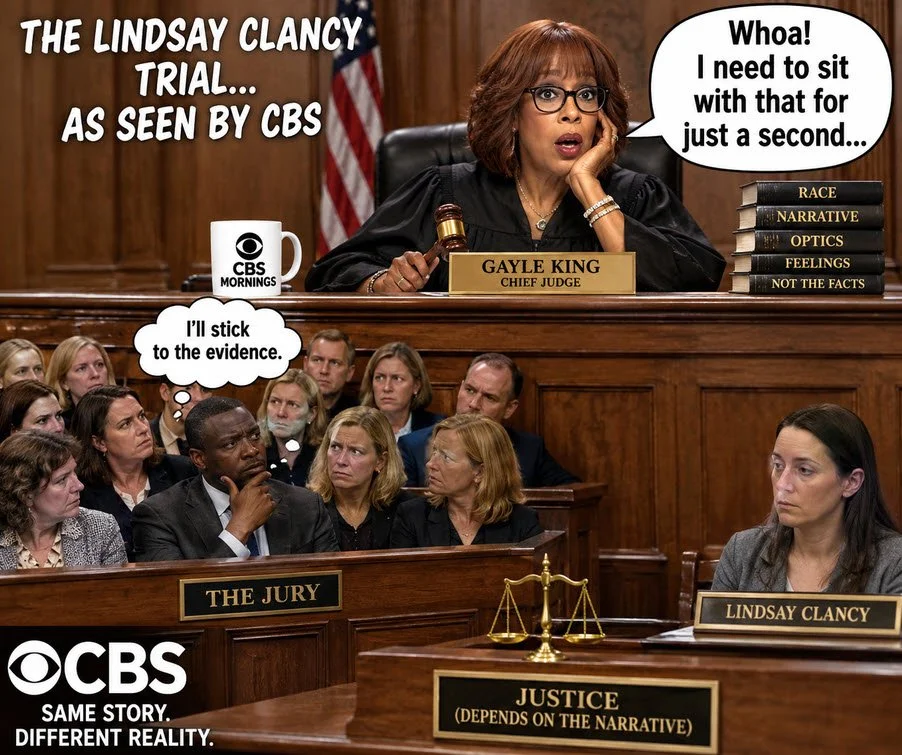
If I were Bari Weiss I would fire Gayle King
Sit with what, Gayle? That a Black man listened to the evidence and reached his own conclusion? That he didn't check with CBS to find out what the approved position was? Or was the surprise that a Black man had somehow wandered off the ideological reservation assigned to him?
The irony is almost too perfect. For years Americans have been lectured about the importance of “diverse voices.” We need diversity in corporations, universities, newsrooms and juries because people from different backgrounds may see things differently. Minority voices are especially important, we are told, because they can challenge conventional wisdom and prevent the majority from steamrolling dissenters.
Fine. Then along comes an actual Black man who does exactly that.
Eleven jurors ultimately reach one conclusion. He reaches another. They argue. Deliberations continue for days. Other dissenters change their positions. He doesn't. The jury eventually stands 11–1, and the Black juror is the last man standing.
That doesn't prove he was right. It proves he had the courage to stand by his own judgment while eleven other people wanted him to change it. There is a legitimate legal question about whether he properly applied the reasonable-doubt instruction, and that deserves examination. But even Clancy's attorney Kevin Reddington acknowledged the larger principle: “I would defend that person's right to be a holdout for a month. That's what the system is about.”
Exactly.
Yet when King discovered the holdout was Black, suddenly his race was fascinating. She later said she was “very fascinated by the holdout juror, learning he's a black man today.”
Why? Would his reasoning have been less interesting if he were white, Asian or Hispanic? His skin color tells us absolutely nothing about whether Lindsay Clancy was criminally responsible for killing her children.
The stereotype doesn't have to be openly hostile to be insulting. Sometimes the supposedly enlightened version is even more patronizing: We celebrate your identity, we value your voice and we desperately want diversity—as long as your diverse voice says what we expected it to say.
This man apparently missed the memo.
And imagine reversing the circumstances. Suppose eleven white jurors wanted to convict a Black defendant and the jury's only Black member held out for acquittal. Would the television narrative center on the troublesome Black juror who wouldn't listen to the other eleven? Or would he be celebrated as the courageous minority voice who refused to be bullied by the majority?
We know the answer.
That's what makes this episode so revealing. Minority dissent cannot be heroic when it produces the conclusion you like and suspicious when it produces the conclusion you don't. Either Black Americans are individuals entitled to reach their own conclusions or “diversity” becomes little more than an expectation that different-looking people will deliver predetermined opinions.
America has spent years being told to listen to Black voices. One Black man spoke with his vote. Eleven people told him he was wrong. He refused to bend. The judge refused to throw him off the jury.
Then Gayle King discovered he was Black.
“Whoa.”
Maybe the person who needed to sit with her assumptions wasn't sitting in the jury box.
Maybe she was sitting at the CBS anchor desk.
Bari Weiss and CBS Options
Firing Gayle King
Potentially, yes—but probably not unilaterally, and certainly not casually.
Bari Weiss has substantial editorial and personnel power at CBS News. Since taking over, she has overseen major restructuring, and CBS has parted ways with prominent 60 Minutes figures including Sharyn Alfonsi and Scott Pelley. But Weiss reports to Paramount CEO David Ellison, while CBS News President Tom Cibrowski also has management responsibilities. Major talent decisions—especially involving someone as prominent and expensive as Gayle King—would almost certainly involve senior Paramount/CBS management and King's contract. (CBS News)
More importantly, King just signed a new CBS deal in March 2026. Weiss publicly praised her at the time: “There is only one Gayle King,” saying CBS was “thrilled” to keep her on CBS Mornings. The terms and duration weren't publicly disclosed. (The Guardian)
So could Weiss now push for King's removal? Yes. Could she simply walk into the office tomorrow and say “Gayle, you're fired” with no corporate or contractual consequences? Probably not. King is major network talent operating under a newly negotiated contract.
And that makes the Clancy episode more interesting. If Weiss is serious about rebuilding CBS News around intellectual independence and ideological unpredictability, King's “Whoa—I have to sit with that” reaction to learning that the lone holdout was the only Black juror is exactly the sort of moment Weiss might reasonably want examined editorially. But there is currently no credible reporting I've found that Weiss is considering firing or disciplining King over the remark.
In fact, given that Weiss personally championed King's new contract only six months ago, firing her over this single episode would be a very dramatic reversal. (The Guardian)