
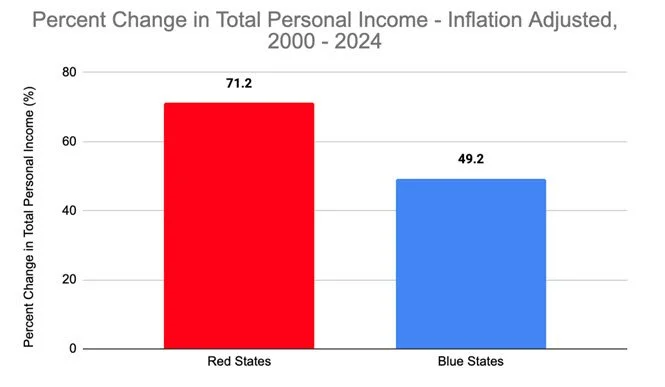
Since 2000 Red State Incomes Have Risen 40% Faster Than Blue States
Segment #919
This text is an excerpt from a publication by the Committee to Unleash Prosperity, an economic think tank founded by supply-side economists like Arthur Laffer and Stephen Moore.
The excerpt outlines an argument regarding state-level economic growth, migration, and tax policy. Here is a breakdown of the key points, context, and underlying economic concepts:
Key Arguments in the Text
Income Growth Disparity: The authors claim that since the year 2000, pre-tax incomes in "red" (Republican-leaning) states have grown 40% faster than in "blue" (Democratic-leaning) states.
After-Tax Disparity: They argue that because blue states generally have higher state income tax rates, the growth gap widens to nearly 50% when looking at after-tax income.
The "Vote with Your Feet" Phenomenon: The text asserts that high taxes, strict environmental regulations, and strong labor union policies in blue states (specifically naming California, New York, and Illinois) are driving residents and businesses to relocate to red states.
The Study: The claims are attributed to an upcoming study by Richard Vedder (a Senior Fellow at the think tank and Professor Emeritus of Economics at Ohio University) and researcher Nicholas Jadwisienczak.
Economic and Political Context
The excerpt touches on a long-standing, highly debated topic in American political economy: Supply-Side Economics vs. Demand-Side Economics.
1. The Supply-Side / Conservative Argument (Represented in the Text)
Proponents of this view argue that low taxes, minimal regulation, and pro-business environments stimulate economic investment. When states like Texas or Florida offer 0% state income tax, it incentivizes individuals and corporations to move there, increasing capital, creating jobs, and driving aggregate income growth.
2. The Counter-Argument / Blue State Perspective
Defenders of "blue state" economic models point to different metrics:
Base Incomes and Productivity: As the text itself notes, absolute incomes and per-capita GDP remain significantly higher in states like California, New York, and New Jersey compared to states like Arkansas or Oklahoma. This is often driven by high-value industries (tech, finance) and highly educated workforces.
Public Investment: Higher tax rates fund public infrastructure, robust education systems, and social safety nets, which proponents argue lead to a higher quality of life and long-term human capital development.
Cost of Living: A portion of the migration from blue to red states is heavily influenced by housing affordability and cost of living rather than purely tax policy.
Summary of the Authors' Thesis
The core premise of the provided text is that tax and regulatory competition between U.S. states is penalizing high-tax states. It projects that if current migration and growth trends persist, the historical income advantage held by wealthier blue states will eventually evaporate.