
Segment #1089
Seattle surrendered a police precinct and endured a month-long occupation; Portland experienced more than 100 consecutive nights of unrest while cutting police positions; and New York reduced its police budget amid a dramatic increase in shootings. There is also a new issue: Mamdani is supporting legislation that could make restrictions on protest policing harder to reverse. That deserves as much attention as the dissolution of the Strategic Response Group itself.
United States Department of Justice+1
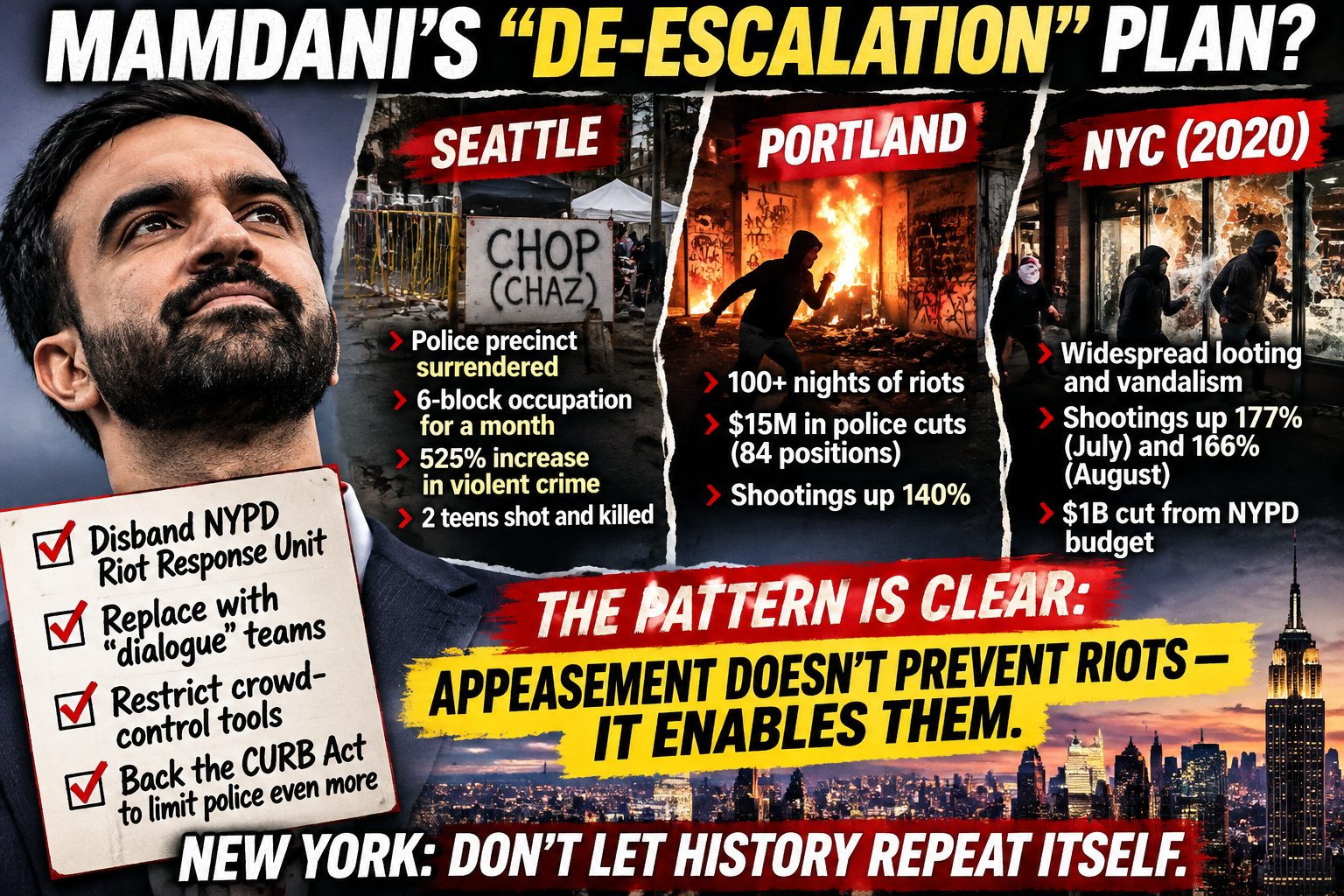
Mamdani's Dangerous Experiment: New York Is Ignoring the Lessons of Seattle, Portland, and Its Own History
November 16, 2026 | Public Safety and Political Accountability
How many times must American cities experience riots, looting, arson, shootings, and police retreat before their political leaders recognize that surrendering enforcement authority is not a public-safety strategy?
New York Mayor Zohran Mamdani has announced the dissolution of the NYPD's approximately 500-member Strategic Response Group, the specialized police unit created in 2015 to respond to major emergencies, terrorism threats, and serious civil disturbances.
In its place, Mamdani is establishing a civilian-led Community Dialogue and De-escalation Division, supported by 30 police officers trained in communication and a new Patrol Support Division.
The new civilian personnel will have neither weapons nor arrest authority. The replacement police division will retain arrest powers, but its officers will spend most of their time on ordinary patrol-related assignments rather than serving as a dedicated riot-response force.
The mayor is also formally restricting the use of tear gas, long guns, kettling, and other crowd-management tactics. Pepper spray will no longer be available for general crowd management.
And Mamdani is endorsing the CURB Act, legislation intended to restrict police responses to demonstrations beyond the administrative restructuring.
This is not simply a change in police organization. It is a political decision to make dialogue the centerpiece of public-order enforcement while reducing the tactical options available to officers.
The question is whether the replacement system can stop serious violence as quickly and effectively as the specialized unit it replaces.
American history provides several reasons to be skeptical.
Seattle, 2020: Six Blocks Surrendered, Two Teenagers Dead
Seattle offers perhaps the clearest modern example of what happens when political leaders allow a protest movement to displace normal law enforcement.
In June 2020, Seattle police evacuated their East Precinct. Protesters subsequently occupied approximately six blocks of the Capitol Hill neighborhood, establishing what became known as CHAZ or CHOP.
The occupation lasted nearly a month.
According to the U.S. Department of Justice's September 2020 assessment:
Person-related crime in the occupied area increased 525% compared with the same period a year earlier.
The reported increase included two additional homicides, six additional robberies, and 16 additional aggravated assaults.
Two teenagers were shot and killed during the occupation.
Police and emergency personnel faced serious restrictions on normal access to the area.
These were figures cited by the Justice Department in its assessment of the city's response, rather than evidence that every offense was caused by the withdrawal.
But the central fact is indisputable: Seattle's government allowed an occupied neighborhood to remain outside normal police control for weeks, and serious violence occurred.
Seattle's own police accountability investigation subsequently documented the precinct evacuation, the establishment of the occupied zone, the presence of armed individuals, and the fatal shootings.
The city ultimately cleared the area on July 1, 2020.
Seattle later agreed to a $3.6 million settlement with businesses affected by the occupation, according to the city's own emergency-management documentation.
The police withdrawal did not produce public safety. It produced an occupied neighborhood that eventually required police intervention to restore normal control.
That is a lesson New York's mayor should study before dismantling specialized response capabilities.
Portland, 2020: One Hundred Nights of Disorder
Portland provides a second example, this time involving prolonged civil disturbances and reductions in police resources.
Following George Floyd's death, Portland experienced more than 100 consecutive nights of demonstrations, repeatedly accompanied by vandalism, fires, attacks on officers, and destruction of property.
In June 2020, Portland's City Council cut approximately $15 million from the police budget, eliminating 84 positions, according to the Justice Department.
Among the eliminated resources was the Gun Violence Reduction Team.
The timing was extraordinary.
The city was experiencing sustained disorder while its elected leadership reduced police resources.
The Justice Department reported that shootings increased more than 140% during June and July 2020 compared with the corresponding period in 2019.
Portland Mayor Ted Wheeler also rejected an offer of additional federal law-enforcement assistance.
It would be inaccurate to attribute every subsequent shooting to those budget cuts. But the combination of rising violence, sustained disturbances, reduced police capacity, and political resistance to federal assistance is a legitimate indictment of the city's priorities.
The disturbances continued for months.
Portland demonstrated that political declarations about reform do not extinguish fires, prevent assaults, or restore order. Police must have the personnel, authority, and equipment to enforce the law.
New York, 2020: The Same Mistake, Closer to Home
New York has already experienced the consequences of political leadership struggling to maintain order during widespread unrest.
Under Democratic Mayor Bill de Blasio, the city endured extensive looting, vandalism, attacks on officers, and violent confrontations during the 2020 demonstrations.
The mayor imposed a curfew, but the damage had already spread.
The NYPD's own response came under serious criticism, and a subsequent Department of Investigation report documented failures of planning, command, and execution.
Meanwhile, the city faced a dramatic rise in gun violence.
According to the Justice Department's September 2020 assessment:
Measure20192020ChangeJuly shootings88244+177%August shootings91242+166%
These figures represent shooting incidents, not fatalities, and the increase cannot be attributed solely to protest policies.
Nevertheless, they reveal the scale of the public-safety crisis confronting the city.
In the middle of that crisis, the New York City Council approved a budget described by city leaders as cutting or shifting approximately $1 billion from the NYPD. The figure included transfers of functions and accounting changes, not simply a billion-dollar reduction in officers on the street.
The Justice Department also reported that several district attorneys declined to prosecute certain protest-related offenses, including disorderly conduct and unlawful assembly.
The city was simultaneously confronting escalating violence, reducing or reallocating police resources, and limiting prosecution of certain offenses.
This was not an abstract debate about police reform. It was a test of whether government could maintain public order.
New York's experience demonstrated the danger of making reductions in enforcement capacity during a period of extraordinary public-safety pressure.
New York, 1977: What Happens When Police Are Overwhelmed
There is an even older warning in New York's history.
On July 13, 1977, a massive electrical blackout plunged the city into darkness.
Under Democratic Mayor Abraham Beame, widespread looting and arson erupted. More than 1,600 stores were damaged, thousands of people were arrested, and hundreds of fires were reported.
The blackout did not result from a policy of appeasement. But it exposed an enduring reality: When criminals believe the authorities cannot protect property or maintain control, disorder can spread with extraordinary speed.
That is precisely why large cities maintain specialized emergency-response capabilities.
They are not designed for ordinary days.
They exist for the extraordinary nights when normal policing is insufficient.
The Most Troubling Part of Mamdani's Plan
The fundamental issue is not the existence of civilian negotiators. It is the decision to eliminate an established specialized unit before demonstrating that its replacement offers equivalent emergency-response capabilities. Mamdani's new Patrol Support Division will include specially trained officers who retain arrest authority.
But the mayor's own announcement says these officers will spend most of their time on other patrol assignments and will conduct arrests at protests only in rare instances when necessary. That raises immediate operational concerns. What happens when several demonstrations become violent simultaneously? How quickly can officers assigned to other duties assemble into a trained tactical formation? What happens when rioters attack police lines, destroy businesses, or set buildings on fire? Who decides when negotiation has failed? And what options will officers have if prohibited crowd-control tactics would otherwise have been appropriate? The mayor has not publicly demonstrated that the replacement structure can match the former unit's response times, deployment strength, or ability to handle simultaneous emergencies.
There is another troubling aspect. The Strategic Response Group reportedly responded to fewer than 20 demonstrations this year and made approximately a dozen arrests. Supporters cite that as evidence that the unit is unnecessary. But this reasoning misunderstands the purpose of emergency preparedness. A specialized unit is not justified by the number of routine incidents it handles. It is justified by the consequences of the extraordinary incident it must be ready to confront. New York does not eliminate specialized firefighting capabilities because major fires are relatively uncommon. Why should riot-response preparedness be judged differently?
The CURB Act: Turning a Political Experiment Into Law
Mamdani's endorsement of Council Member Chi Ossé's CURB Act deserves particular scrutiny.
The proposal would regulate police responses to public gatherings and restrict deployment of the Strategic Response Group at demonstrations.
Council Speaker Julie Menin has reportedly expressed serious concerns about the legislation.
The political significance is considerable.
Administrative policies can generally be revised by a mayor or police commissioner. Statutory restrictions may be substantially harder to change.
If the new approach proves inadequate during a major emergency, New York could find itself constrained not merely by departmental policy but by legislation.
Before approving any such measure, the City Council should demand a public operational assessment from the NYPD detailing the replacement unit's staffing, equipment, command structure, deployment times, and emergency exceptions.
Legislators should not permanently restrict police capabilities without first establishing what those restrictions will mean when officers face serious violence.
The Political Pattern Is Difficult to Ignore
Seattle, Portland, and New York were all governed by Democratic mayors during the 2020 disturbances.
Each experienced serious public disorder. Each faced criticism for its response. And each became part of a national debate over whether progressive approaches to policing had undermined enforcement.
In September 2020, the Trump administration's Justice Department formally identified all three as jurisdictions that had permitted persistent violence and property destruction.
That designation was withdrawn in February 2021. The withdrawal does not erase the documented shootings, fires, looting, police withdrawals, or budget decisions.
Nor does the designation itself prove that party affiliation caused the violence.
The important common denominator is more specific: Public officials made consequential decisions about police deployment, enforcement priorities, and resources while their cities were experiencing serious disorder.
Those decisions deserve to be judged by their results, not by the political intentions behind them.
Conclusion: New York Is Taking an Unnecessary Risk
Mamdani is making a substantial change to New York's public-safety infrastructure while asking residents to trust that a new combination of civilian negotiators, specially trained patrol officers, and restricted police tactics will be sufficient.
Perhaps his administration believes it has developed a better model.
But belief is not evidence.
Seattle's police withdrawal ended in an occupied neighborhood, fatal shootings, and eventual police intervention.
Portland experienced months of disorder while reducing police resources.
New York experienced widespread looting, sharply rising shootings, and serious failures of public-order management.
These are not hypothetical scenarios. They are documented episodes from recent American history.
Mamdani has the responsibility to demonstrate that his replacement system can prevent their recurrence.
Until he does, dismantling a specialized response unit and restricting enforcement tactics represents an unnecessary gamble with the safety of New Yorkers.
The first responsibility of government is to protect its citizens and uphold the law. A mayor who weakens the means of maintaining public order must be prepared to answer for the consequences.
New York has seen what happens when police lose control of the streets.
It should not need another lesson.
Sources
NYC Mayor's Office, November 16, 2026. Official announcement detailing the SRG dissolution, replacement divisions, and crowd-control restrictions.
U.S. Department of Justice, September 21, 2020. Assessment of violence, policing, and public-order failures in Seattle, Portland, and New York, including shooting statistics and police budget decisions. The designation was subsequently withdrawn.
Seattle Office of Police Accountability, 2021. Investigation of the evacuation of the East Precinct and the establishment of CHOP/CHAZ.
https://www.seattle.gov/Documents/Departments/OPA/ClosedCaseSummaries/2020OPA-0354ccs093021.pdf
Seattle Office of Emergency Management, Hazard Identification and Vulnerability Analysis, 2026. Documentation of damage, the $3.6 million business settlement, and consequences of the 2020 unrest.
https://www.seattle.gov/documents/Departments/Emergency/PlansOEM/SHIVA/SHIVA.pdf
Portland Independent Police Review, April 2022. Lessons learned from more than 100 nights of protests and the city's police response.
NYC Department of Investigation, December 2020. Independent investigation of NYPD protest response failures.
https://www.nyc.gov/assets/doi/press-releases/2020/December/16ProtestRptandRelease12.18.20FINAL.pdf
New York Post, November 16, 2026. Reporting on Mamdani's endorsement of the CURB Act and concerns regarding restrictions on police deployment.
https://nypost.com/2026/11/16/us-news/mamdani-backs-curb-act-after-disbanding-nypd-tactical-unit/
The most consequential facts are the 525% reported increase in person-related crime in Seattle's occupied zone, Portland's elimination of 84 police positions, and New York's 177% increase in July shooting incidents. Those figures come from the Justice Department's contemporaneous assessment.
United States Department of Justice
The central criticism is now specific: Mamdani is replacing a dedicated tactical unit with a system whose equivalent emergency-response capability has not yet been publicly demonstrated. That is a stronger, more defensible argument than simply labeling the policy appeasement.