
Is Globalism Losing Its Luster?
Segment # 705
The globalists underestimated a massive civilizational backlash. Worldwide, nations are reasserting their sovereignty, borders, and cultural identities, a phenomenon known as civilizational populism. From Italy to India, countries are reclaiming their right to decide who enters. President Trump's actions aren't just about firing judges; they're about dismantling the institutional framework of the liberal globalist order. Judges like Gordon-Uru-akpa weren't anomalies; they were the system functioning as designed, creating backlogs to keep illegal migrants indefinitely. Trump's moves, by replacing judges with enforcement-minded ones, are ripping out the globalist wiring and installing a sovereign enforcement apparatus.
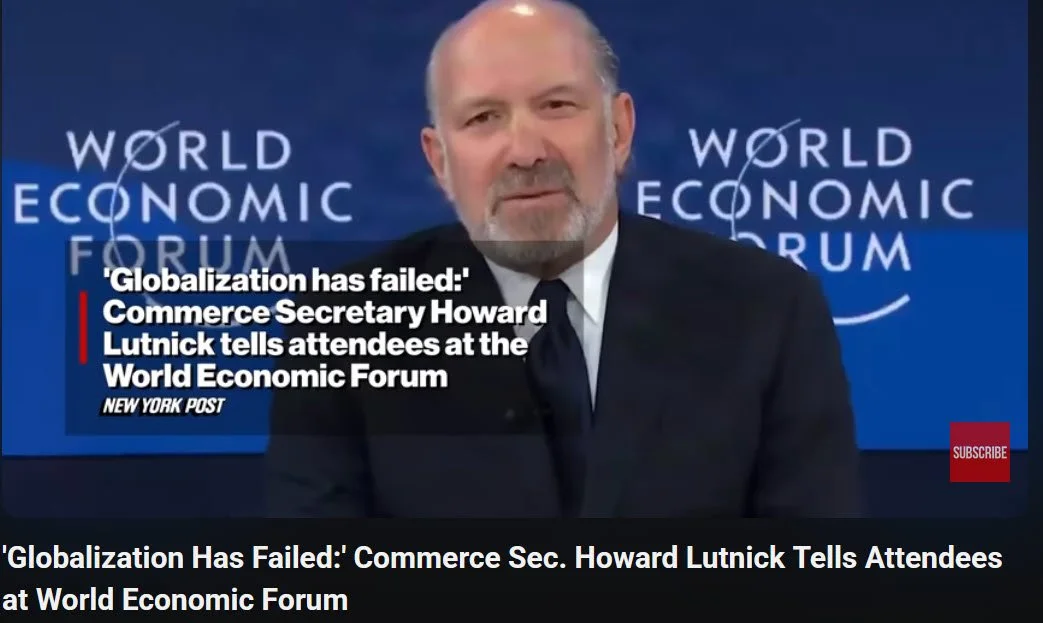
Commerce Secretary Howard Lutnick told attendees at this year’s World Economic Forum that “globalization has failed the West,” before criticizing green energy efforts by Europeans that would make them “subservient to China.” “The Trump Administration and myself, we are here to make a very clear point — globalization has failed the West and the United States of America,” Lutnick declared.
1. The "Three-Dimensional Collapse" of Globalism
Conservative think tanks (such as American Compass) argue that the narrative globalism was built upon has collapsed across three main pillars:
Trade: The promise that free trade would "lift all boats" is now viewed as having hollowed out the Western middle class while empowering adversaries (specifically China).
Immigration: Long seen by globalists as a "labor supply" issue, conservatives now argue it is a social stability issue. The rethink in the West (from the U.S. mass deportations to Europe’s "outsourcing" of asylum) reflects a pivot toward national sovereignty over international humanitarian norms.
National Identity: There is a move toward "Civilizationalism." Prominent voices on the Right argue that the West is a distinct culture that cannot be maintained if borders are functionally open.

Globalization as we knew it is over, and a new multipolar world is taking its place. Countries are forming power blocs, competing for capital, talent, and investors, while the West tightens control through higher taxes and regulations. In this video, I break down what pluralateralism really means, why sovereign wealth funds see it as the future, and how you can legally use this global shift to diversify your money, lower your taxes, secure residencies and citizenships, and protect your freedom in an increasingly fragmented world.
2. Why the "Luster" Faded (Conservative Critique)
According to conservative analysis, globalism failed because it ignored the "guardrails" needed for a healthy society.
Globalist PromiseConservative Reality (2026 View)Open Borders promote economic dynamism.Unrestricted Migration strains public services and erodes social trust.Offshoring lowers consumer prices.Offshoring destroys the dignity of work and creates fragile supply chains.International Law ensures global peace.Universalism undermines the power of the nation-state to protect its own citizens.
Export to Sheets
3. The 2026 Landscape: From Theory to Policy
This isn't just "talk" anymore; it has manifested in drastic policy shifts:
The U.S.: The second Trump administration has moved from rhetoric to action, including negative net migration in 2025 and a focus on "The One Big Beautiful Bill" (a protectionist tax/tariff package).
Europe: Once the bastion of open borders (Schengen), countries like France, Germany, and the UK are seeing a "vicious circle" of restrictionist policies as populist-right parties (like France’s RN or Reform UK) gain mainstream dominance.
The "De-globalization" Trend: Even moderate conservatives now admit that "market forces" must be reined in to preserve the social fabric.
The Conservative Bottom Line: Globalism is increasingly viewed not as an inevitable "evolution" of humanity, but as a specific policy choice that benefited a "cosmopolitan elite" at the expense of the "working patriot." The current trend toward restrictionist immigration and protectionist trade is seen as a restoration of the Nation-State as the primary unit of human organization.
In 2026, the global shift away from open-border policies is no longer just a "conservative talking point"—it is being codified into law across the West.
Globalism Crumbles: Sovereignty Reclaimed
United States: The "Enforcement Realignment"
Under the second Trump administration, the U.S. has shifted from a policy of "management" to "active removal."
Mass Deportations: In 2025, the U.S. launched the largest domestic deportation operation in history, utilizing a $45 billion detention budget to build a network of "warehouse" processing centers.
Negative Net Migration: For the first time in over 50 years, the U.S. estimated negative net migration in 2025 (more people leaving than entering).
Policy Barriers: The "One Big Beautiful Bill" (OBBBA) allocated $170 billion for border enforcement and suspended most refugee and humanitarian parole programs.
Immigration Judges: In a sweeping move that's bound to send shock waves through the immigration system, President Trump has fired hundreds of left wing judges, marking a monumental shift in judicial priorities. Imagine a goalie who lets in 97 percent of shots or a security guard who opens the door for 97 percent of intruders. Now, consider a judge who grants asylum to 97 percent of illegal migrants — it's a scenario that defies common sense! Fortunately, this madness is being rectified as these judges, including the notorious Vivienne Gordon-Uru-akpa, are shown the door. The era of unchecked asylum grants is being dismantled. In February alone, 33 new judges were sworn in, including 27 temporary ones. Half of the permanent judges are from military backgrounds, and all temporary judges hail from military or Department of Defense legal backgrounds. Not a single new judge has immigration defense experience; they all come from enforcement.
Canada: The End of "Immigration Exceptionalism"
Long considered the most pro-immigration country in the West, Canada has pivoted sharply due to housing and healthcare crises.
Target Reductions: The government slashed permanent resident targets from 500,000 in 2024 to 380,000 for 2026.
Temporary Resident Caps: For the first time, Canada set an explicit cap on temporary residents (students and foreign workers), aiming to reduce their share of the population to 5% by 2027.
Study Permits: New international student permits were cut by nearly 50% in 2026 compared to previous peak levels.
Germany: The Death of the "Willkommenskultur"
Germany, which took in over a million refugees in 2015, has now effectively "closed" its internal borders.
Schengen Suspension: Germany has extended stationary controls at all nine of its land borders through at least September 2026, a move that functionally pauses the "borderless" spirit of the European Union.
The Results: These controls led to a nearly 50% drop in asylum applications in 2025 as the government prioritizes "security and order" over open transit.
Sweden and Denmark: The "Zero-Refugee" Model
The Nordic countries have become the blueprint for the rest of Europe’s rightward shift.
Denmark: Has maintained a "zero refugee" policy goal, approving fewer than 900 asylum applications in all of 2025.
Sweden: Once the most liberal, Sweden now offers increased repatriation grants (paying migrants to leave) and has tied labor visas to 90% of the median Swedish wage to discourage low-skilled migration.
United Kingdom: "Restoring Control"

UK Prime Minister Keir Starmer has announced a major tightening of immigration rules aimed at significantly reducing net migration by the end of Parliament in 2029. The new policies, detailed in a government white paper, introduce stricter English language requirements for all visa applicants and their dependents, with the required proficiency level depending on the visa type. The qualifying period for settled status-the right to live and work in the UK indefinitely-has been doubled from five to ten years, though high-contributing individuals such as doctors and nurses may still qualify in five years. Watch for more
Following the 2025 "Restoring Control" White Paper, the UK has focused on making it harder for migrants to stay long-term.
Visa Restrictions: The government ended the ability for social care workers to bring family dependents and raised the English language requirement for skilled workers (from B1 to B2 level).
Settlement Hurdles: The standard period to qualify for permanent residency (Indefinite Leave to Remain) is being increased from 5 years to 10 years for many categories starting in April 2026.
France: Massive U-Turn
As of January 1, 2026, the French government has implemented some of the strictest integration and residency requirements in modern French history.\1. The "2026 Shift": Mandatory Civic Exams and Language
The most significant change is that France now treats residency as something that must be "earned" through cultural assimilation, rather than just time spent in the country.

European migration policy is under renewed pressure as ministers meet to discuss tougher measures against smuggling and deportations, amid rising influence of far-right anti-immigration parties and criticism from Donald Trump. British and Danish leaders argue for “tough but fair” reforms and a modernisation of human rights rules, while the EU is preparing a major overhaul of its asylum system. Critics warn that the push for stricter policies risks sacrificing human rights in an effort to counter populism.
The Civic Exam:
Starting January 1, 2026, all non-EU nationals (including Laotians) applying for a multi-year residence permit or a 10-year card must pass a formal civic exam. This is a 40-question test on French history, republican values, and rights. You must score at least 80% to pass.
Stricter Language Bars: The "A2" level of French is no longer enough for many.
Multi-year permits: Now require A2 (up from just "attending classes").
10-year Resident Cards: Now require B1 (intermediate) level.
Citizenship: Now requires B2 (upper-intermediate) level.
The "Two-Track" System
France is effectively splitting its immigration into two categories: those the economy "needs" and everyone else.
CategoryPolicy in 2026High-Skilled (Talent Passport)Fast-tracked. Highly skilled workers (tech, doctors, researchers) are largely exempt from the new language and civic exam requirements to keep France competitive.Shortage Sectors (Tension Jobs)Temporary. Undocumented workers in "tense" sectors (construction, healthcare) can get a 1-year permit without their employer's permission, but it’s a temporary "test" through the end of 2026.Family & Low-SkilledHardened. New laws make it much more difficult to bring family members to France and have increased the required residence time for a 10-year card from 5 years to 7 years.
Export to Sheets
The Political Context (The Barnier Government)
The government under Prime Minister Michel Barnier and Interior Minister Bruno Retailleau has taken a hardline stance to satisfy the growing influence of the populist right (Rassemblement National).
"Border Force": France has generalized a new "Border Force" to conduct random checks even within the Schengen area.
Detention Extension: A new law proposed for 2026 aims to extend the administrative detention of "dangerous" irregular migrants from 90 days to 210 days.
Summary for Laotian Citizens
For citizens of Laos specifically, there are no special exemptions in these new laws. Unless you are entering on a "Talent Passport" (for high-level professionals), you will face the new 2026 requirements:
Mandatory 24-hour civic training before getting a permit.
Passing the 80% score threshold on the new civic exam.
Proving higher French language proficiency through official diplomas (no more simple teacher evaluations).