
HR 3492 - “Gender Affirming” Care and the Science
Segment #727
History of the Bill
History of H.R. 3492 (119th Congress, 2025-2026)H.R. 3492, titled the Protect Children’s Innocence Act, is a bill sponsored by Rep. Marjorie Taylor Greene (R-GA) that seeks to criminalize providing gender-affirming medical care (such as puberty blockers, hormone therapy, or surgeries) to minors under 18. It amends 18 U.S.C. § 116 (originally prohibiting female genital mutilation) to expand prohibitions to include "genital and bodily mutilation" or "chemical castration" of minors for gender transition purposes, with penalties including fines and up to 10 years in prison. Exceptions apply for certain medical necessities, such as procedures on intersex children or treating complications from prior interventions.Previous VersionsRep. Greene has introduced similar bills in prior Congresses, but none advanced significantly:
117th Congress (2021-2022): H.R. 8731 – Introduced but did not pass committee or receive a floor vote.
118th Congress (2023-2024): H.R. 1399 (initial) and H.R. 5636 – Both introduced but stalled without advancing to a vote.
These earlier iterations aimed to prohibit gender-affirming care on minors federally but failed to gain traction amid Democratic control of the Senate and differing House priorities.Timeline in the 119th Congress

This is the silly elitist non scientific argument pervasive in our universities
May 19, 2025: Introduced by Rep. Greene in the House of Representatives and referred to the House Judiciary Committee.
April 9, 2025: Related hearing ("Ending Lawfare Against Whistleblowers Who Protect Children") in the Judiciary Subcommittee on the Constitution and Limited Government.
June 10, 2025: House Judiciary Committee ordered the bill favorably reported (17-10 vote, largely party-line) with an amendment in the nature of a substitute.
September 26, 2025: Committee report (H. Rept. 119-311) issued.
December 16-17, 2025: Considered under H. Res. 953 (rule for debate). Advanced to floor vote.
December 17, 2025: Passed the House of Representatives by a vote of 216-211 (mostly along party lines, with some cross-aisle votes). A motion to recommit failed.
December 18, 2025: Received in the Senate, read twice, and referred to the Senate Judiciary Committee.
As of December 28, 2025, the bill remains in the Senate Judiciary Committee with no further action. It faces significant challenges to becoming law, including the need for 60 votes to overcome a potential filibuster in the Senate. Proponents view it as protecting minors; critics argue it criminalizes evidence-based care and interferes with medical decisions.
It now moves to the Senate, where it is unlikely to pass due to needing 60 votes to overcome a potential filibuster in a divided chamber.
Even if it passed Congress, implementation would depend on the broader political context (e.g., alignment with executive actions under the Trump administration, which has supported restrictions).
Similar state-level bans exist in many Republican-led states, and the Supreme Court upheld a Tennessee ban in 2024 (U.S. v. Skrmetti), providing precedent for restrictions but not mandating a federal one.
Critics (e.g., ACLU) vow legal challenges if it advances further, arguing it criminalizes evidence-based care.
The Law Regarding Transition Children Without Parents Consent Was Passed
Yes, providing or facilitating medical gender transition (such as puberty blockers, hormone therapy, or surgeries) for minors without parental consent is generally against the law across the United States, with very limited exceptions under specific circumstances.Standard Legal RequirementIn all 50 states, minors (under 18) typically require parental consent for medical treatments, including gender-affirming care. Major medical guidelines (e.g., from WPATH and the Endocrine Society) also mandate parental involvement for minors. Genital surgeries on minors are extremely rare and virtually never performed without parental consent (or court order in exceptional cases).Limited Exceptions Where Minors May Consent IndependentlyA few states have "mature minor" doctrines or lower consent ages for certain medical care, but these rarely extend fully to gender-affirming interventions without caveats:
Oregon — Minors aged 15+ can consent to general medical treatment, including gender-affirming care like hormone therapy, without parental permission under state law (ORS 109.640). This is one of the clearest exceptions, though providers may still seek parental involvement for liability reasons or per clinic policies.
Maine — A 2023 law (Title 22, §1508) allows minors to consent to gender-affirming hormone therapy without parental consent if specific conditions are met, including a health professional determining the minor is experiencing harm without treatment, the minor has discussed it with a parent who refused support, and informed consent requirements are documented.
Other states (e.g., California, Washington) have "shield" laws protecting access to care and providers, but still require parental consent for minors under 18. Some older reports referenced proposals for 16-17-year-olds, but no broad independent access exists.
In practice, even in these states, providers follow strict protocols, and independent minor consent is uncommon due to ethical guidelines and potential legal risks.Federal and Broader RestrictionsAs of late 2025:
Approximately 27 states ban or severely restrict gender-affirming medical care for minors entirely (upheld by the Supreme Court in U.S. v. Skrmetti, June 2025), regardless of parental consent.
Federal actions under the Trump administration (e.g., executive orders and HHS policies) restrict federal funding for such care for minors and promote enforcement of restrictions.
The recently passed House bill (H.R. 3492, December 2025) aims to criminalize providing this care to minors federally but has not yet become law.
There is no widespread "transgender movement" legally enabling minors to transition medically without parents—claims of routine secret transitions are not supported by law or medical practice. Care for transgender youth, when provided, emphasizes family involvement and multidisciplinary assessment.
Scientific Evidence, Including RCTs, Supporting Gender-Affirming Care for MinorsGender-affirming care for minors (primarily puberty blockers and, less commonly, hormones) is a highly debated topic. Major medical organizations (e.g., American Medical Association, American Academy of Pediatrics, Endocrine Society) endorse it as medically necessary and supported by evidence for reducing distress in transgender youth with gender dysphoria. However, systematic reviews highlight limitations in the evidence base.

The Science
Randomized Controlled Trials (RCTs): There are no high-quality RCTs evaluating puberty blockers or hormones for gender dysphoria in minors. Experts argue RCTs are methodologically inappropriate and unethical here because:
Interventions have visible effects (e.g., blocked puberty vs. natural changes), making blinding/masking impossible.
Withholding treatment from a control group could cause harm (e.g., increased distress/suicidality in dysphoric youth).
Recruitment/adherence issues: Parents/youth often refuse randomization if it risks delaying care.
Similar challenges exist in other pediatric fields (e.g., precocious puberty treatment).
Existing Evidence: Relies on observational studies (cohort, before-after, case series) and systematic reviews:
Many show associations with improved mental health (e.g., reduced depression, anxiety, suicidality) and quality of life.
However, rigorous reviews (e.g., UK's Cass Review, 2024; University of York systematic reviews; NICE 2020; Finnish/Swedish/Norwegian reviews) rate the evidence as low to very low quality due to risks of bias, small samples, short follow-up, and confounding factors.
The Cass Review (independent NHS-commissioned report) concluded the evidence is insufficient to justify routine use of puberty blockers/hormones outside research protocols, leading to restrictions in England (puberty blockers limited to trials; hormones rarely before 16-18).
Some reviews find benefits (e.g., reduced dysphoria), but long-term outcomes (bone health, fertility, detransition) remain uncertain. Detransition rates are low (~1-2%), but regret data is limited.
In summary, while supported by professional guidelines and observational data showing benefits for some youth, the lack of RCTs and low-quality evidence has led to restrictions in several countries (e.g., UK, Sweden, Finland). Ongoing research and ethical debates continue.
Scientific Evidence Supporting Gender-Affirming Care for Minors
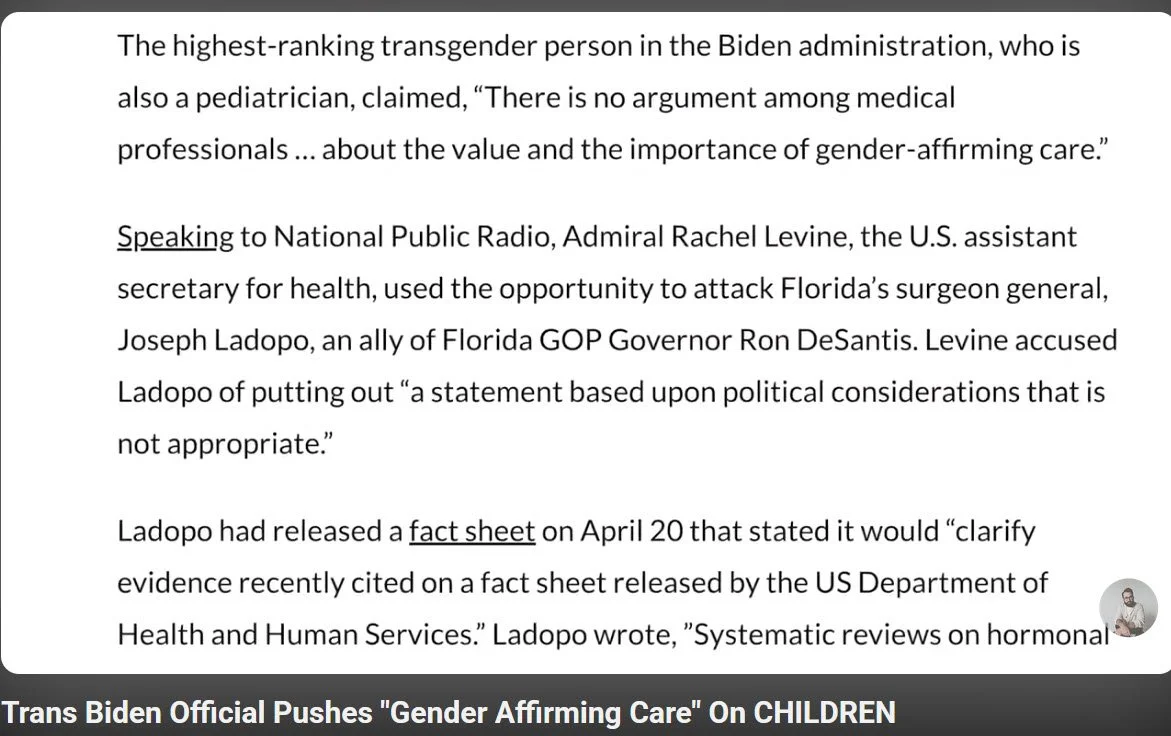
Rachel Levine, pediatrician and highest-ranking transgender person in the Biden administration, claimed, “There is no argument among medical professionals … about the value and the importance of gender-affirming care.” Walsh reacts.
Gender-affirming care (GAC) for minors typically includes social support, mental health care, puberty blockers (for adolescents), hormone therapy (rarely before age 16 and usually with parental consent), and very rarely surgery (e.g., chest masculinization in older teens under strict guidelines). Proponents, including major U.S. medical organizations (e.g., American Academy of Pediatrics, Endocrine Society, American Medical Association), describe it as evidence-based, medically necessary, and life-saving for reducing gender dysphoria-related distress, depression, anxiety, and suicidality in transgender youth.However, the evidence base is heavily debated:
Absence of Randomized Controlled Trials (RCTs): There are no high-quality RCTs evaluating puberty blockers, hormones, or surgeries for gender dysphoria in minors. RCTs are considered the gold standard but are widely viewed as unethical and impractical here: withholding treatment could harm distressed youth (violating equipoise), blinding is impossible due to visible effects, and recruitment/adherence would be poor. Some experts argue observational data suffices, similar to other pediatric treatments (e.g., for precocious puberty).
Observational Studies and Systematic Reviews:
Critical evidence: Multiple independent systematic reviews (e.g., UK's Cass Review 2024; University of York reviews; NICE 2020; Swedish, Finnish, Norwegian health authorities) rate the evidence as low to very low quality due to small samples, high risk of bias, short follow-up, confounding factors, and lack of controls. Benefits are uncertain; risks (e.g., bone density loss, infertility, cardiovascular effects) are better documented but understudied long-term.
The Cass Review (influential in Europe) concluded evidence is insufficient for routine use outside research, leading to restrictions in England (blockers only in trials; hormones rarely before 18). Similar shifts occurred in Sweden, Finland, and Norway.
U.S.-specific: Guidelines (e.g., WPATH SOC8, Endocrine Society) endorse care but face criticism for relying on lower-quality evidence and potential conflicts (e.g., internal WPATH discussions revealed concerns over evidence suppression). A 2025 HHS report under the Trump administration deemed treatments "unsafe and ineffective" based on weak benefits and known harms.
In summary, while observational data suggests benefits for carefully selected youth, rigorous reviews find the evidence inconclusive and insufficient to outweigh risks for most minors. No major review supports unrestricted access; ongoing research is needed.