
Segment #1088
The strongest argument is not that college enrollment is collapsing nationally. It is that universities are charging increasingly difficult-to-justify prices while students and parents face greater uncertainty about the economic value of a degree.
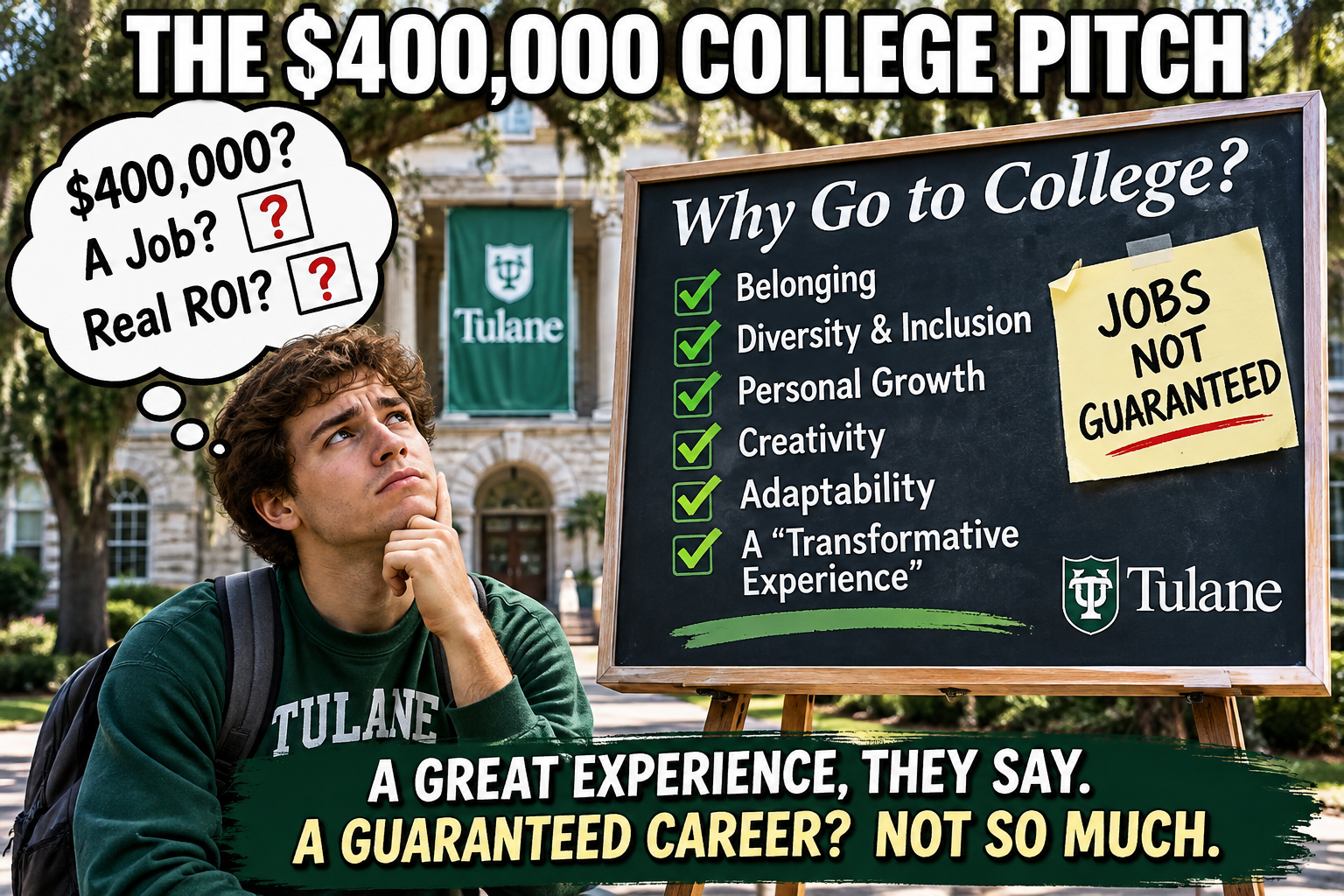
Tulane provides a particularly useful case study because its published attendance costs approach $100,000 annually, its applications have fallen substantially from their peak, and its enrollment yield has weakened.
The blog post should distinguish those measurable financial pressures from the interpretation that universities are increasingly marketing belonging, personal development, and DEI-related values as alternatives to demonstrable career outcomes.
November 14, 2026
American universities face an increasingly uncomfortable question: How do you persuade families to spend as much as $400,000 on a college education when a degree no longer guarantees a good job?
Tulane University offers a revealing example of a nationwide challenge. Consider the numbers:
Tulane University
$98,710: Published annual cost of attendance for incoming students in 2026–27, before financial aid.
$394,840: Four years at that annual rate, without accounting for future tuition increases.
28%: Decline in undergraduate applications, from 45,525 in 2021 to 32,942 in 2025.
50.9% to 39.0%: Decline in enrollment yield between 2022 and 2025—the percentage of accepted applicants who actually enrolled.
Tulane's entering class has remained relatively stable, so these figures do not establish an enrollment crisis. They do suggest increasing competition for students willing to make an extraordinary financial commitment.
The National Picture
$67,610: Average annual published cost of attendance at private nonprofit four-year colleges in 2026–27, before financial aid.
$46,350: Average annual published tuition and fees at those institutions, up 3.7% from the previous year.
42.5%: Underemployment rate for recent college graduates in the third quarter of 2026, according to the Federal Reserve Bank of New York. These graduates are working in jobs that typically do not require a college degree.
5.2%: Unemployment rate among recent college graduates during the same period.
47%: Share of 2024–25 bachelor's degree recipients who graduated with student debt. Among borrowers, the average was $30,220.
0.6%: Preliminary nationwide undergraduate enrollment growth in fall 2026, with enrollment at private nonprofit four-year institutions essentially unchanged.
Financial aid significantly reduces actual costs for many students, and college graduates generally retain an earnings advantage over those without degrees. Nevertheless, these figures expose a fundamental problem: The financial commitment is substantial, while the economic return is far from guaranteed.
The New Marketing Strategy: Sell What Cannot Be Measured
Tulane's 2026 liberal arts magazine, Built for This Moment, emphasizes creativity, adaptability, intellectual curiosity, critical thinking, and judgment.
Across higher education, universities also promote diversity, inclusion, personal development, and the increasingly fashionable concept of belonging.
These are legitimate aspirations. But they are also convenient selling points when families begin questioning tuition, debt, employment prospects, and the value of particular degrees.
Belonging offers another advantage: It allows universities to preserve elements of their DEI philosophy using less politically controversial language.
The concern is not that universities should abandon liberal arts education or intellectual development. It is that they may increasingly emphasize benefits that are difficult to measure rather than demonstrate the economic value of what they are selling.
An Alumnus's Perspective
I graduated from Tulane in 1968 with an English major and minors in psychology and philosophy. My liberal arts education proved invaluable throughout careers in the Navy, business, art dealing, and professional appraisal.
I am hardly suggesting that liberal arts degrees are worthless.
But education should teach students how to think, not what to think. That includes questioning fashionable ideologies, institutional priorities, and the universities themselves.
Artificial intelligence now raises additional questions about the employment value of traditional degrees, making financial accountability even more important.
The $400,000 Question
The national challenge is no longer simply persuading students that college is a worthwhile experience. It is convincing families that the experience justifies its cost.
Universities should be prepared to demonstrate employment outcomes, earnings by major, actual student debt, and the measurable value of their educational programs.
Belonging doesn't pay student loans. Diversity doesn't guarantee employment. And intellectual development, however valuable, cannot justify an unlimited price tag.
The question facing Tulane and universities across America is whether they are preparing students for independent, productive lives—or repackaging an increasingly expensive business model to keep the tuition dollars flowing.
Perhaps the ultimate test of a successful college education is whether its graduates have learned enough to question the value of the education they were sold.
Sources supporting the figures
The statistics above come from these published sources:
Tulane 2026–27 Cost of Attendance and Tulane Common Data Sets.
College Board, 2026 College Pricing and 2026 Student Aid Statistics.
Newsroom+1
Federal Reserve Bank of New York, Recent Graduate Labor Market.
FEDERAL RESERVE BANK of NEW YORK
National Student Clearinghouse, Fall 2026.
NSC Research Center
Tulane School of Liberal Arts Magazine, 2026.
Tulane University School of Liberal Arts
The statistics substantiate the financial pressures and employment uncertainty. The argument that belonging and DEI-related messaging form part of a deliberate national marketing strategy remains an interpretation, rather than an established institutional policy.