Segment #711
The Smith-Mundt Act of 1948 (formally the U.S. Information and Educational Exchange Act), which prohibited the domestic dissemination of information materials produced by the U.S. government (such as broadcasts from Voice of America or Radio Free Europe) that were intended for foreign audiences. This was designed during the Cold War to prevent government-funded content from being used inside the U.S.In 2012, Congress passed the Smith-Mundt Modernization Act as part of the National Defense Authorization Act for Fiscal Year 2013 (H.R. 4310). Obama signed this larger bill into law on January 2, 2013. The modernization amendment lifted the blanket ban on domestic access to these government-funded international broadcasting materials, allowing them to be made available in the U.S. upon request (e.g., for journalists, researchers, or the public to view what taxpayers fund for overseas audiences).Key facts correcting common misconceptions:
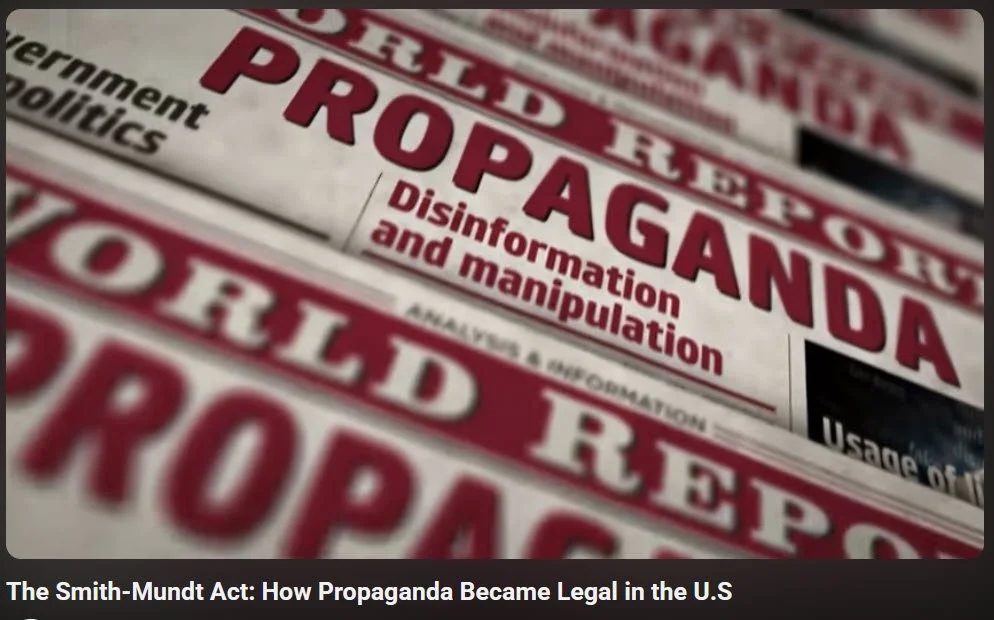
Uncover the truth behind the 1948 Smith-Mundt Act and its significant implications for American citizens. For over 60 years, this legislation prohibited the U.S. government from disseminating propaganda domestically. However, the Obama administration's amendments in 2013 changed the game, allowing the government to influence the U.S. public through media channels. In this eye-opening documentary, we analyze how news agencies have echoed government narratives and the consequences of this shift. Using powerful stock footage, including historical clips and recent events, we reveal the extent of this propaganda machine. It's time to hold our media accountable and call on local politicians to restore the original Smith-Mundt Act. Join us in this critical conversation!
The original Smith-Mundt Act was amended, not repealed or revoked—it remains in effect today.
The change did not authorize the government to create or target propaganda/disinformation specifically at domestic audiences. It still prohibits using those funds to influence U.S. public opinion, and agencies like the U.S. Agency for Global Media (formerly Broadcasting Board of Governors) are not allowed to produce content aimed at Americans.
It had no effect on private media outlets (e.g., CNN, MSNBC, Fox News) or their ability to report news—claims that it legalized "lying" by the media are false.
The amendment was bipartisan: introduced by Rep. Mac Thornberry (R-TX) and co-sponsored by Rep. Adam Smith (D-WA), with more Republicans voting for the overall bill in the House.
Further Analysis
The Smith-Mundt Modernization Act of 2012 (enacted as part of the National Defense Authorization Act for Fiscal Year 2013, signed by President Obama) provides no leeway for the U.S. government to engage in spreading disinformation domestically or to knowingly ignore disinformation. The amendment maintains explicit prohibitions against using funds to influence or propagandize U.S. public opinion.Key Provisions Retained or Added
The modernization primarily lifted a prior blanket ban on making government-funded materials (produced by the Department of State or the U.S. Agency for Global Media, e.g., Voice of America) available domestically upon request. It allowed greater transparency and access for Americans to these foreign-targeted materials.However, it explicitly retains and restates restrictions:
Funds appropriated for these programs cannot be used "to influence public opinion or propagandizing in the United States" (amending the Foreign Relations Authorization Act, Fiscal Years 1986 and 1987).
The agencies remain authorized only to create and disseminate content intended for foreign audiences.
Nothing in the amendment authorizes the Department of State or the Broadcasting Board of Governors (now USAGM) to target or focus broadcasting on U.S. audiences.
The law applies only to the State Department and USAGM—not to other agencies like the Defense Department.
Critics
Criticisms and Indirect Concerns Critics (e.g., in academic analyses like the Northwestern University Law Review article "Apple Pie Propaganda?") argue that once materials are available domestically, they could indirectly circulate and influence U.S. discourse, especially via the internet or third-party amplification. Some view this as creating potential for "covert" government influence on public opinion, even if not intentional targeting.However, this is interpretive concern about practical effects, not evidence of legal leeway. The statute does not authorize creating disinformation (these outlets are mandated to provide accurate, objective reporting), nor does it permit knowingly ignoring disinformation. No provision addresses "ignoring" disinformation at all
There does appear to be “wiggle room” for materials designed for international consumption to influence may or may not be considered disinformation depending on the consumer. In the interest of ‘transparency” this information could be made available under the Obama amended act to a domestic audience. There appears to be no disclaimer or qualification of he information which suggests that it has the potential of being misunderstood by the domestic audience
No, under the Smith-Mundt Modernization Act (effective 2013), there is no required disclaimer warning domestic audiences that the information from U.S. Agency for Global Media (USAGM) outlets (e.g., Voice of America, Radio Free Europe/Radio Liberty) "could be false" or is potentially disinformation/propaganda.Key Reasons and Details
The law (amending 22 U.S.C. § 1461 and § 1461-1a) allows these materials—produced primarily for foreign audiences—to be made available domestically upon request or online for transparency. It does not mandate any disclaimer suggesting the content might be inaccurate or false.
USAGM broadcasters are legally required to adhere to standards of accurate, objective, and comprehensive journalism (per the U.S. International Broadcasting Act of 1994 and VOA Charter). Their mission emphasizes factual reporting, not disinformation.
Voice of America and USAGM websites include statements in their Terms of Use/Privacy notices clarifying: "Our programs are intended for overseas audiences, as is our website" and that domestic broadcasters with similar names are unaffiliated. This discloses the foreign focus but does not imply the content could be false.
No provision in the statute, USAGM policies, or implementation requires a warning about potential falsity. Critics and academic analyses (e.g., Northwestern Law Review) have suggested adding attribution or disclaimers to highlight government sourcing and prevent indirect influence, but this was not adopted in the 2013 modernization.
Recent bills (e.g., proposals to repeal the modernization in 2025) have floated ideas like watermarks or identifiers for older archived materials, but these are not current law and do not claim content is false.