Cuba and Its Impact - Past, present, and Future
Segment #1002
The U.S. Department of State released the 100-page report, titled "Cuba: The Capital of 21st Century Communism," on July 20, 2026. The document presents an extensive assessment detailing alleged decades of espionage, subversion, and ideologically driven influence operations conducted by the Cuban government against the United States and across the Western Hemisphere.
Key Claims & Findings
Allegations of Infiltration & Espionage: The report asserts that Cuban intelligence services have systematically targeted U.S. institutions for nearly seven decades, placing agents inside key federal bodies including the State Department, the National Security Council, and the Department of Defense. It highlights high-profile intelligence cases—such as former U.S. Ambassador Manuel Rocha and former Defense Intelligence Agency analyst Ana Belén Montes—as evidence of deep, long-term covert penetration.
Influence on Domestic Political Movements: The document alleges that Havana constructed a "revolutionary infrastructure" within the U.S. by cultivating relations with progressive activists, campus organizations, and left-wing political groups. It links Cuban ideological influence to domestic events, ranging from racial justice demonstrations to anti-war and pro-Palestinian university protests.
"Exporting Revolution" as Core Strategy: The report frames Cuba not merely as a former Cold War Soviet satellite, but as an independent, persistent center for 21st-century Marxist-Leninist subversion, alleging that Havana has provided safe harbor to political fugitives, supported regional insurgencies, and aligned with anti-Western actors globally.
Reactions & Controversy
Cuban Government Response: Foreign Minister Bruno Rodríguez Parrilla rejected the report, labeling it a false pretext designed to justify Washington's "cruel and criminal economic war" against the island nation amid severe energy shortages and economic sanctions.
Domestic Criticism & Legal Activists: Civil liberties organizations, such as Defending Rights & Dissent, and groups named in the document (including the Democratic Socialists of America) criticized the report as a modern revival of McCarthyism. Critics argued that the State Department relied on guilt-by-association techniques and historical House Un-American Activities Committee (HUAC) framing to discredit domestic political opposition and justify foreign intervention.
Academic & Analytical Assessment: Latin America scholars and intelligence experts noted that while Cuban espionage capabilities have historically been effective, claims that Havana coordinates or directs broad American social movements lack concrete evidence and serve primarily domestic political narratives.
To evaluate Cuba’s role today and in the coming years, analysts look beyond Cold War ideological frameworks to examine its immediate geopolitical, economic, and security impact, as well as its long-term trajectories.
Present Impact
Severe Domestic Crisis & Regional Migration
Humanitarian & Energy Collapse: Following the loss of Venezuelan subsidized oil exports and tightened U.S. sanctions and energy blockades, Cuba is enduring an acute economic and energy crisis marked by prolonged daily blackouts, acute food and medicine shortages, and rising infant mortality rates.
Mass Exodus: Deprived of reliable basic utilities and public services, hundreds of thousands of Cubans have left the island in recent years. This ongoing historic brain drain and demographic loss directly impacts border management, immigration policies, and social services in the United States, Mexico, and across Latin America.
Strategic Hub for External Great Powers
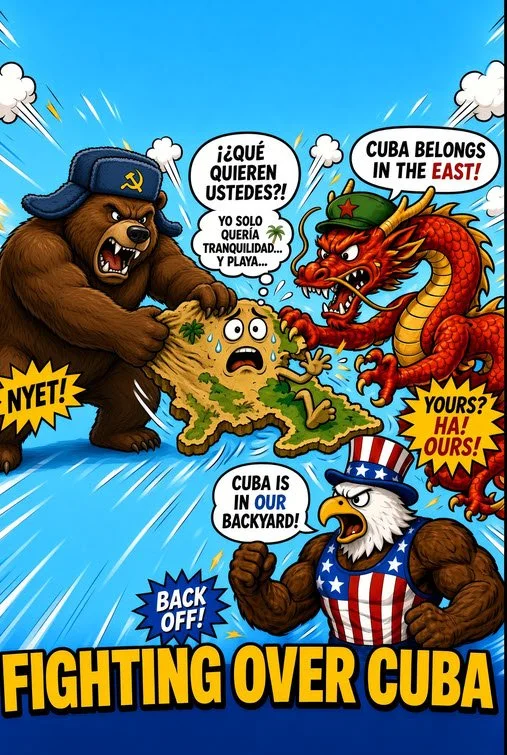
Geopolitical Counterweight: Despite its internal economic weakness, Cuba remains a key geographical and diplomatic foothold in the Western Hemisphere for non-Western powers, including Russia, China, and Iran.
Intelligence & Military Capabilities: U.S. national security analysts and official reports highlight Cuba’s continued hosting of signal intelligence gathering stations, naval port calls, and security cooperation agreements. For Moscow and Beijing, Havana provides low-cost geopolitical leverage near the U.S. mainland.
Diplomatic Friction & Foreign Policy Divergence
U.S. Policy Anchor: Cuba remains a central flashpoint in American domestic and foreign policy debates. While Washington maintains an aggressive containment policy—squeezing energy supplies and state-owned military enterprises (GAESA)—several UN member states and Latin American governments routinely criticize sanctions on humanitarian grounds.
Medical Diplomacy & Soft Power: Though weakened by economic strain and foreign sanctions, Cuba continues to deploy medical missions and technical advisors across the Global South. These programs serve as both a crucial source of foreign currency and a key diplomatic tool for maintaining influence within international bodies like the United Nations.
Future Outlook & Potential Trajectories
Scenario 1: Managed Economic Liberalization (The "Vietnam/Chinese" Model)
Mechanism: Facing systemic economic insolvency and dwindling external lifelines, the ruling Communist Party of Cuba (PCC) could accelerate partial market reforms, expanding the non-state private sector (mipymes) and attracting targeted foreign investment in tourism and renewable energy while attempting to retain strict political control.
Impact: Could gradually stabilize domestic supply chains, reduce humanitarian flight, and provide a path toward pragmatic, limited normalization with regional neighbors and Western trade partners.
Scenario 2: Regime Fragility & Uncontrolled Humanitarian Collapse
Mechanism: If the energy starve-out, infrastructure failure, and sanctions continue without structural relief or substantial external subsidies, the state apparatus risks functional paralysis.
Impact: An uncontrolled breakdown would trigger an unprecedented humanitarian disaster and refugee emergency across the Caribbean basin. The resulting power vacuum could create regional security instability, organized crime escalation, and maritime security risks for nearby nations.
Scenario 3: Realignment & Strategic Compromise
Mechanism: Pragmatic elements within Havana and Washington could engage in quiet transactional diplomacy—trading domestic political/economic adjustments and security guarantees (e.g., limiting foreign intelligence facilities) for sanctions relief and energy stabilization.
Impact: Would fundamentally alter the Latin American geopolitical landscape, removing a decades-old friction point and realigning Caribbean trade, security, and diplomatic networks.
Strategic Value Common to Russia and China
Signals Intelligence (SIGINT) & Eavesdropping: Cuba provides an unparalleled physical location to monitor sensitive U.S. military, commercial, and government communications across the Gulf of Mexico, Atlantic seaboard, and Southeastern U.S. Intelligence reports highlight that Beijing and Moscow have upgraded electronic surveillance facilities across the island (including major SIGINT installations such as Bejucal). These operations track U.S. military activity at key hubs like U.S. Southern Command (Miami), U.S. Central Command (Tampa), and launch facilities at Cape Canaveral.
Western Hemisphere Geopolitical Leverage: Operating in America’s immediate neighborhood allows Russia and China to establish a tit-for-tat counterweight to U.S. power projection near their own borders (e.g., NATO’s presence in Eastern Europe or U.S. alliances across the Indo-Pacific).
Diplomatic & Institutional Voting Block: Cuba acts as a key ideological anchor and diplomatic vocal force within international bodies (such as the UN General Assembly and the Non-Aligned Movement), consistently supporting Russian and Chinese positions while countering U.S.-led sanctions regimes and regional initiatives.